全球储能:中国宣布对电池征收消费税-影响
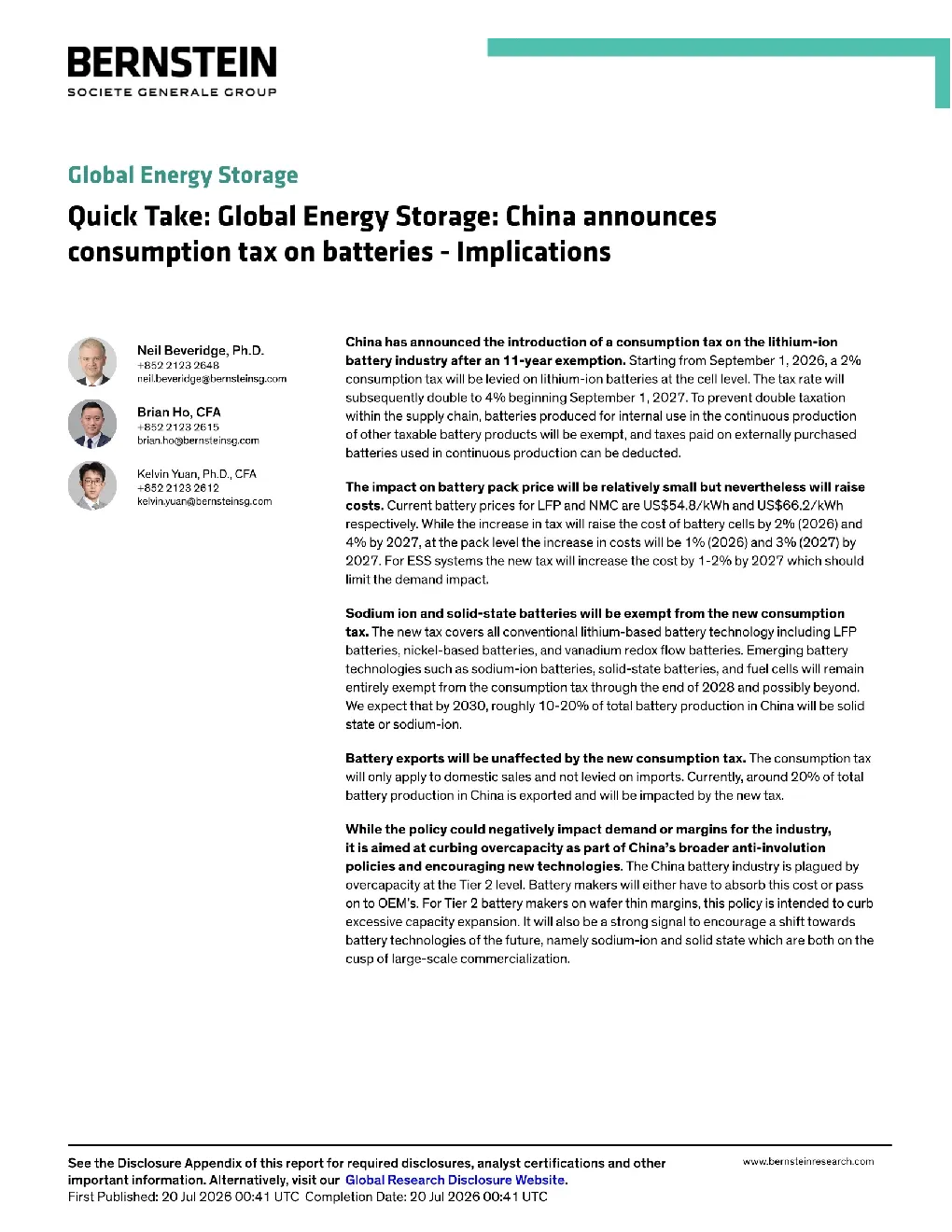
consumption tax on batteries - Implications battery industryafteran11-yearexemption.Startingfrom September1,2026,a2%consumption tax willbe levied on lithium-ion batteries at the cell level.The tax rate willwithin the supply chain, batteries produced for internal use in the continuous productionof othertaxablebattery products will be exempt,and taxes paid on externallypurchasedbatteries used in continuousproductioncan bededucted.Theimpactonbatterypackpricewill berelatively smallbut neverthelesswillraise +8522123 2648neil.beveridge@bernsteinsg.comBrian Ho, CFA +85221232615brian.ho@bernsteinsg.comKelvin Yuan, Ph.D., CFA +85221232612kelvin.yuan@bernsteinsg.com costs.CurrentbatterypricesforLFPandNMCareUS$54.8/kWhandUS$66.2/kWhrespectively.While the increase in tax will raisethe cost of battery cells by 2% (2026)and4%by 2027,atthepacklevel the increase incosts will be1%(2026)and3%(2027)by2027.For ESS systems the newtax will increase thecost by 1-2%by 2027which shouldlimit the demand impact. tax.The new tax covers all conventional lithium-based battery technology including LFPbatteries,nickel-based batteries,and vanadiumredoxflowbatteries.Emerging batterytechnologies such as sodium-ion batteries, solid-state batteries,and fuel cells will remainentirely exemptfrom the consumption taxthrough the end of 2028 and possiblybeyond.We expect that by 2030, roughly 10-20% of total battery production in China will be solidstate or sodium-ion. Batteryexportswillbeunaffected bythe new consumption tax.Theconsumption taxwill only apply to domestic sales and not levied on imports. Currently,around 2o% of totalbatteryproductioninChinaisexportedandwill beimpactedbythenewtax. While the policy could negatively impact demand or margins for the industry,itis aimed at curbing overcapacity as partof China's broader anti-involutionpolicies and encouraging new technologies. The China battery industry is plagued byovercapacity at the Tier 2level. Batterymakers will eitherhaveto absorb this cost or passon to OEM's. For Tier 2 battery makers on wafer thin margins, this policy is intended to curbbattery technologies of the future, namely sodium-ion and solid state which are both on thecusp of large-scalecommercialization. affects batteries produced,processed,sold, imported, orused domestically in China.Details otheimpacton batterypricing isshownbelow.EXHIBIT1: Price &changefor LFP and NMC under different tax rate Cell level (USD/kWh) From1September2026,thefollowingbatteryproducts will besubjectto a 2% consumptiontax: . Primary lithium batteries;Mercury-free primary batteries;: Nickel-metal hydride batteries;.Vanadiumredox-flowbatteries. TEMPORARYEXEMPTIONSFOREMERGINGTECHNOLOGIESChinawillcontinuetoexemptthefollowingproductsfromconsumptiontaxfrom1September2026through31December 2028: . Sodium-ionbatteries;: Solid-state batteries;.Fuel cells;:Perovskitephotovoltaic cells;:Tandemphotovoltaic cells;Gallium-arsenidephotovoltaic cells. Theannouncementdoesnotspecifythetaxtreatmentofthese emergingtechnologiesafter31December2028. CONDITIONSFORCLAIMINGANEXEMPTION Theexemptions are not automatic.Batteryproducts manufactured orprocessed under commissionmustcomply withtheapplicable Chinese national standards.Products that do not meet the relevant national standard-or for which no nationalstandardexists-cannotqualifyforthepreferentialtreatment. approvedtestingscopemust includetherelevant battery-testing items.DEDUCTIONFORTAXALREADYPAIDONBATTERYINPUTS Whereacompanypurchases,imports,orreceivesfromcommissionedprocessingbatteryproductsonwhichconsumptiontax may deduct the consumption tax already paid on the inputs. The deductible amount is determined based on the quantity actuallyused inproduction duringthe relevantperiod.Similarly,taxablebatteries produced and used internallyforthecontinuous production of othertaxable batteries are notsubject to consumption tax atthepoint of internaltransfer.However, if the batteries are used tomanufacturenon-taxable products orforotherpurposes,consumptiontaxbecomespayablewhentheyaretransferredforsuchuseEXPORTTREATMENT:NOCHANGETOCONSUMPTION-TAXEXPORTRELIEF stages:.Domestic production and sale; .Internal useoutsidethecontinuousproductionoftaxablebatteries. otherwords,the announcementdoes notimposeanadditionalconsumption-taxburden onqualifyingbattery exports. VAT export rebates, which are governed bya separate policy. BUSINESSIMPLICATIONSThe policy represents a shift from broad tax exemptions toward differentiated treatment based on technological maturity: .Establishedtechnologies,particularly conventional lithium-ion batteries, will gradually move to the standard 4%consumption-tax rate;:Emerging technologies, such as solid-state and sodium-ion batteries, will continue to receive tax support:Domesticmanufacturers andimporterswill needto reviewpricing,productclassifications,contracts,andtax-accountingsystems.Export-oriented companies should separate the consumption-tax impactfrom the separate VAT export-r