您的浏览器禁用了JavaScript(一种计算机语言,用以实现您与网页的交互),请解除该禁用,或者联系我们。 [花旗]:台湾印制电路板及层压板:ABF/BT板块 产能利用率与定价上行周期开启;买入,目标价上调 - 发现报告

台湾印制电路板及层压板:ABF/BT板块 产能利用率与定价上行周期开启;买入,目标价上调

电子设备 2026-06-30 - 花旗 高杨
报告封面

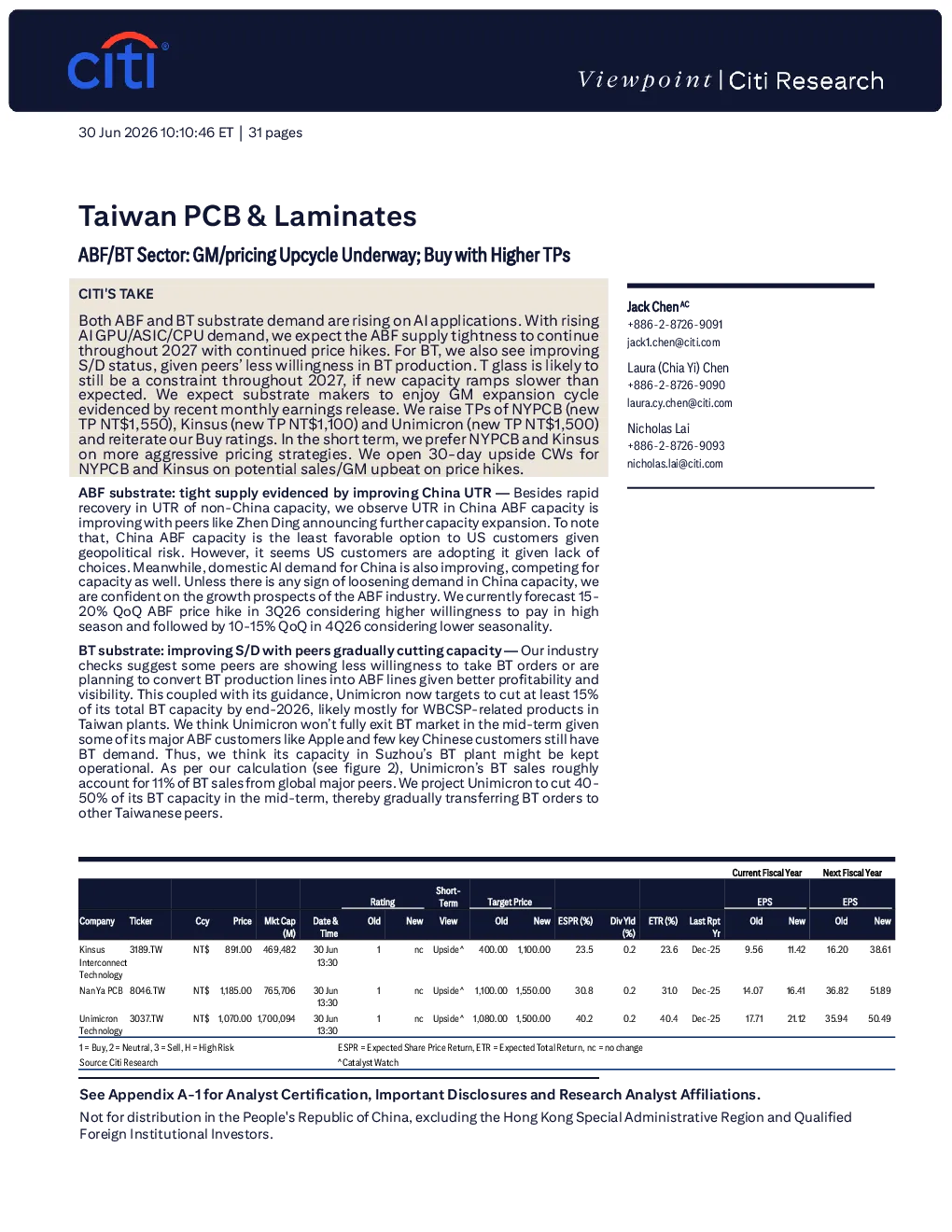
ABF/BT Sector: GM/pricing Upcycle Underway; Buy with Higher TPs CITI'S TAKE Jack ChenAC Both ABF and BT substrate demand are rising on AI applications. With risingAI GPU/ASIC/CPU demand, we expect the ABF supply tightness to continuethroughout 2027 with continued price hikes. For BT, we also see improvingS/D status, given peers’ less willingness in BT production. T glass is likely tostill be a constraint throughout 2027, if new capacity ramps slower thanexpected. We expect substrate makers to enjoy GM expansion cycleevidenced by recent monthly earnings release. We raise TPs of NYPCB (newTP NT$1,550), Kinsus (new TP NT$1,100) and Unimicron (new TP NT$1,500)and reiterate our Buy ratings. In the short term, we prefer NYPCB and Kinsuson more aggressive pricing strategies. We open 30-day upside CWs forNYPCB and Kinsus on potential sales/GM upbeat on price hikes. +886-2-8726-9091jack1.chen@citi.com Laura (Chia Yi) Chen+886-2-8726-9090laura.cy.chen@citi.com Nicholas Lai+886-2-8726-9093nicholas.lai@citi.com ABF substrate: tight supply evidenced by improving China UTR —Besides rapidrecovery in UTR of non-China capacity, we observe UTR in China ABF capacity isimproving with peers like Zhen Ding announcing further capacity expansion. To notethat, China ABF capacity is the least favorable option to US customers givengeopolitical risk. However, it seems US customers are adopting it given lack ofchoices. Meanwhile, domestic AI demand for China is also improving, competing forcapacity as well. Unless there is any sign of loosening demand in China capacity, weare confident on the growth prospects of the ABF industry. We currently forecast 15-20% QoQ ABF price hike in 3Q26 considering higher willingness to pay in highseason and followed by 10-15% QoQ in 4Q26 considering lower seasonality. BT substrate: improving S/D with peers gradually cutting capacity —Our industrychecks suggest some peers are showing less willingness to take BT orders or areplanning to convert BT production lines into ABF lines given better profitability andvisibility. This coupled with its guidance, Unimicron now targets to cut at least 15%of its total BT capacity by end-2026, likely mostly for WBCSP-related products inTaiwan plants. We think Unimicron won’t fully exit BT market in the mid-term givensome of its major ABF customers like Apple and few key Chinese customers still haveBT demand. Thus, we think its capacity in Suzhou’s BT plant might be keptoperational. As per our calculation (see figure 2), Unimicron’s BT sales roughlyaccount for 11% of BT sales from global major peers. We project Unimicron to cut 40-50% of its BT capacity in the mid-term, thereby gradually transferring BT orders toother Taiwanese peers. Not for distribution in the People's Republic of China, excluding the Hong Kong Special Administrative Region and QualifiedForeign Institutional Investors. T glass: likely continued constraint throughout 2027 —With rising AIGPU/ASIC/CPU demand, we think T glass constraint will likely continue into 2027, given the qualification progress for new vendors seems to be slower than expected.Among all the new vendors, Taiwan Glass Industry takes the lead in thick glass, butits product quality still falls short of Nittobo’s. End-customers/fabless currently arestill trying to find new vendors or other kinds of new solutions, which is why EMC’sABF CCL, MGC’s RS Resin solution, Nanya Plastics’ T glass or other new unlistedvendors’ T glass are considered yet without proven. In our view, Nittobo’s capacityexpansion plan remains the key to the supply, yet whether to initiate another pricehike is up to Nittobo’s willingness, which is addressed in our JP analyst YutaNishiyama’s report. In our view, whether industrywide T glass supply is able tofulfill all the AI chips demand is less concerning as we think substrate makerswould just hike the prices to achieve growth despite the unit shipments beingconstrained. We expect fabless in the queue eventually needs to pay premium forthe shortage, unless there is any delay in their AI chip development. NYPCB: aggressive ABF/BT pricing strategies —NYPCB is the key beneficiary toBroadcom’s Tomahawk products for ABF. Besides switch ICs, the company wouldalso supply some ASIC projects with minority share. For BT, the company seesstrong demand from memory. NYPCB is reluctant to enter into long-termagreements with customers with high exposure to spot market. Based on the lastcycle experience, we expect the company to be aggressive in both ABF and BTpricing strategies in the coming quarters. We expect price hikes and improving UTRto drive its GM profile in the coming quarters. Our 2027E profit forecast increasesby ~40% to NT$33.5bn given more aggressive pricing strategies. Kinsus: Vera CPU key suppliers + improving BT S/D —The company is bullish onits market share in Vera CPU, which echoes our view of market share >50%. Theupside to its market share in Vera CPU would hinge on its capacity expansion pace.For its