2027AI全球酒店与旅游业发展方向白皮书
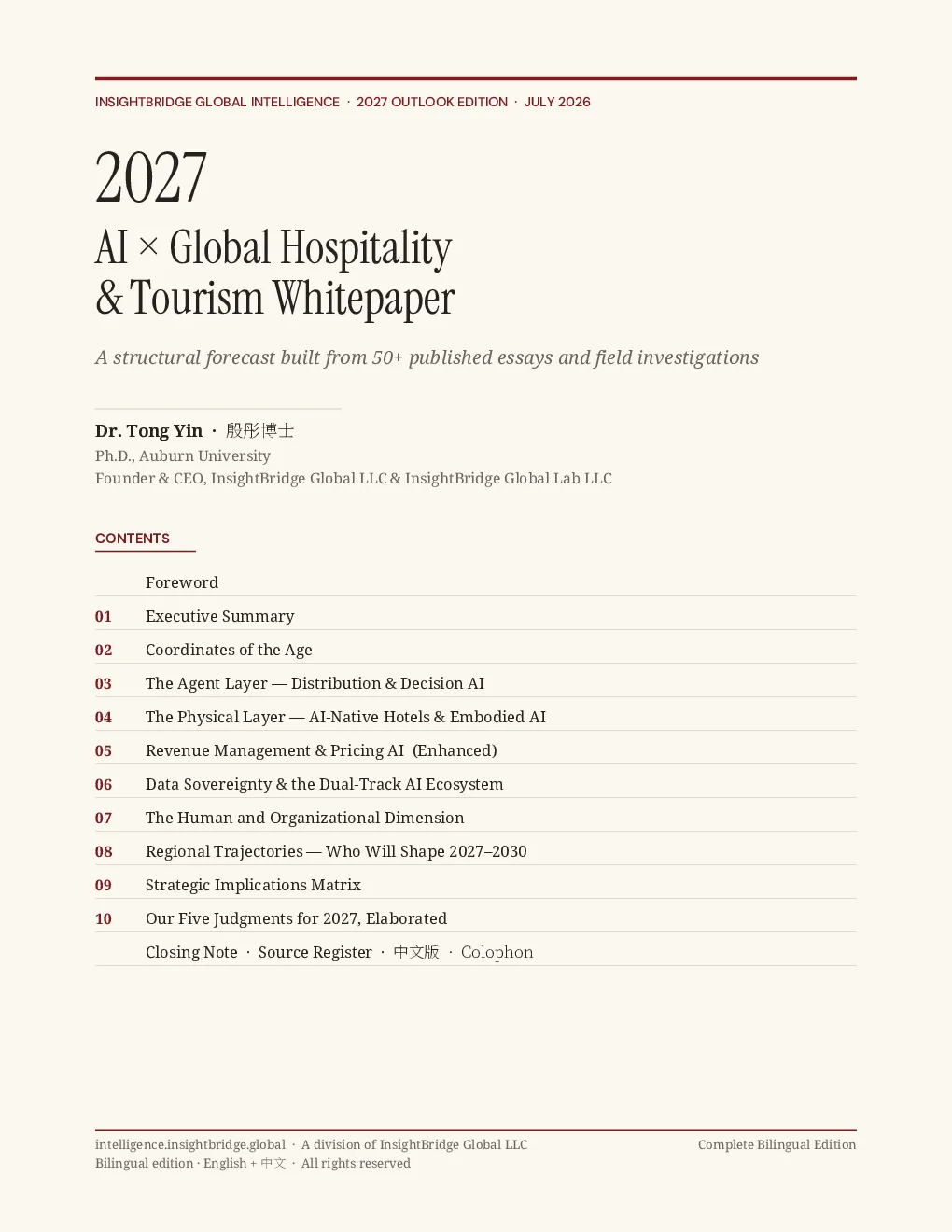
A structural forecast built from 50+ published essays and field investigations Dr. Tong Yin ·殷彤博士Ph.D., Auburn UniversityFounder & CEO, InsightBridge Global LLC & InsightBridge Global Lab LLC CONTENTS FOREWORD Why this whitepaper exists Every industry transition has a defining question. In hospitality's cloud-and-mobile transition of2010–2018, the question waschannel. In the OTA-consolidation transition of 2018–2023, the questionwasmargin. In the AI transition reaching its structural inflection in 2027, the question islayer—because three value layers are re-forming simultaneously, and this simultaneity is what makes thecurrent moment distinct. This whitepaper is deliberately non-prescriptive. Our analytical stance is that industry structure iscurrently in a live re-formation phase, and any operator, investor, or sovereign entity claimingcertainty is over-fitting a snapshot. What we offer instead is a framework — six strategic axes, fourregional trajectories, and a matrix of eight operating archetypes across three time horizons. It also serves as a synthesis. Fifty-plus original research pieces we published onInsightBridge GlobalIntelligence, onHospitality Net, onHotel News Resource, and onPhocuswireduring 2025–2026 are thesource material. Every claim in this document is traceable to one or more of those pieces; thewhitepaper's job is to assemble them into a single coherent picture. If you are reading this at asovereign-fund desk, at a hotel-group C-suite table, at a graduate seminar on hospitality strategy, oracross a Zoom from a research partner — this is exactly what the document is for. — Dr. Tong YinAuburn, Alabama · July 2026 01 Executive Summary 2027 will not be remembered as the year AI "arrived" in hospitality — arrival happened years earlier. Itwill be remembered as the year the industry stopped debating whether AI matters and started fightingoverhow value is captured across three simultaneously reorganizing layers: the Agent Layer(demand capture), thePhysical Layer(embodied AI and robotics), and theSovereignty Layer(datalocalization and regulatory posture). This whitepaper synthesizes fifty-plus original InsightBridge Global research pieces published over2025–2026 into a single, integrated 2027 outlook. It is deliberately non-prescriptive: our analyticalstance is that industry structure is currently in a live re-formation phase, and any operator, investor, orsovereign entity claiming certainty is over-fitting a snapshot. What we offer instead is a framework —six strategic axes, four regional trajectories, and a matrix of eight operating archetypes. Our five headline judgments for 2027: 1.The distribution layer of hospitality is being re-priced, not disrupted.OTAs are neitherdying nor untouched; they are being restructured into service and data-capability providers,sitting alongside — not replaced by — AI travel agents. 2.AI-native hotel infrastructure will bifurcate assets into two economic classes.By end of2027, we expect a clear cost-per-key gap between operators who deployed embodied AI during the2026–2027 CapEx window and those who did not — likely 15–25% at the operating margin line. 3.Data sovereignty will be the single most consequential regulatory frameshaping travel-AIvendor selection. The industry is heading toward a two-track ecosystem — cross-border-flow AIand locally-integrated AI — and global hotel groups will need to serve both simultaneously. 4.AI pricing will remain a solved-in-theory, unsolved-in-practice problem.The bottleneck isno longer model quality; it is the quality of management decisions surrounding the model. 5.The human dimension of hospitality is becoming a scarcer strategic asset, not a cheaperone.AI absorbs the routine,elevates the exceptional,and creates a new premium fororganizations able to retain trained service teams through downturns. PART 1 Coordinates of the Age Every industry transition has a defining question. In hospitality's cloud-and-mobile transition of2010–2018,the question was channel("Where does the guest book?").In the OTA-consolidationtransition of 2018–2023, the question was margin ("How much do we surrender to intermediaries?"). Inthe AI transition beginning in earnest around 2024 and reaching its structural inflection in 2027, thequestion is neither channel nor margin — it islayer. Three layers are re-forming simultaneously, and this simultaneity is what makes the current momentdistinct from any prior technological wave in hospitality: •Layer 1 · Agent Layer— The demand-capture surface. Autonomous travel agents (OpenAIOperator-class systems, Perplexity Comet, Anthropic-driven agents, and localized equivalents inChina and the Gulf) are moving user attention off search engines and off OTA apps, into a singleconversational surface where the choice architecture is set by the agent, not by the platform. •Layer 2 · Physical Layer— The service-execution surface. Embodied AI (Pudu-class servicerobots, ABB-class kitchen automation