您的浏览器禁用了JavaScript(一种计算机语言,用以实现您与网页的交互),请解除该禁用,或者联系我们。 [亚开行]:简化合规:使用训练有素的人工智能工具清理政策污泥(英) - 发现报告

简化合规:使用训练有素的人工智能工具清理政策污泥(英)

信息技术 2026-06-01 亚开行 💤 👏
报告封面

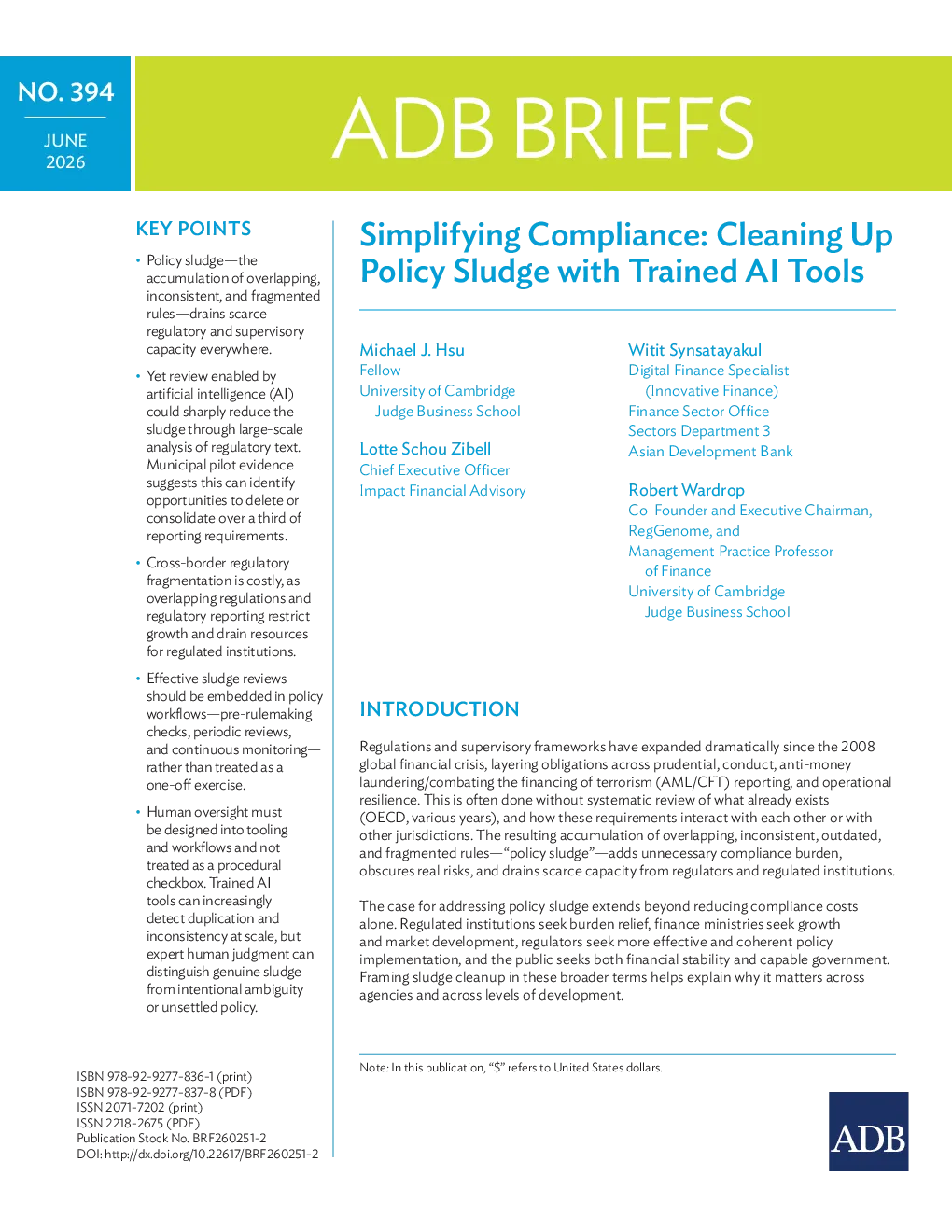
Simplifying Compliance: Cleaning UpPolicy Sludge with Trained AI Tools KEY POINTS •Policy sludge—theaccumulation of overlapping,inconsistent, and fragmentedrules—drains scarce Witit SynsatayakulDigital Finance Specialist(Innovative Finance)Finance Sector Office Michael J. HsuFellow •Yet review enabled byartificial intelligence (AI)could sharply reduce thesludge through large-scaleanalysis of regulatory text.Municipal pilot evidencesuggests this can identify Lotte Schou ZibellChief Executive OfficerImpact Financial Advisory Robert WardropCo-Founder and Executive Chairman,RegGenome, andManagement Practice Professor •Cross-border regulatoryfragmentation is costly, asoverlapping regulations andregulatory reporting restrict •Effective sludge reviewsshould be embedded in policyworkflows—pre-rulemakingchecks, periodic reviews,and continuous monitoring— INTRODUCTION Regulations and supervisory frameworks have expanded dramatically since the 2008global financial crisis, layering obligations across prudential, conduct, anti-moneylaundering/combating the financing of terrorism (AML/CFT) reporting, and operationalresilience. This is often done without systematic review of what already exists(OECD, various years), and how these requirements interact with each other or withother jurisdictions. The resulting accumulation of overlapping, inconsistent, outdated, •Human oversight mustbe designed into toolingand workflows and nottreated as a proceduralcheckbox. Trained AItools can increasinglydetect duplication andinconsistency at scale, but The case for addressing policy sludge extends beyond reducing compliance costsalone. Regulated institutions seek burden relief, finance ministries seek growthand market development, regulators seek more effective and coherent policyimplementation, and the public seeks both financial stability and capable government. ISBN 978-92-9277-836-1 (print)ISBN 978-92-9277-837-8 (PDF)ISSN 2071-7202 (print)ISSN 2218-2675 (PDF)Publication Stock No. BRF260251-2DOI: http://dx.doi.org/10.22617/BRF260251-2 ADB BRIEFS NO. 394 Policy sludge can accumulate vertically,horizontally, and over time. The term policy sludge originated in behavioral economics todescribe process friction with outsized effects on access toimportant programs and benefits (Sunstein, 2020).In financialregulation, sludge refers to the complexity of compliance arisingfrom overlapping, fragmented, inconsistent, or stale requirements. Finally, sludge can accumulate over time, as statutes, regulations,risks, and practices change. Typically, new rules and expectationsare simply layered on, rather than reset. Rapid changes in technology and finance, meanwhile, increasepressure on regulatory authorities to keep up with flat or evenshrinking resources. In addition, agencies grapple with the tensionbetween deglobalization and demanding global standards.These include those issued by the Financial Action Task Force, These three vectors of policy sludge accumulation can reinforceone another, as changes over time—for instance, in cybersecurity—contribute to the buildup of overlapping jurisdictional requirements(horizontal sludge), which leads to a buildup of overlapping A central challenge in addressing policy sludge is bringing it into thelight. A good place to start is identifying similar obligations acrossrules, handbooks, and guidance that use slightly different wordingor thresholds. Supervisors and institutions spend significant timecross-referencing, reconciling, and interpreting these layered Artificial intelligence (AI) may be able to help, particularlywhen effectively overseen by humans. It now makes large-scaleregulatory text analysis feasible, allowing systematic identificationand addressing of policy sludge within and across regulatory This policy brief examines how AI-enabled policy analysisand structured regulatory data can support more consistent,transparent, and evidence-based review of legal and regulatoryframeworks—and recommends practical steps to embed sludgereview into routine supervisory workflows. In doing so, it draws oninsights from financial regulators, financial institutions, regulatorytechnology service providers, and international agencies, reflecting In many developing countries, regulatory materials are dispersedacross multiple authorities and often maintained in formats thathinder systematic comparison. At the same time, the processesused to identify, reconcile, and manage policy sludge remain largelymanual, problems compounded when authorities need to operateacross myriad laws, regulations, guidance, supervisory expectations,and enforcement actions. Developing country authorities lacking The references to AI tooling and structured regulatory data in thebrief are technology neutral and constitute no endorsement ofany provider. “Baselining” the burden requires a shift from anecdote to evidence.Practical metrics may include the percentage of pages with highsemantic similarity to another page; th