您的浏览器禁用了JavaScript(一种计算机语言,用以实现您与网页的交互),请解除该禁用,或者联系我们。 [全球碳捕集与封存研究院]:水泥与CCS问答 - 发现报告

水泥与CCS问答

建筑建材 2026-06-23 全球碳捕集与封存研究院 付瑶瑶瑶瑶瑶瑶瑶瑶瑶瑶瑶瑶瑶
报告封面

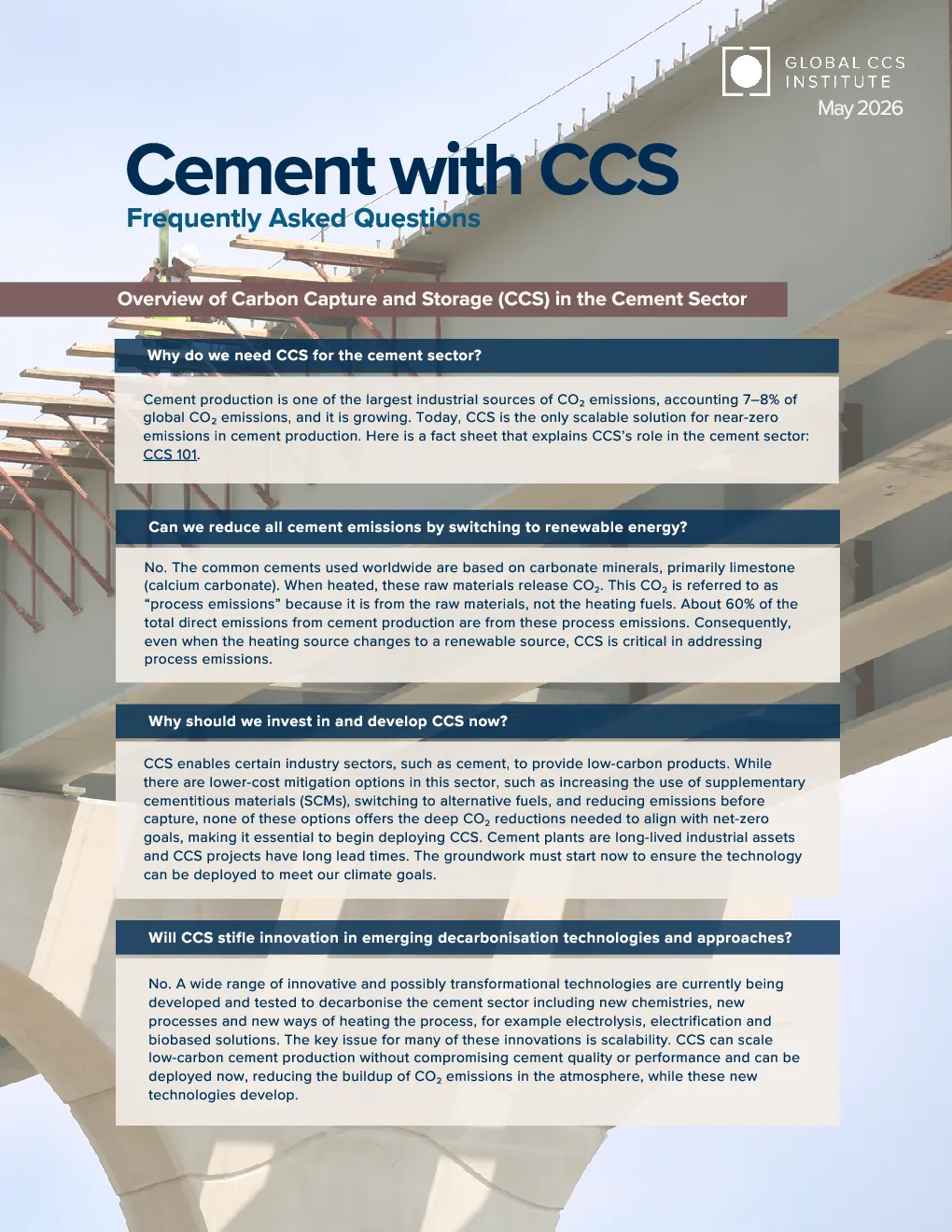
Why do we need CCS for the cement sector? Cement production is one of the largest industrial sources of CO₂emissions,accounting 7–8%ofglobal CO₂emissions,and it is growing.Today,CCS is the only scalable solution for near-zeroemissions in cement production.Here is a fact sheet that explains CCS’s role in the cement sector: Can we reduce all cement emissions by switching to renewable energy? No.The common cements used worldwide are based on carbonate minerals,primarily limestone(calcium carbonate).When heated,these raw materials release CO.This CO is referred to as“process emissions”because it is from the raw materials,not the heating fuels.About 60%of thetotal direct emissions from cement production are from these process emissions.Consequently,even when the heating source changes to a renewable source,CCS is critical in addressing22 Why should we invest in and develop CCS now? CCSenables certain industrysectors,such as cement,to provide low-carbon products.While there are lower-cost mitigation options in this sector,such as increasing the use of supplementarycementitious materials(SCMs),switching to alternative fuels,and reducing emissions before capture,none of these options offers the deep CO reductions needed to align with net-zerogoals,making it essential to begin deploying CCS.Cement plants are long-lived industrial assets2 Will CCS stifle innovation in emerging decarbonisation technologies and approaches? No.A wide range of innovative and possibly transformational technologies are currently beingdeveloped and tested to decarbonise the cement sector including new chemistries,newprocesses and new ways of heating the process,for example electrolysis,electrification andbiobased solutions.The key issue for many of these innovations is scalability.CCS can scalelow-carbon cement production without compromising cement quality or performance and can be Is CCS only an option for new cement plants? No.CCS can be integrated into new plants and added to existing plants as a retrofit,which iswhere most near-term deployment is expected.Cement plants have long lifetimes,and manythat are operating today will still be operating in 2050. Integrating CCS Into Cement Production How is COcaptured at a cement plant?2 In a cement plant,most CO₂is generated when limestone is heated in a large kiln to makeclinker,the main ingredient in cement.CO₂generated during clinker production can be capturedusing chemical solvents,solid materials,membranes,cryogenic systems,or hybrid combinationsto separate it,enabling transport,storage,or reuse rather than release into the atmosphere.This Can CCS capture all of the emissions from cement plants? CCS can capture 90–95%of CO₂emissions from cement plants,including both process-andcombustion-related emissions,depending on the technology and integration approach.Common integration approaches include: Post-combustion capture using solvents,membranes,or cryogenic capture.Oxy-fuel combustion,which burns fuel in pure oxygen to produce a CO₂-rich flue gas.Calcium looping,leveraging the cement process chemistry for CO₂capture.Other approaches,such as indirect calcination. How does CCS integration affect cement plant operations? Cement kiln flue gas has 18–25%CO₂concentration,significantly higher than coal-fired power plants(~12–15%).This higher concentration makes CCS more energy-efficient for cement comparedto some other sectors.However,adding capture units can increase cement plant size by 100%andmore than double cement production energy demand.Operating capture units can also require When designing plants,important considerations include optimising plant efficiency andmaximising the use of low or zero-carbon energy.For example,renewable energy can be used for Will CCS impact cement quality or performance? No.CCSintegration will not compromise the safety or performance of cement.Regardless of whether a cement plant uses CCS technology,cement products must comply with rigorous qualityand performance standards,established by national regulatory bodies and independentcertification bodies,such as ASTM International,the European Committee for Standardization, Where can captured CO₂from cement plants be stored? COcan be permanently stored in deep saline formations or depleted oil and gas reservoirs.Between 1996 and 2024,nearly 400 million tonnes of captured CO have been storedunderground in geologic formations.For more information,go to:The London Register ofSubsurface COStorage.At a smaller scale,CO can also be used in the chemical and syntheticfuels industries and permanently stored through mineralisation as COreacts with alkalinematerials(e.g.recycled aggregates or mineral carbonation).22222 Is COstorage safe?2 Yes.CO₂storage is widely considered safe when it is done in properly selected,well- characterised,and carefully regulated geological formations.As of early 2026,there were 27commercial dedicated COstorage projects.There were also 36 enhanced oil recovery or EORproj