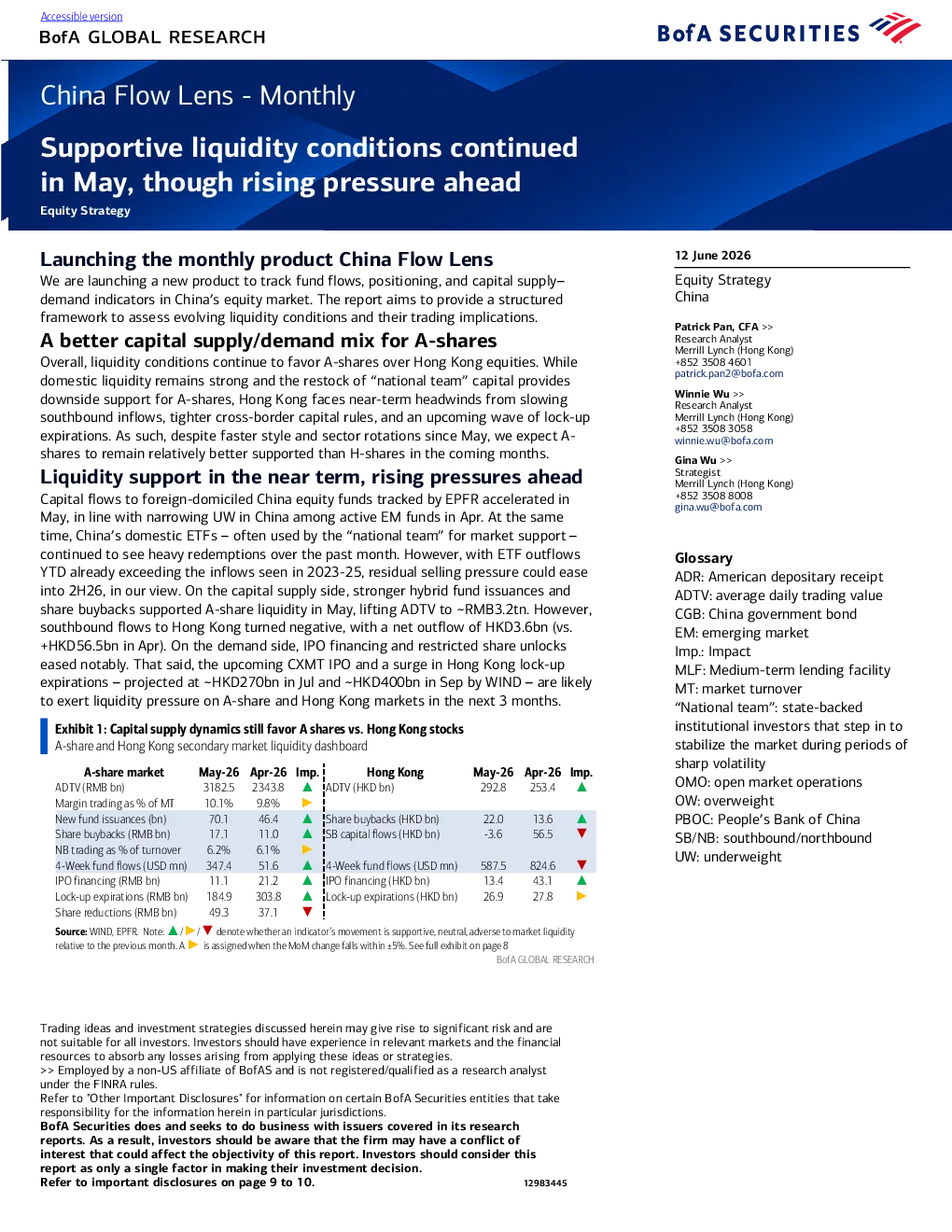
Supportiveliquidity conditions continuedin May, though rising pressure ahead Equity Strategy 12 June 2026 Launching the monthly product China Flow LensWeare launching a new product to track fund flows, positioning, and capital supply– Equity StrategyChina demand indicatorsin China’s equity market. The report aims to provide a structuredframework to assess evolving liquidity conditions and their trading implications.A better capital supply/demand mix for A-shares Patrick Pan, CFA>>Research AnalystMerrill Lynch (Hong Kong)+852 3508 4601patrick.pan2@bofa.com Overall, liquidity conditions continue to favor A-shares over Hong Kong equities. While domestic liquidity remains strong and the restock of“national team”capital providesdownside support for A-shares, Hong Kong faces near-term headwinds from slowingsouthbound inflows, tighter cross-border capital rules, and an upcoming wave of lock-upexpirations. As such, despite faster style and sector rotations since May, we expect A-shares to remain relatively better supported than H-shares in the coming months. Winnie Wu>>Research AnalystMerrill Lynch (Hong Kong)+852 3508 3058winnie.wu@bofa.com Gina Wu>>StrategistMerrill Lynch (Hong Kong)+852 3508 8008gina.wu@bofa.com Liquidity support in the near term, rising pressures aheadCapital flows to foreign-domiciled China equity funds tracked by EPFR accelerated inMay, in line with narrowing UW in China among active EM funds in Apr. At the sametime, China’s domestic ETFs–often used by the“national team”for market support–continued to see heavy redemptions over the past month. However, with ETF outflowsYTD already exceeding the inflows seen in 2023-25, residual selling pressure could easeinto 2H26, in our view. On the capital supply side, stronger hybrid fund issuances andshare buybacks supported A-share liquidity in May, lifting ADTV to ~RMB3.2tn. However,southbound flows to Hong Kong turned negative, with a net outflow of HKD3.6bn (vs.+HKD56.5bn in Apr). On the demand side, IPO financing and restricted share unlockseased notably. That said, the upcoming CXMT IPO and a surge in Hong Kong lock-upexpirations–projected at ~HKD270bn in Jul and ~HKD400bn in Sep by WIND–are likelyto exert liquidity pressure on A-share and Hong Kong markets in the next 3 months. Glossary ADR: American depositary receiptADTV: average daily trading valueCGB: China government bondEM: emerging marketImp.: ImpactMLF: Medium-term lending facilityMT: market turnover“National team”: state-backedinstitutional investors that step in tostabilize the market during periods ofsharp volatilityOMO: open market operationsOW: overweightPBOC: People’s Bank of ChinaSB/NB: southbound/northboundUW: underweight Trading ideas and investment strategies discussed herein may give rise to significant risk and arenot suitable for all investors. Investors should haveexperience in relevant markets and the financialresources to absorb any losses arising from applying these ideas or strategies.>> Employed by a non-US affiliate of BofAS and is not registered/qualified as a research analyst under the FINRA rules.Refer to "Other Important Disclosures" for information on certain BofA Securities entities that take responsibility for the information herein in particular jurisdictions.BofA Securities does and seeks to do business with issuers covered in its research reports.As a result, investors should be aware that the firm may have a conflict ofinterest that could affect the objectivity of this report. Investors should consider thisreport as only a single factor in making their investment decision.Refer to important disclosures on page 9 to 10.12983445 Supportive liquidity conditions continue Launching the new product of China Flow Lens We are launching a monthly strategy product to track liquidity dynamics and investorsentiment in China’s stock market. By integrating fund flows, positioning, and indicatorson both capital supply and demand, the report offers a structured framework forassessing how liquidity and sentiment evolve–and what it implies for trading direction.Over the past decade, fund flow data have shown a strong correlation with Chinaequities, particularly during market reversals triggered by major events. For instance,flows to foreign-domiciled China equity funds turned positive swiftly during the post-COVID reopening in late 2022 and again amid policy easing in September 2024. Exhibit2: Fund flow data show a strong correlation with China stocksMonthly capital flows to foreign-domiciled China funds (USD bn) vs. MSCI China and CSI 300 indices Fund flows and market allocation: recovering inflows – but for how long? Following a slowdown in April this year, capital flows into foreign-domiciled China equityfunds, tracked by EPFR, re-accelerated in May, with rolling 4-week net flows to activeChina funds turning positive again after March. By market, both A-share and Hong Kong-focused China funds saw solid inflows. In contrast, funds benchmarking the MSCI