您的浏览器禁用了JavaScript(一种计算机语言,用以实现您与网页的交互),请解除该禁用,或者联系我们。 [联合国]:人工智能能源使用的环境成本 - 发现报告

人工智能能源使用的环境成本

信息技术 2026-06-03 联合国
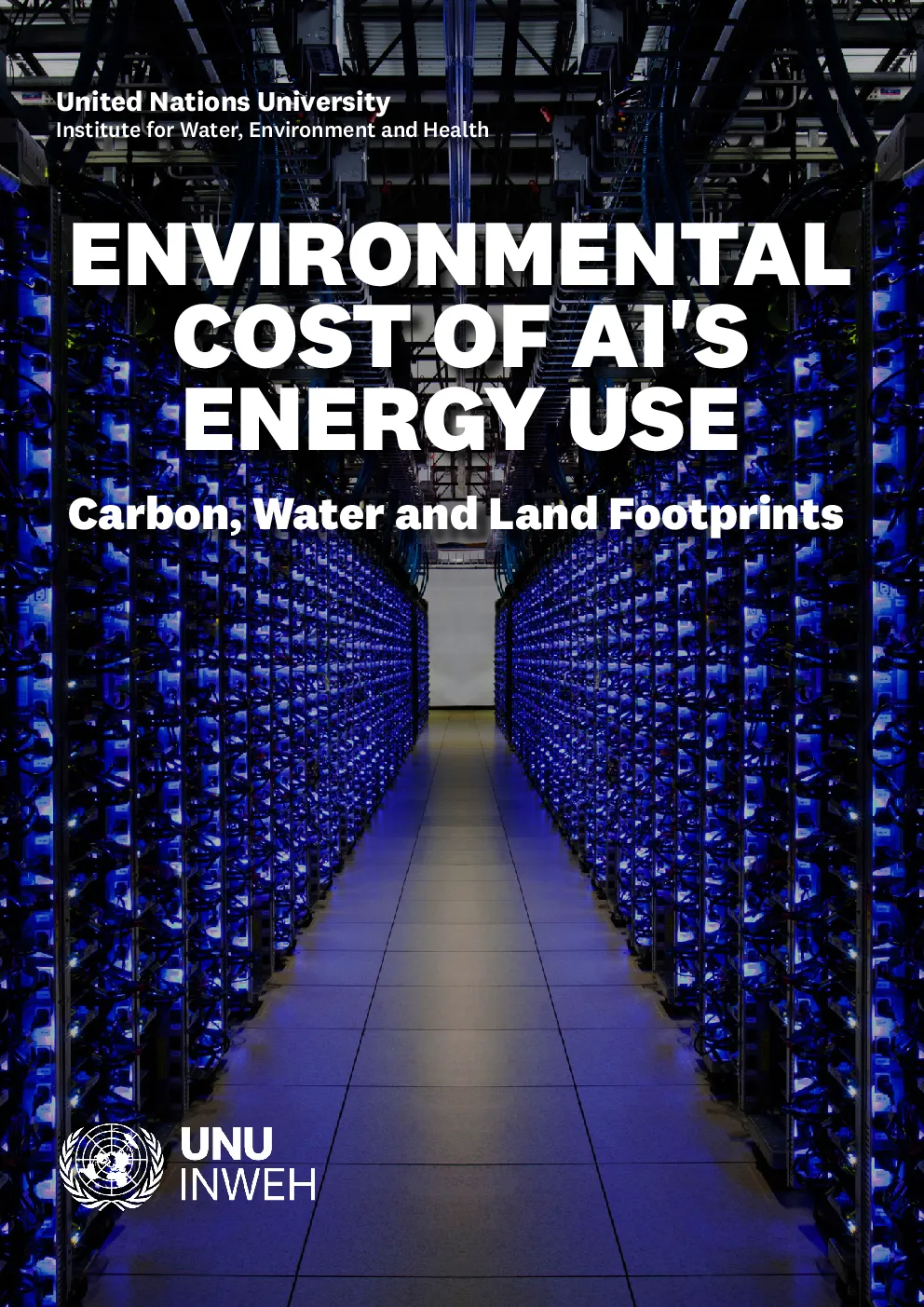
报告封面

Carbon, Water and Land Footprints AcknowledgmentUNU-INWEH gratefully acknowledges its host, the Government of Canada, and ongoing financial support from Global Affairs Canada. About UNU-INWEH The United Nations University Institute forWater, Environment and Health (UNU-INWEH) is one of 13 institutions comprisingthe United Nations University (UNU),the academic arm of the United Nations.Established in 1996 through an agreementwith the Government of Canada, UNU-INWEH is headquartered in the City ofRichmond Hill, Ontario. Redistribution This publication may be copied, adapted,reproduced in whole or in part and inany form for educational or non-profitservices without special permissionfrom the copyright holder, providedacknowledgement of the source isproperly made. UNU-INWEH specializes in addressingcritical global security and developmentchallenges at the intersection of water,environment, and health. Through research,capacity development, policy engagement,and knowledge dissemination, the institutebridges the gap between scientific evidenceand the practical needs of policymakers andUN member states, with particular attentionto low- and middle-income countries. Bycollaborating with a diverse arrayof partners—including UN agencies,governments, academia, the private sector,and civil society—UNU-INWEH developssolutions that advance human security,resilience, and sustainability worldwide. Disclaimer UNU-INWEH enjoys the generous support ofGlobal Affairs Canada. As a United Nationsentity, UNU-INWEH operates independently.The content of UNU-INWEH publicationsis grounded in scientific evidence and isnot intended to be influenced by, nor doesit necessarily reflect, the views of theGovernment of Canada, as host government,or any other government, donor, or fundingpartner. Environmental Cost of AI's Energy UseCarbon, Water and Land Footprints United Nations University Institute for Water, Environment and Health (UNU-INWEH)Richmond Hill, Ontario, Canada, 2026 © United Nations University Institute forWater, Environment and Health (UNU-INWEH) © Maps, photos, and illustrations asspecified How to cite:Aczel M., Chamanara S., MatinM., Farsi A., Marwala T., Madani K. (2026)Environmental Cost of AI's Energy Use:Carbon, Water and Land Footprints, UnitedNations University Institute for Water,Environment and Health (UNU-INWEH),Richmond Hill, Ontario, Canada, doi:10.53328/INR26RMA002 Authors:Miriam Aczel, Sanaz Chamanara,Mir Matin, Aria Farsi, Tshilidzi Marwala,Kaveh Madani Contributors:Luying Wang, Jenna Elshurafa Front cover:A row of servers in Google'sDouglas County, Georgia, data center.Photo from Google Gallery ISBN:978-92-808-6141-9DOI:10.53328/INR26RMA002Download at:inweh.unu.edu/publications CONTENTS 1.1 A Technological Explosion171.2 The Expanding Reach of AI Across Sectors181.3 The Global Market for AI181.4 Impacts on the Global Labor Market191.5 Growing Concerns about AI201.6 Environmental Dimensions of AI221.7 A Just and Sustainable AI Future24 2. AI's Growing Energy Demand 2.1 Energy Intensity of AI Training262.2 AI's Energy Demand and its Environmental Footprints262.3 AI's Training Footprints262.4 Data Centers and AI's Expanding Energy Demand302.5 AI's Contributions to Data Centers' Energy Use332.6 World's Top Data Center Hosts and their Energy Mixes342.7 Local Costs and Distant Benefits36 3. AI in Use: Tools and Tasks 3.1 Two Forces Shaping AI’s Operational Footprint393.2 AI Tasks and their Footprints403.3 AI Use at Scale413.4 Conventional Search Versus Enhanced Search423.5 Efficiency Improvement and Rebound Effects433.6 Behavioral Energy Costs: Model Choice and User Prompts Matter433.7 Toward Sustainable Use and Scale45 4. The Way Forward 4.1 Guiding Principles for a Responsible AI Ecosystem474.2 From Measurement to Action484.3 Roles and Responsibilities494.4 Putting Principles into Practice524.5 Conclusion52 53 FIGURES Figure 1.The evolution of artificial intelligence16Figure 2.Industrial revolutions from mechanization to intelligent systems17Figure 3.Key breakthroughs in deep learning23Figure 4.Global electricity supply by source27Figure 5.Electricity supply mixes in major data center host locations28Figure 6.Global electricity footprints29Figure 7.Footprints of electricity in the world's top 20 data center hubs31Figure 8.Global distribution of data center locations32Figure 9.Global electricity footprint intensities across the world’s top 20 datacenter hubs relative to the global average37Figure 10.Energy demand in AI arises from two distinct phases39Figure 11.Energy per query for representative text and image generation tasks41Figure 12.How video generation settings shape energy demand44Figure 13.Six guiding principles for operationalizing responsible AI48 ABBREVIATIONS 4IRFourth Industrial RevolutionAIArtificial IntelligenceCO2eCarbon dioxide equivalentCPUCentral Processing UnitGPTGenerative Pre-trained TransformerGPUGraphics Processing UnitGWGigawatt, 1,000,000,000 WGWhGigawatt-hou