您的浏览器禁用了JavaScript(一种计算机语言,用以实现您与网页的交互),请解除该禁用,或者联系我们。 [巴克莱银行]:中国上游因素推动PPI,转嫁能力疲软 - 发现报告

中国上游因素推动PPI,转嫁能力疲软

基础化工 2026-06-10 巴克莱银行 江边的鸟
报告封面

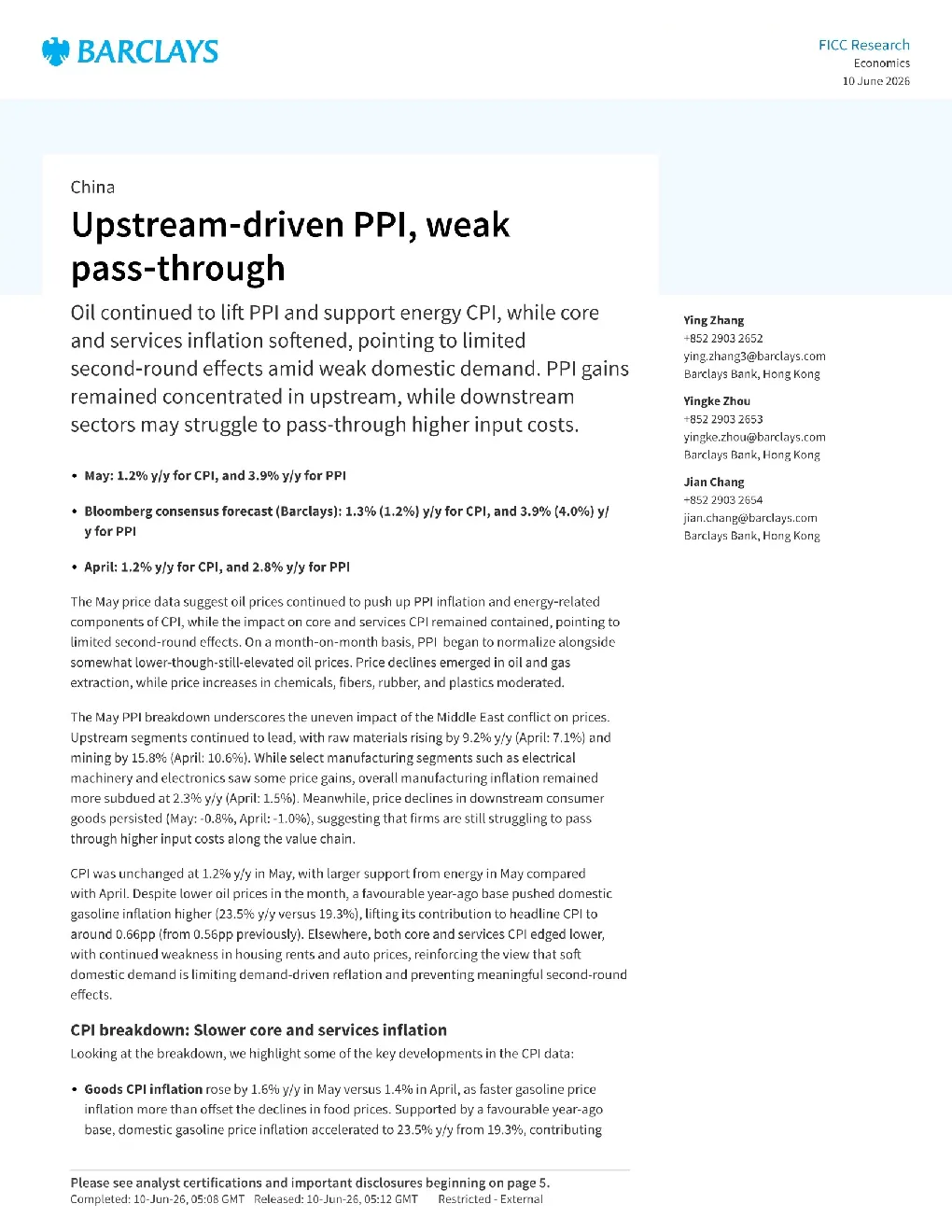
Upstream-driven PPl, weakpass-through Oil continued to lift PPI and support energy CPl, while coreand services inflation softened, pointing to limitedsecond-round effects amid weak domestic demand. PPl gainsremained concentrated in upstream, while downstreamsectors may struggle to pass-through higher input costs. +852 2903 2652ying.zhang3@barclays.comBarclays Bank, Hong KongYingke Zhou +852 2903 2653yingke.zhou@barclays.comBarclays Bank, Hong Kong ·May:1.2% y/yfor CPl, and 3.9% y/yfor PPI +852 2903 2654jian.chang@barclays.comBarclays Bank, Hong Kong :Bloomberg consensus forecast (Barclays):1.3% (1.2%)y/yfor CPl,and3.9% (4.0%)y/y for PPI · April: 1.2% y/y for CPI, and 2.8% y/y for PPI The May price data suggest oil prices continued to push up PPl inflation and energy-relatedcomponents of CPl, while the impact on core and services CPI remained contained, pointing tolimited second-round effects. On a month-on-month basis, PPI began to normalize alongsidesomewhat lower-though-still-elevated oil prices. Price declines emerged in oil and gasextraction, while price increases in chemicals, fibers, rubber,and plastics moderated. The May PPI breakdown underscores the uneven impact of the MiddleEast conflict on prices.Upstream segments continued to lead, with raw materials rising by 9.2% y/y (April: 7.1%) andmining by 15.8% (April: 10.6%). While select manufacturing segments such as electricalmachineryand electronics saw some pricegains, overall manufacturing inflation remainedmore subdued at 2.3% y/y (April: 1.5%). Meanwhile, price declines in downstream consumergoods persisted (May: -0.8%, April: -1.0%), suggesting that firms are still struggling to passthrough higherinput costs along the value chain. CPl was unchanged at 1.2% y/y in May, with larger support from energy in May comparedwith April. Despite lower oil prices in the month, a favourable year-ago base pushed domesticgasoline inflation higher (23.5% y/y versus 19.3%), lifting its contribution to headline CPItoaround 0.66pp (from 0.56pp previously).Elsewhere, both core and services CPl edged lower,with continued weakness in housing rents and auto prices, reinforcing the view that softdomestic demand is limiting demand-driven reflation and preventing meaningful second-roundeffects. CPIbreakdown:Slowercoreand servicesinflation Looking at the breakdown, we highlight some of the key developments in the CPl data: Goods CPl inflation rose by 1.6% y/y in May versus 1.4% in April, as faster gasoline priceinflation more than offset the declines in food prices. Supported by a favourable year-agobase, domestic gasoline price inflation accelerated to 23.5% y/y from 19.3%, contributing second month, down 1.7% y/y (April: -1.6%), subtracting 0.3pp from the headline print,mainly driven by a deeper decline in pork prices and softer fruit prices. headline inflation, although its impact has moderated (o.2pp in April) alongside easing goldprice growth. Vehicle prices continued to decline, down 1.1% y/y and 0.4% m/m. Prices inother key goods categories stayed stable, with household appliances and clothing rising 3.4%and 1.5% y/y, respectively, together adding about 0.12pp to CPl inflation. service prices moderated by 0.9pp to 2.8% y/y.Prices of basic public services remainedlargely stable, with healthcare services (May: 3.2%, April: 3.4% ), household services (steadyat 1.1%) and education services (steady at 0.5%) continuing to rise. Housing rents declinesheld at 0.6% y/y in May, still the fastest pace of decline since January 2023, while data fromthe China Index Academy show rents in major cities declined at a much sharper rate of 3.2%y/y. PPIbreakdown:NotableriseinupstreamsectorsMay PPl advanced for a second month, rising by 3.9% following a 2.8% gain in April. The notable sectors, with rising copper prices amid strong Al and green tech-related demand and supplyconcerns amid the Middle East conflict. On a m/m basis, the increase in PPI moderated to 0.5%,after picking up 1.7% in April, which was thefastest pace since late 2021. Looking at the breakdown, PPI gains remain highly concentrated in upstream sectors. The(May: 9.2%, April: 7.1%, March: 1.1%) accelerated, while manufacturing PPI picked up at a muchmeasured pace (May: 2.3%, April: 1.5%, March: 0.9%). According to the NBS, non-ferrous miningsegments such as electrical machinery and electronics, contributing 2.56pp to the headline PPlprint (April: 2.05pp). Energy and chemicals were another key driver, with oil and gas extraction,refined fuels, and chemical products all saw strong price increases,jointly adding close to 2ppto the headline print, again with a larger contribution than in April (1.5pp). In contrast, theconsumer goods PPI remained in deflation, despite some narrowing (May: -0.8%, April: -1%,March: -1.3%). We, Yingke Zhou, Jian Chang and Ying Zhang, hereby certify (1) that the views expressed in this research report accurately reflect our personal views indirectly related to the specific re