您的浏览器禁用了JavaScript(一种计算机语言,用以实现您与网页的交互),请解除该禁用,或者联系我们。 [FIME]:放射科市场动态:人工智能如何重塑医学影像行业 - 发现报告

放射科市场动态:人工智能如何重塑医学影像行业

医药生物 2026-06-03 FIME 有梦想的人不睡觉
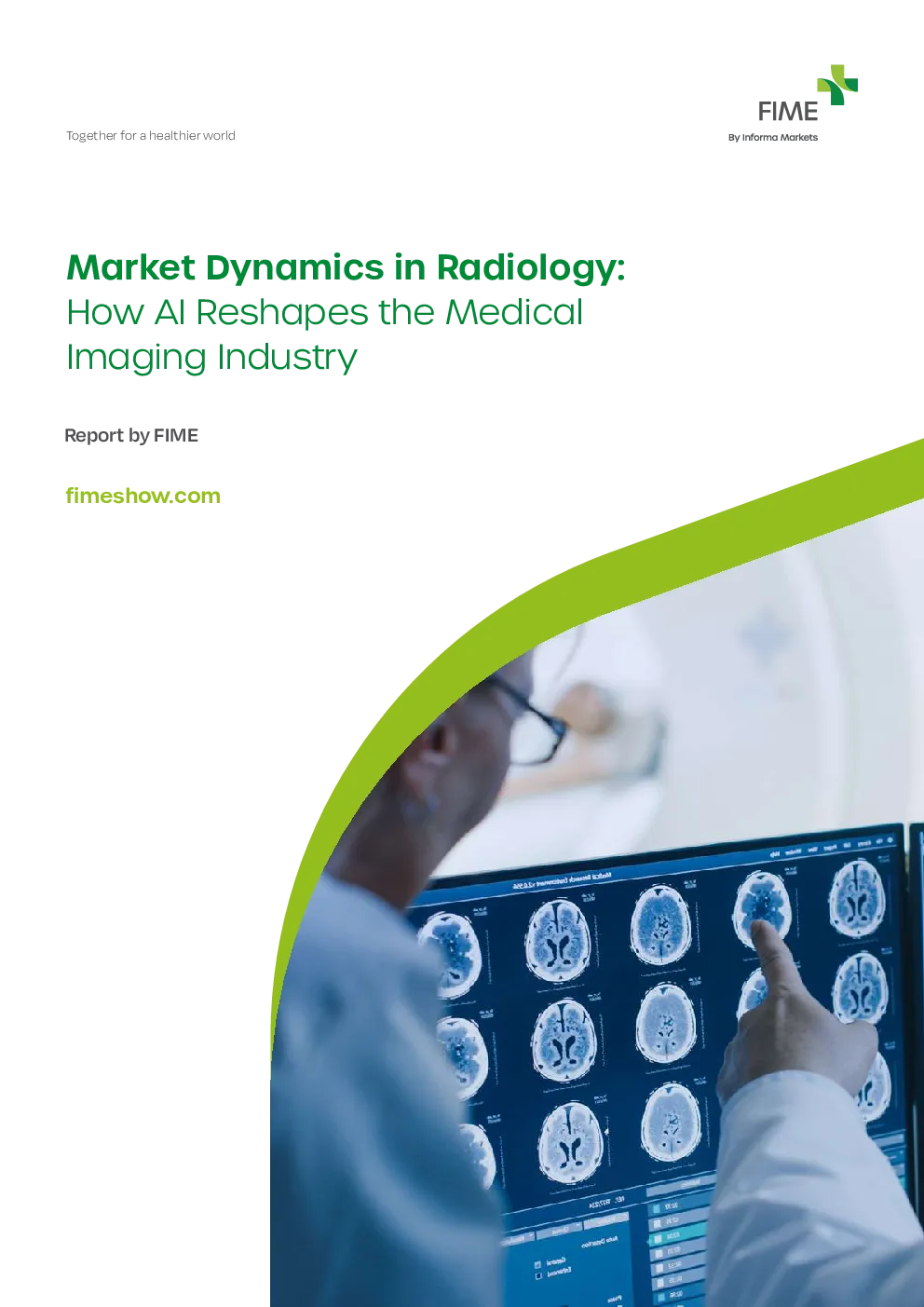
报告封面

Report by FIME fimeshow.com Contents Overview of Diagnostic Trends ..........................03Market Outlook ............................................................04Global Market Size of the AI in the MedicalImaging Sector ............................................................04US Market Size of AI-Medical Imaging ..........06Latin America Market Size ofAI-Medical Imaging ....................................................07Market Dynamics .......................................................07Benefits of AI in Healthcare ..................................10Challenges and Considerations .........................10Future Prospects of AI in Diagnostics .............11Conclusion ......................................................................12 AOverview of Diagnostic Trends rtificial intelligence (AI) has transformed medicalimaging to facilitate accurate and quick diagnosisof any underlying disease. Healthcare expertsincreasingly leverage AI-integrated devices todecipher X-ray readings, computed tomography (CT) scansand magnetic resonance imaging (MRI).AI technologies such as machine learning, image It makes AI-integrated diagnostics a vital tool for evenexperienced radiologists who may not always be able todetect subtle abnormalities. The radiology domain has been hampered by a shortfallof skilled staff. Medical images make up nearly 90% ofdata generated in clinics and hospitals. The large volumepressurizes radiologists to process several images in a singleday. AI is expected to improve the diagnosis rate with betterimage capture and reduce burnout among experts. Thebenefits go beyond medical imaging analysis as AI can serveas an aid to streamline operations such as automation ofworkflow, form filling, result sheets and quality audits. processing, natural language processing (NLP), neuralnetworks and deep learning can analyze vast numberof datasets to identify patterns within images for quickdiagnosis. The capability enables AI algorithms to spotanomalies in organs, tissues, blood vessels and bones. Market Outlook The AI in diagnostics market is set for substantial growth ashealthcare systems digitize. AI-driven medical imaging utilizesalgorithms along with machine learning to improve diagnosisand patient care. The convergence of medical equipment,healthcare IT, IoT, wearables, mobile apps and social media isexpected to generate troves of data, with AI playing a pivotal rolein extracting insights from Big Data sources. According to Markets and Markets, the global revenue forAI in medical diagnostics was estimated at USD 1.3 billion in2023. With a projected compound annual growth rate (CAGR)of 23.2%, the market is expected to reach USD 3.7 billion by2028. The surge in chronic diseases and the escalating demandfor swift and cost-effective diagnosis are major catalystspropelling the growth of the AI-powered diagnostic market. As we step into 2024, regulatory agencies worldwideare increasingly approving AI-driven diagnostic tools forimplementation in healthcare. The integration of AI intoradiology not only elevates diagnosis and care but also unfoldsa realm of personalized treatment plans, enriching the overallhealthcare experience. AI-driven treatment plans leveragealgorithms to analyze patient data, encompassing medicalhistory, genetics, and lifestyle to tailor treatments according tounique individual parameters. Market Analysis of AI-Powered Diagnostics In 2023, the healthcare landscape witnessed a remarkabletransformation, primarily driven by the infusion of AI intopatient diagnostics. This paradigm shift to AI not onlyintroduced unprecedented levels of efficiency and precisionbut also marked a significant leap towards personalizedhealthcare. AI’s role in diagnostics extends beyond automation;it empowers medical professionals to make well-informeddecisions while streamlining operational processes. Rapidanalysis of extensive patient data facilitates early diseasedetection, accelerating diagnostics and drastically enhancingpatient outcomes. One of AI’s remarkable strengths lies in predictive analytics,enriching accuracy by identifying patterns and correlations. Thisnot only reduces errors but also optimizes time and resources,heralding a new era in the realm of medical diagnostics. Global Market Size of the AIin Medical Imaging Sector providers, and buyers to ensure widespread acceptance.Innovative technologies like deep learning promise more valuein diagnosis and therapy compared to traditional methods.Among modalities, the CT scan segment dominated with a31.15% revenue share in 2023, while the X-ray segment ispoised for the highest CAGR of 35.4% from 2023 to 2032. Interms of applications, neurology claimed the largest marketshare at 20.95% in 2023, driven by the increasing prevalence ofneurodegenerative diseases. In 2024, the AI in medical imaging market is valued at USD5.86 billion. The market is projected to soar to over USD 20.40billion by 2029, boasting a compellin