您的浏览器禁用了JavaScript(一种计算机语言,用以实现您与网页的交互),请解除该禁用,或者联系我们。 [东盟能源中心]:2025回顾:可再生能源洞察 - 发现报告

2025回顾:可再生能源洞察

公用事业 2026-02-15 Indra Pradnyaswari, Rhea Oktaiqara, Edelweiss Agatha Zaneta Devi, Zahrah Zafira 东盟能源中心 路仁假
报告封面

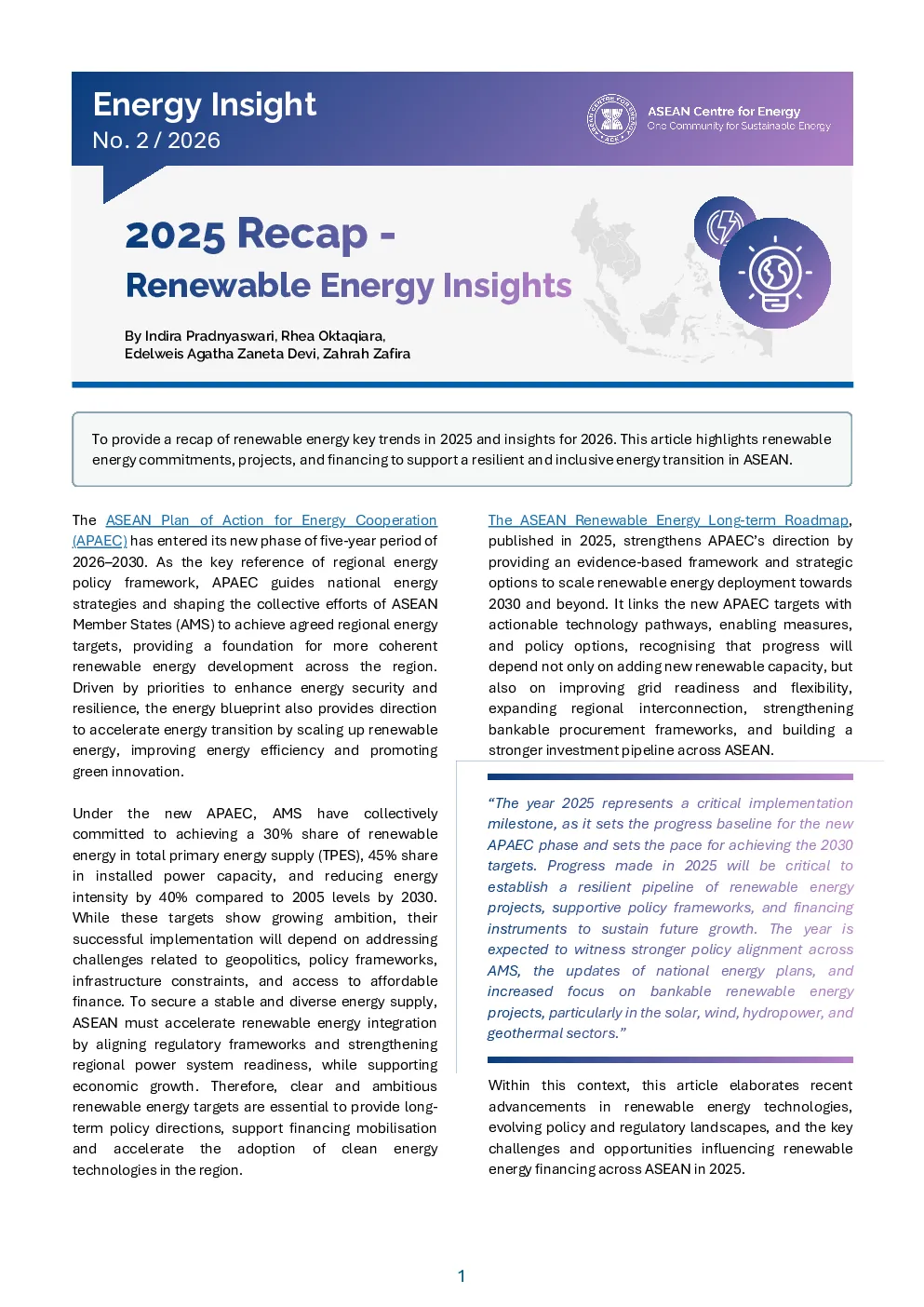
By Indira Pradnyaswari, Rhea Oktaqiara,Edelweis Agatha Zaneta Devi, Zahrah Zafira To provide a recap of renewable energy key trends in 2025 and insights for 2026. This article highlights renewableenergy commitments, projects, and financing to support a resilient and inclusive energy transition in ASEAN. TheASEAN Plan of Action for Energy Cooperation(APAEC)has entered its new phase of five-year period of2026–2030. As the key reference of regional energypolicyframework,APAEC guides national energystrategies and shaping the collective efforts of ASEANMember States (AMS) to achieve agreed regional energytargets,providing a foundation for more coherentrenewableenergy development across the region.Driven by priorities to enhance energy security andresilience, the energy blueprint also provides directionto accelerate energy transition by scaling up renewableenergy,improving energy efficiency and promotinggreen innovation. The ASEAN Renewable Energy Long-term Roadmap,published in 2025, strengthens APAEC’s direction byproviding an evidence-based framework and strategicoptions to scale renewable energy deployment towards2030 and beyond. It links the new APAEC targets withactionable technology pathways, enabling measures,andpolicy options,recognising that progress willdepend not only on adding new renewable capacity, butalsoon improving grid readiness and flexibility,expandingregional interconnection,strengtheningbankableprocurement frameworks,and building astronger investment pipeline across ASEAN. “The year 2025 represents a critical implementationmilestone, as it sets the progress baseline for the newAPAEC phase and sets the pace for achieving the 2030targets.Progress made in 2025 will be critical toestablisha resilient pipeline of renewable energyprojects, supportive policy frameworks, and financinginstrumentsto sustain future growth.The year isexpected to witness stronger policy alignment acrossAMS,the updates of national energy plans,andincreasedfocus on bankable renewable energyprojects, particularly in the solar, wind, hydropower, andgeothermal sectors.” Underthe new APAEC,AMS have collectivelycommitted to achieving a 30% share of renewableenergy in total primary energy supply (TPES), 45% shareininstalled power capacity,and reducing energyintensity by 40% compared to 2005 levels by 2030.Whilethese targets show growing ambition,theirsuccessful implementation will depend on addressingchallenges related to geopolitics, policy frameworks,infrastructure constraints, and access to affordablefinance. To secure a stable and diverse energy supply,ASEAN must accelerate renewable energy integrationby aligning regulatory frameworks and strengtheningregionalpower system readiness,while supportingeconomicgrowth.Therefore,clear and ambitiousrenewable energy targets are essential to provide long-term policy directions, support financing mobilisationandaccelerate the adoption of clean energytechnologies in the region. Withinthis context,this article elaborates recentadvancementsin renewable energy technologies,evolving policy and regulatory landscapes, and the keychallengesand opportunities influencing renewableenergy financing across ASEAN in 2025. Energy Insight 1 April 2026, which will support SAF procurement fortheir 1% SAF blend in all jet fuel used by 2026 target. ThePhilippines has outlined ambitions to become amajorSAFproducer using agricultural waste throughcollaborations with aviation industryand establishing aSAF Committee. Thailand has shown a strong policycommitment through its biofuel roadmap, introducing aSAF blending mandatestarting at 1% in 2026 and risingto 8% by 2036. The country hasan operating SAFproduction facilityusing used cooking oil as feedstock,with initial output of 6 million litres per year and plans toexpand to 24 million litres, alongsidecommunity-basedUCO collection programmesthat have converted 7.09tons of used cooking oil (UCO) into 1.75 tons of SAFduringits pilot phase,reducing 5,655 kg of CO₂-equivalent. RenewableEnergyDeploymentbyTechnology The acceleration of renewable energy across ASEANhas established a robust foundation for implementingthe regional energy targets outlined in the APAEC 2026-2030.As renewable energy projects transition intoutility-scale implementation, AMS continue to diversifytheregional energy mix through technologicalinnovation and the exploration of alternative energysources. These efforts are essential to ensure long-termenergysystem resilience,driving the specialiseddeployment of key technologies including advancedbioenergysolution to solar,wind,and geothermalacross the regional landscape. The Surge of Sustainable Aviation Fuels (SAF) Rapid Growth of Solar Photovoltaic One of the notable progresses in ASEAN’s renewableenergy deployment is the scaling of Sustainable AviationFuels (SAF). ASEAN is increasingly positioned as apotential global hub forsustainable aviation fuel (SAF),supportedby abundant biomass and waste-basedfeedstocksacross the region.South