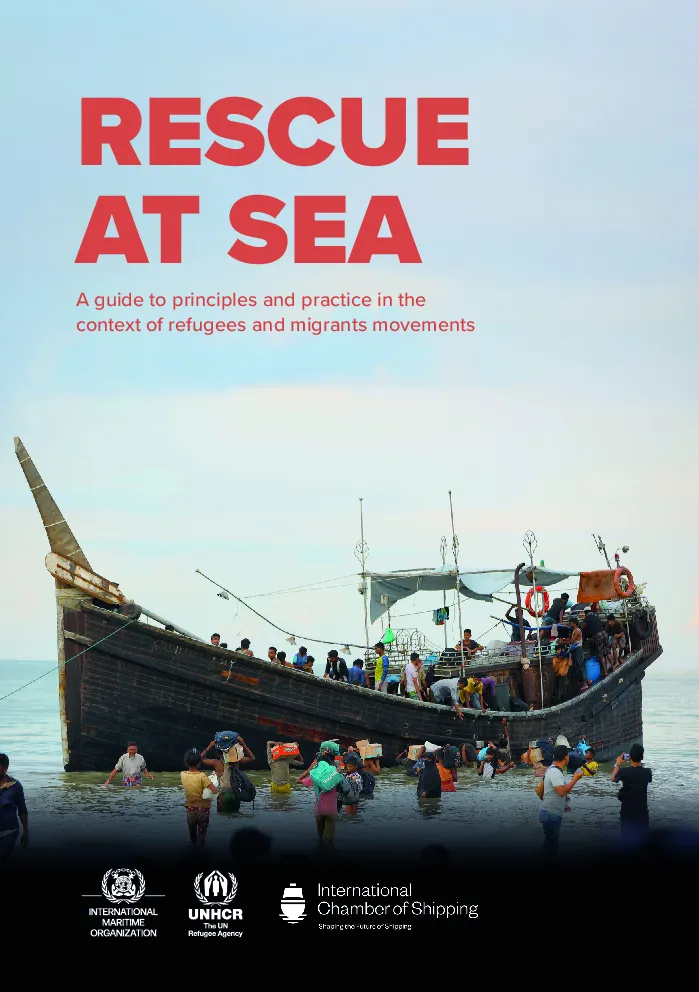
A guide to principles and practice in thecontext of refugees and migrants movements Introduction Migrants and refugees travelling by sea are not a new phenomenon. Desperate people inall parts of the world have long risked their lives aboard unseaworthy ships and other craft.Some do so in search of work, better living conditions or educational opportunities. Othersare seeking international protection against persecution, conflict or other threats to their Search and rescue (SAR) services throughout the world largely depend on international Nowadays, distress signals can be rapidly transmitted by satellite and terrestrialcommunication techniques both to search and rescue authorities ashore, and to ships in Nonetheless, rescue and disembarkation to a place of safety are complex operations involvinga range of actors, each of which has particular obligations under international maritime law, as Even when the rescue has been accomplished, problems can arise in securing the agreementof States to the disembarkation of migrants and refugees. Recognizing this problem, MemberStates of the International Maritime Organization (IMO) adopted amendments to two ofthe relevant maritime conventions in 2004.1Just as masters have an obligation to render This leaflet has been prepared jointly by the International Maritime Organization (IMO),the International Chamber of Shipping (ICS) and the Office of the United Nations HighCommissioner for Refugees). It is intended for Masters, ship owners, Government authorities,insurance companies, and other interested parties involved in rescue-at-sea situations.It provides guidance on relevant legal provisions, on practical procedures to ensure the The LegalFramework RELEVANTOBLIGATIONS AND International Maritime Law Obligations of the master The master has an obligation to render assistance to those in distress at sea without regardto their nationality, status or the circumstances in which they are found. This is a longstandingmaritime tradition as well as an obligation enshrined in international law. Compliance with The1982 United Nations Convention on the Law of the Sea (UNCLOS)provides that without serious danger to the ship, the crew or the passengers:(a) to render assistance to any person found at sea in danger of being lost; (b) to proceed with all possible speed to the rescue of persons in distress, ifinformed of their need of assistance, in so far as such action may reasonably beexpected of him’ (Article 98(1),heading and sub(a)and(b)). The1974 International Convention for the Safety of Life at Sea (SOLAS Convention)obliges the‘master of a ship at sea which is in a position to be able to provide assistance, on receiving information from any source that persons are in distressat sea, … to proceed with all speed to their assistance, if possible informing them or Obligations of Governments and Rescue Coordination Centres (RCCs) Several maritime conventions define the obligations of State Parties to ensure arrangementsfor distress communication and coordination in their area of responsibility and for the rescue UNCLOSimposes an obligation on every coastal State to‘… promote the establishment,operation and maintenance of an adequate and effective search and rescue serviceregarding safety on and over the sea and, where circumstances so require, by way of mutual TheSOLASConvention requires each State Party to‘… ensure that necessary responsibility and for the rescue of persons in distress at sea around its coasts. Thesearrangements shall include the establishment, operation and maintenance of such search In addition, the1979 International Convention on Maritime Search and Rescue (SAR Convention)obliges State Parties to‘… ensure that assistance [is] provided to anyperson in distress at sea … regardless of the nationality or status of such a person orthe circumstances in which that person is found’ (Chapter 2.1.10) and to ‘… provide for Definition of distress phase .2 when, following the alert phase, furtherunsuccessful attempts to establish contactwith a person, a vessel or other craft and morewidespread unsuccessful enquiries point to The SAR Conventiondefines “distress phase”as‘a situation wherein there is a reasonablecertainty that a person, a vessel or other craftis threatened by grave and imminent dangerand requires immediate assistance’2whereas in its annex chapter 4 provides the followingdetails on this phase for operational purposes: .3when information is received whichindicates that the operating efficiency of a 2SAR Convention, 1979, annex, paragraph 1.3.13.3SAR Convention 1979, annex, paragraph 4.4.3. InternationalRefugee Law If people rescued at sea claim to be refugees or asylum seekers or indicate in any way thatthey fear persecution or ill treatment if disembarked at a particular place, key principlesprescribed by international refugee law need to be upheld. The Master is not responsible Under International Refugee Law the main concepts that