美国生物制药:ASCO会议上Ivo及全体会议数据对非小细胞肺癌的交叉解读 - MRK、BMY、PFE、ABBV
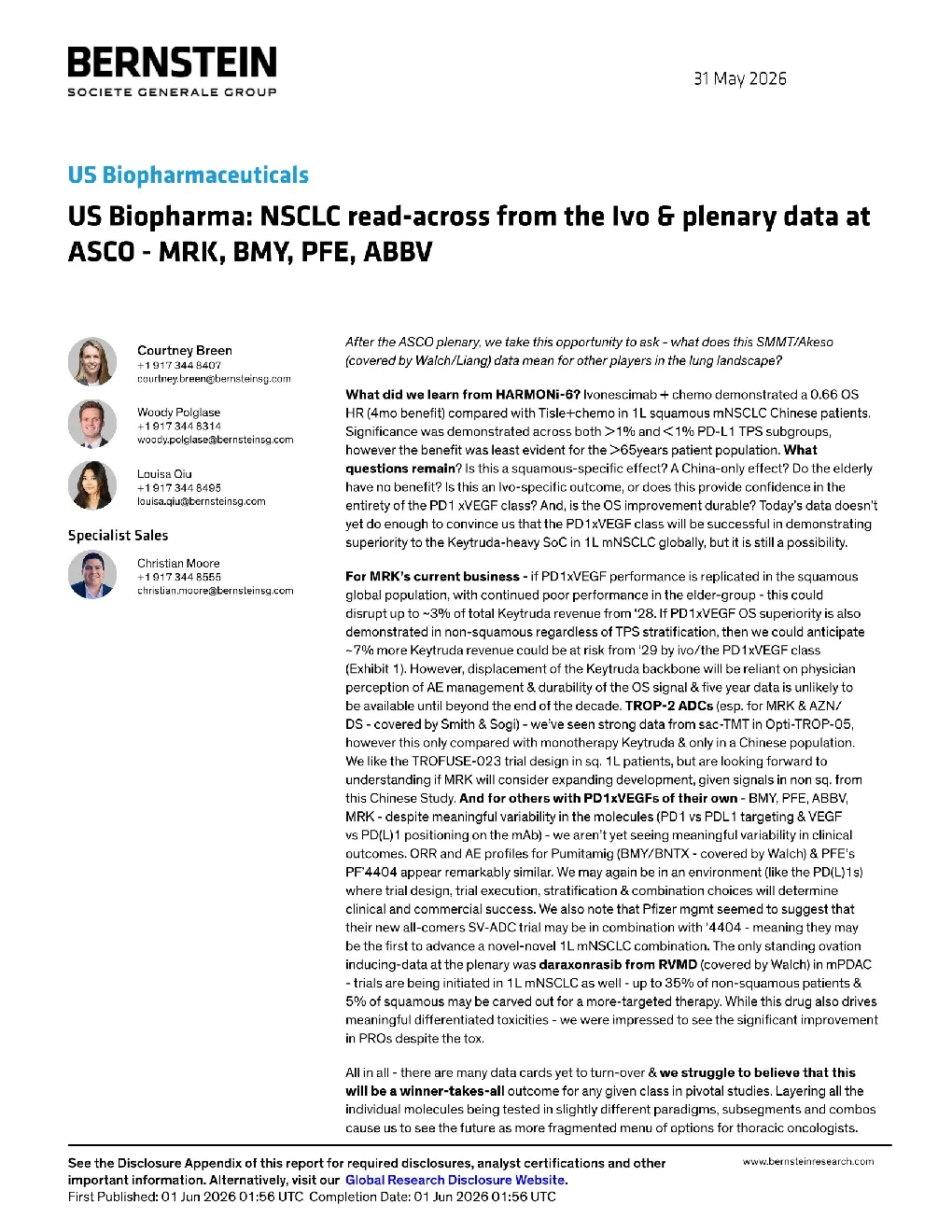
US Biopharma: NSCLC read-across from the Ivo & plenary data atASCO - MRK. BMY.PFE.ABBV (coveredbyWalch/Liang)datameanforotherplayers in the lunglandscape? +19173448407courtney.breen@bernsteinsg.com HR(4mobenefit)comparedwithTisle+chemo in1LsquamousmNSCLC Chinesepatients.Significance was demonstratedacross both>1%and<1%PD-L1TPS subgroups,howeverthebenefit wasleastevidentforthe>65yearspatientpopulation.Whatquestions remain?Is this a squamous-specific effect? A China-only effect? Do the elderlyhave no benefit?Is this an Ivo-specific outcome, or does this provide confidence in theentirety of the PD1xVEGFclass? And, is the OS improvement durable?Today's data doesn'tyet do enough to convince us that the PD1xVEGF class will be successful in demonstratingsuperiority to the Keytruda-heavy SoC in 1L mNSCLC globally, but it is still a possibility. +1917344 8314woody.polglase@bernsteinsg.com +1917344 8495louisa.qiu@bernsteinsg.com Specialist Sales +19173448555christian.moore@bernsteinsg.com For MRK's current business -if PD1xVEGFperformance is replicated in the squamousglobal population, with continued poor performance in the elder-group-this coulddisrupt up to~3% of total Keytruda revenue from28.If PD1xVEGF OS superiority is alsodemonstrated in non-squamous regardless of TPS stratification,then we could anticipate~7%moreKeytruda revenue couldbeat risk from29by ivo/thePD1xVEGFclass(Exhibit 1).However,displacement of the Keytruda backbone will be reliant on physicianperception of AE management &durability of the OS signal &five yeardata isunlikely tobe available until beyond the end of the decade.TROP-2ADCs (esp.for MRK &AZN/DS - covered by Smith & Sogi)-we've seen strong data from sac-TMT in Opti-TROP-O5,howeverthis only comparedwithmonotherapyKeytruda &only in a Chinese population.We like the TROFUSE-023 trial design in sq.1Lpatients, but are looking forward tounderstanding if MRK will consider expanding development,given signals in non sq.fromthis Chinese Study. And for others with PD1xVEGFs of their own - BMY, PFE, ABBV,MRK -despite meaningful variability in the molecules (PD1 vs PDL1 targeting & VEGFvs PD(L)1 positioning on the mAb)-we aren't yet seeing meaningful variability in clinicaloutcomes.ORR andAEprofilesfor Pumitamig (BMY/BNTX-covered byWalch) &PFE'sPF4404 appear remarkably similar.We may again be in an environment (like the PD(L)1s)where trial design,trial execution,stratification &combination choices will determineclinical and commercial success.We also note that Pfizermgmt seemed tosuggestthattheir new all-comers SV-ADC trial may be in combination with'4404 -meaning they maybethefirstto advancea novel-novel 1L mNSCLC combination.The only standing ovationinducing-data at theplenarywas daraxonrasibfrom RVMD (covered by Walch) in mPDAC-trials are being initiated in 1L mNSCLC as well -upto 35% of non-squamous patients &5% of squamous may be carved out for a more-targeted therapy.While this drug also drivesmeaningfuldifferentiatedtoxicities -we were impressedto see the significant improvementin PROs despite the tox. All in all -there are many data cards yet to turn-over & we struggle to believe that thiswill be a winner-takes-all outcome for any given class in pivotal studies. Layering all theindividual molecules being tested in slightly different paradigms, subsegments and comboscause us to see the future as more fragmented menu of options forthoracic oncologists. EXHIBIT 1:If you assume thatPD1xVEGF1L mNSCLC trials are successful, almost10% of Keytruda revenue maybe accessible bytheclass (does not consider successof other ADCsinoverlappingpatient populations) HARMONI-6RESULTS SUMMARYOFHARMONI-6RESULTSAt ASCO2026,the HARMONi-6 trial showed that ivonescimabplus chemotherapydelivereda statisticallysignificant and clinicallymeaningful overall survival (oS)benefit versus tislelizumab plus chemotherapy in first-line advancedsquamous NSCLC (HR 0.66; medianOS 27.9 vs.23.7months). Importantly,this marks the first time a PD-1xVEGFbispecific approachhas demonstratedan OSbenefit inthe 1LNSCLC(PFS). The OS benefit was generally consistent across PD-L1 (TPS) subgroups, including PD-L1-low and PD-L1-negative patients(something not seen in KN-407), supporting the hypothesis that VEGF inhibition may broaden immunotherapy benefit beyondPD-L1-selected populations. However,several importantcaveats remain: The study was conducted exclusively in a Chinese population,limiting immediateglobal generalizability Thedatasetis interimwith~21monthsfollow-up,so long-termOSdurabilityisnotyetestablishedThere are limitations in older patients, including exclusion of patients >75 years and a weaker signal in the ≥65 subgroup(HR~0.93),raising uncertainty in typical Western populations. Overall, HARMONi-6provides a proof-of-conceptthat dual PD-1/VEGFtargeting can translate PFS gains into OSbenefit in 1LNSCLC, but external validation in global and olderpopulations remains a key next step. achieved a median0Sof 27.9 months,