您的浏览器禁用了JavaScript(一种计算机语言,用以实现您与网页的交互),请解除该禁用,或者联系我们。 [PitchBook & Morningstar]:SaaS启示录机会:AI生态系统中竞争情报和战略合作的分类学 - 发现报告

SaaS启示录机会:AI生态系统中竞争情报和战略合作的分类学

信息技术 2026-05-08 Rudy Torrijos, Adi George PitchBook & Morningstar
报告封面

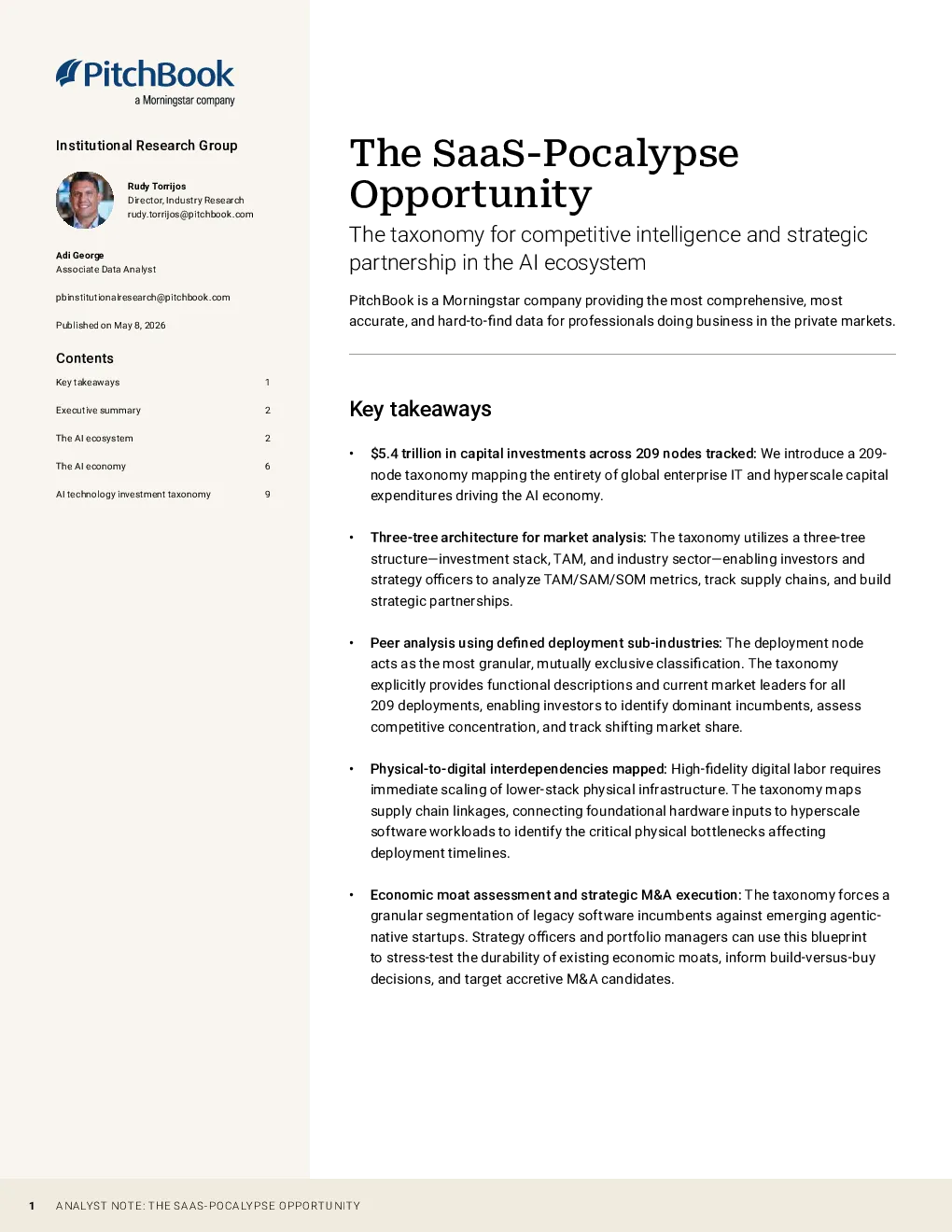
The SaaS-PocalypseOpportunity Institutional Research Group Rudy TorrijosDirector, Industry Researchrudy.torrijos@pitchbook.com The taxonomy for competitive intelligence and strategicpartnership in the AI ecosystem Adi GeorgeAssociate Data Analystpbinstitutionalresearch@pitchbook.comPublished on May 8, 2026 PitchBook is a Morningstar company providing the most comprehensive, mostaccurate, and hard-to-find data for professionals doing business in the private markets. Contents Key takeaways1Executive summary2The AI ecosystem2The AI economy6AI technology investment taxonomy9 Key takeaways •$5.4 trillion in capital investments across 209 nodes tracked:We introduce a 209-node taxonomy mapping the entirety of global enterprise IT and hyperscale capitalexpenditures driving the AI economy. •Three-tree architecture for market analysis:The taxonomy utilizes a three-treestructure—investment stack, TAM, and industry sector—enabling investors andstrategy officers to analyze TAM/SAM/SOM metrics, track supply chains, and buildstrategic partnerships. •Peer analysis using defined deployment sub-industries:The deployment nodeacts as the most granular, mutually exclusive classification. The taxonomyexplicitly provides functional descriptions and current market leaders for all209 deployments, enabling investors to identify dominant incumbents, assesscompetitive concentration, and track shifting market share. •Physical-to-digital interdependencies mapped:High-fidelity digital labor requiresimmediate scaling of lower-stack physical infrastructure. The taxonomy mapssupply chain linkages, connecting foundational hardware inputs to hyperscalesoftware workloads to identify the critical physical bottlenecks affectingdeployment timelines. •Economic moat assessment and strategic M&A execution:The taxonomy forces agranular segmentation of legacy software incumbents against emerging agentic-native startups. Strategy officers and portfolio managers can use this blueprintto stress-test the durability of existing economic moats, inform build-versus-buydecisions, and target accretive M&A candidates. Executive summary Today, we released a 209-node AI taxonomy to track the combined $5.4 trillion inglobal enterprise IT and hyperscaler spending as it rapidly shifts toward digital labordelivery and accelerated human capital. In our foundational analyst noteMapping the AI Super-Cycle, we introduced atechnology investment stack to describe how digital labor re-engineers companies,industries, and sectors to enable the work-as-a-service (WaaS) AI economy. In thisnew paradigm, work will be based on outcome guarantees rather than hours spent.Fully enabled agentic AI, through service-as-software (SaS) products, will drivethis transition. While our investment stack provides a robust organizational blueprint, investorsand corporate strategy officers will also require a more granular framework tomap the vast competitive and partnership ecosystem needed to build this neweconomy. The taxonomy below is our view on how the AI ecosystem is evolving in theintermediate term. The AI ecosystem As enterprises rearchitect their technology stacks to support the management ofautonomous agents, a new map is needed. Categories like enterprise software,IT hardware, and networking have lost meaning and fail to capture the complex,interdependent nature of the modern AI value chain and capital requirements. To capture this transition, we introduce a 209-node taxonomy designed to track thethree primary forces driving the AI super-cycle: strategic partnerships, competitivedynamics, and investment capital. This framework allows stakeholders to identifyinterdependencies of physical infrastructure and digital labor that will accelerateenterprise value. Building strategic partnerships The AI ecosystem is defined by physical and digital interdependencies. Trueintelligence for machine automation and human assistance cannot be achieved untilall lower levels of the physical stack can enable high-fidelity intelligent digital labor.This taxonomy allows investors to trace the partnership linkages required to scalethat intelligence. With this taxonomy, stakeholders can identify the critical supply chain partners. Thisranges from specialized chemical firms providing semiconductor materials to heavycivil contractors pouring concrete for mission-critical datacenters. It maps howhyperscalers must simultaneously integrate advanced liquid-cooling architectures,continuous power generation, and high-performance computing hardware at a scalenever before seen. Importantly, physical layers of technology must now account for software-levelapplication workloads. Simultaneously, every layer of the edge AI and application tiersmust now integrate intelligence or face instant obsolescence. The type of computingrequired to support any number of generative or agentic AI calls from anywhere inthe technology stack requires a vast, highly variable array of workloads to minimizecost/token