日本货币政策观察:历史会重演吗?植田和男的讲话与政策展望
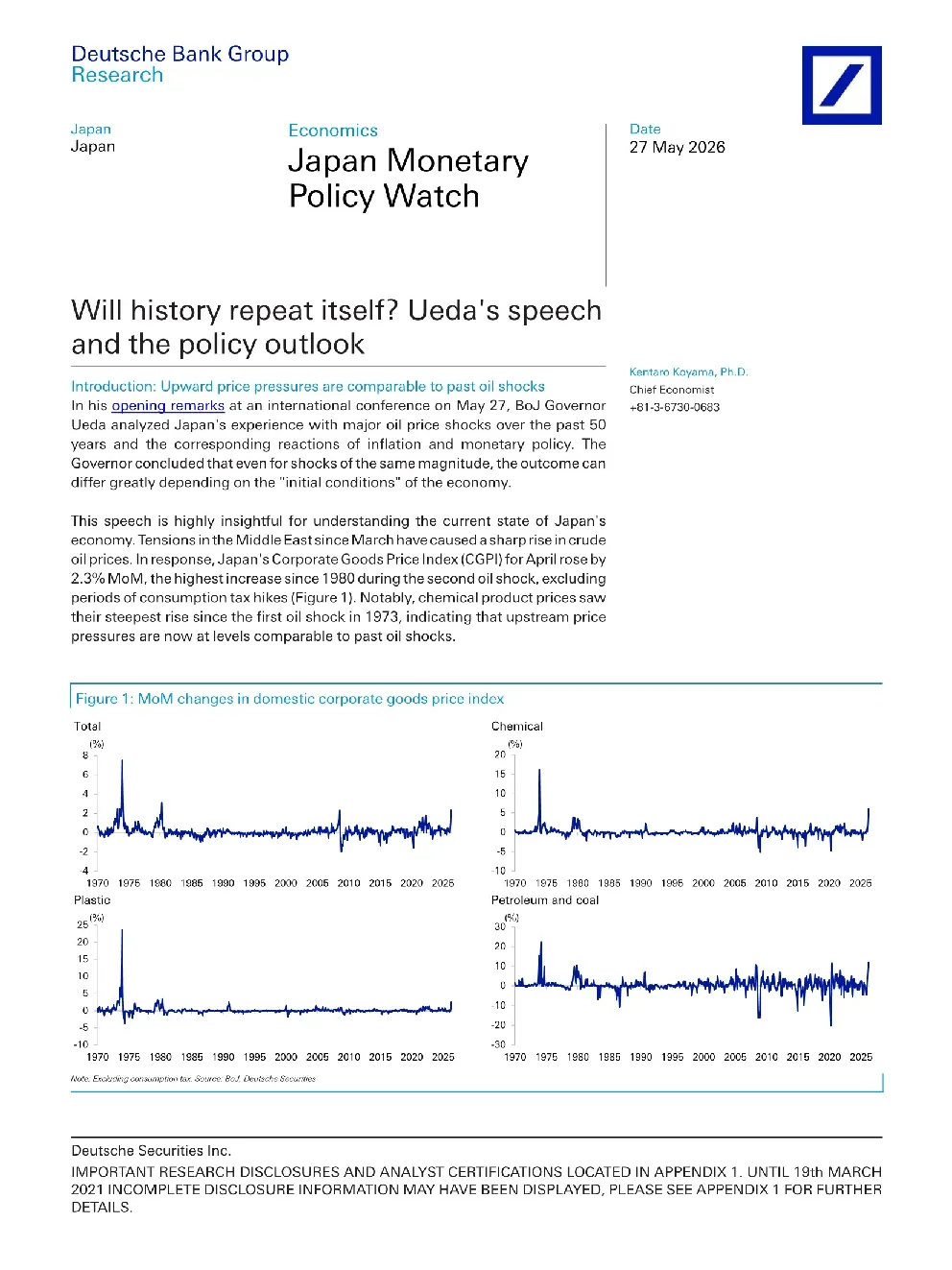
Japan Japan MonetaryPolicy Watch Will history repeat itself? Ueda's speechand the policy outlook Chief Economist+81-3-6730-0683 Inhisopening remarks at an international conferenceon May27,BoJ Governor Uedaanalyzed Japan'sexperiencewithmajor oilprice shocksoverthepast 50Governorconcludedthatevenforshocksofthesamemagnitude,theoutcomecandiffergreatly depending on the"initial conditions"of the economy. economy.TensionsintheMiddleEastsinceMarchhavecausedasharpriseincrudeoilprices.Inresponse,Japan'sCorporateGoodsPriceIndex(CGPl)forAprilroseby2.3%MoM,thehighestincrease since1980 duringthe secondoil shock,excludingperiodsofconsumptiontaxhikes(Figure1).Notably,chemicalproductpricessawtheir steepest rise since the first oil shock in 1973, indicating that upstream pricepressures arenowatlevelscomparabletopastoilshocks. Japan Monetary Policy Watch for forecasting the BoJ's future monetary policy.By delving deeper into theGovernor's speech,we will clarify the differences in initial conditions between thetwo past oil shocks and the present, and considerthe implications formonetarypolicy. In his speech,the Governoridentified the following six key initial conditions thatinfluence inflation dynamics: 2.Inflationexpectations3.Priceand wage-setting norms4.Theexchangerate5.Economicmomentum (demand-sideconditions)pre-shock6.Themonetarypolicystance whichareparticularly importantand canbeanalyzed quantitatively,to conductacomparativeanalysiswithpastepisodes. Deepdive (1):Will awage-pricespiraloccur?Past experience: Unit labor costs made allthedifference Comparing the first oil shock in1973and thesecond in1980,thepaceof import price increases wassimilar, yet there was a significant difference in the resulting CPl inflation rates(Figure 2). During the first oil shock in 1973, which triggered a wage-price spiral, Japan'seconomy was already in a high-pressure state.Amid chronic labor shortages,nominalwagesweregrowingat+15-20%YoYevenbeforethe shock(Figure3).Theclassic spiral. JapanMonetaryPolicyWatch contained,wagegrowthwasrestrainedthroughlabor-managementcoordination,based on the painful lessons from the first shock.Real wages decelerated inresponsetoaccelerating inflation,andaspiral wasaverted. ThisdifferencebecomesclearerwhenlookingatUnitLaborCosts(ULC),definedasnominal employee compensationdivided by real GDP,which indicates corporatelabor cost pressure (Figure 4).The sharp rise in ULC growth during the first shock,versus its limited increase during the second, contributed significantly to pricestability. Currentassessment: Lowshort-termrisk,butnextyear'swagenegotiations arekey Current ULC growth is at a higher level than it was just before the second oilshock in 1979.Furthermore,the employment conditions DI in the BoJTankansurveyislowerthanduringpastoilshocks,indicatingthatlaborshortagesaremore Japan Monetary Policy Watch persistentdepends onwhetherthis ULC growthaccelerates further. In this regard, since the crude oil price surge occurred after the 2026"Shunto"significantreflectionofthepricehikes in scheduledcashearnings (basesalary)willlikely be deferred until next year.Moreover, surveys indicate that summer bonusgrowth will be lower than last year. Thus, the probability of a sharp near-termincrease in ULC is low. In conclusion, the risk of a wage-price spiral in the short term is limited. However,againstabackdropofhistoriclaborshortages,ifthisyear'shighinflationtranslatesintostrongwagedemandsinthe2027Shunto,ascenarioofrelativelyhighinflationpersisting fora longerperiod is entirelyplausible. Deepdive (2):Isthemonetarypolicystanceappropriate?Pastexperience:Accommodativepolicythatfueled inflationvs.tighteningthat curbed it During the first oil shock, monetary policy was accommodative bothbefore and after the shock. A comparison of the policy rate with a proxy for thenominal neutral rate of interest (using a 4-year moving average of nominal GDPgrowth) shows that the policy rate was consistently below the neutral ratethroughout the 1970s (Figure 6).As the Governor himself mentioned in his speech,"thedegreeoftightening wasclearlyinadequate,"andmonetarypolicyundeniablycontributed to the inflation. Incontrast,afterthesecondoilshockfrom1980onwards,thepolicyratewasraisedabovetherateofnominalgrowth,whichisconsideredtohaveexerteddownwardpressure on inflation. Current assessment: Unprecedented accommodation, risk of delay Measuringthedegreeofmonetaryaccommodationbythegapbetweenthenominalgrowthand policy rate,wefind that evenafterthe initiation ofrate hikes since2024,thecurrent degree of accommodation is at its highest level since 1980 (Figure 7). Inthenearfuture,nominalgrowthmaytemporarilyslowas deterioratingtermsoftrade squeeze the economy.However,if this transitions into an"homemadeinflation" accompanied by wage growth, nominal growth will likelyre-accelerate.In sucha scenario,a delay in monetary policynormalizationwould significantlyincrease the risk of accelerating inflation. Japan Monetary Policy Watch Aco