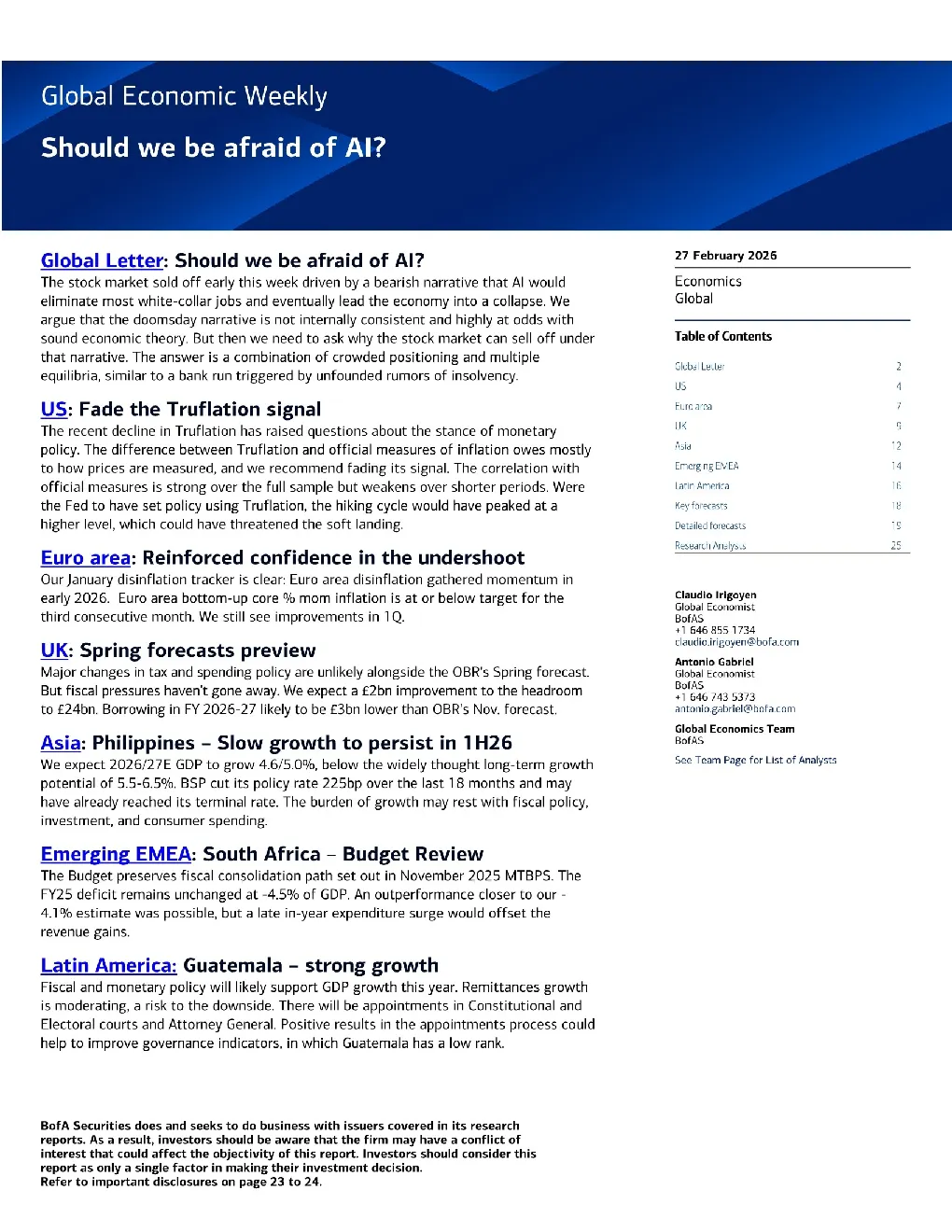
Global eliminate most white-collar jobs and eventually lead the economy into a collapse.Weargue that the doomsday narrative is not internally consistent and highly at odds with Table of Contents sound economic theory.But then we need to ask why the stock market can sell off underthat narrative. The answer is a combination of crowded positioning and multipleequilibria, similar to a bank run triggered by unfounded rumors of insolvencyUS:FadetheTruflationsignal policy.The difference between Truflation and official measures of inflation owes mostly to how prices are measured, and we recommend fading its signal. The correlation withofficial measures is strong over the full sample but weakens over shorter periods. Werethe Fed to have set policy using Truflation, the hiking cycle would have peaked at ahigher level, which could have threatened the soft landing.Euroarea:Reinforcedconfidenceintheundershoot Our January disinflation tracker is clear: Euro area disinflation gathered momentum inearly 2026.Euro area bottom-up core % mom inflation is at or below target for the third consecutive month. We still see improvements in 1Q.UK:Springforecastspreview BofAS+1 646 855 1734claudio.irigoyen@bofa.comAntonio GabrielGlobal Economist Major changes in tax and spending policy are unlikely alongside the OBR's Spring forecast.But fiscal pressures haven't gone away. We expect a 2bn improvement to the headroom BofAS+1 646 743 5373antonio.gabriel@bofa.comGlobal Economics TeamBofAS to24bn.Borrowing in FY2026-27 likely to be3bnlower than OBR's Nov.forecast.Asia:Philippines-Slowgrowthtopersistin1H26 See Team Page for List of Analysts Weexpect2026/27EGDP togrow4.6/5.0%,belowthewidelythought long-termgrowth potential of 5.5-6.5%. BSP cut its policy rate 225bp over the last 18 months and mayhave already reached its terminal rate. The burden of growth may rest with fiscal policy,investment, and consumer spending. The Budget preserves fiscal consolidation path set out in November 2025MTBPS.The FY25 deficit remains unchanged at -4.5% of GDP. An outperformance closer to our -4.1% estimate was possible, but a late in-year expenditure surge would offset therevenue gains. Latin America: Guatemala - strong growthFiscal and monetary policy will likely support GDP growth this year.Remittances growth is moderating, a risk to the downside. There will be appointments in Constitutional andElectoral courts and Attorney General. Positive results in the appointments process couldhelp to improve governance indicators, in which Guatemala has a low rank. BofA Securities does and seeks to do business with issuers covered in its researchreports. As a result, investors should be aware that the firm may have a conflict ofinterest that could affect the objectivity of this report. Investors should consider thisreportasonlyasinglefactorinmakingtheirinvestmentdecision.Refer to important disclosures onpage23to 24. Global LetterClaudio Irigoyen BofAS BofAS The stock market sold off early this week driven by a bearish narrative that Al would eliminate most white-collar jobs and eventually lead the economy into a collapse aspeople losing their jobs won't be able to consume the cheaper goods and services thatthe economy will be able to produce thanks to those technological breakthroughs. highly at odds with sound economic theory and the existing empirical evidence. But thenwe need to ask why the stock market can sell off under that narrative. The answer is acombination of crowded positioning and multiple equilibria, similar to a bank runtriggered by unfounded rumors of insolvency The apocalyptic narrative on Al argues a productivity improvement would induce a collapse in aggregate spending. Basically, Al developments and aggressive competitioninthesoftware industry would lead tomassive substitution of labor infavor of Al,whichleads to a collapse in the labor market for white collar workers, which represent the bulkof aggregate consumption.At the sametimeprofit margins would compress and assetprices sell off, bringing with it the private credit and mortgage markets and leading theeconomy into aprotracteddepression. The above narrative doesn't square well with sound economic theory. Most likely the Alshock will be another case of Schumpeterian creative destruction. The Al market is awinner-takes-all market as it heavily relies on network effects for the business model tosurvive. Companies invest to win that race, understanding that many will not survive,rather than mechanically investing even when there will be no final demand in the steadystate, which would make no economic sense. There could be many economic casualties,but that is a healthy dynamic-even if it leads to overinvestment, it is not a recipe forthe next depression. If Al will bring the next technological revolution, it will be a supply shock that will bringdown costs and prices and will increase profit margins in real terms for the winners ofthat race. And most likely Al will af