周末医疗脉搏:人工智能处方,谷歌健康领先
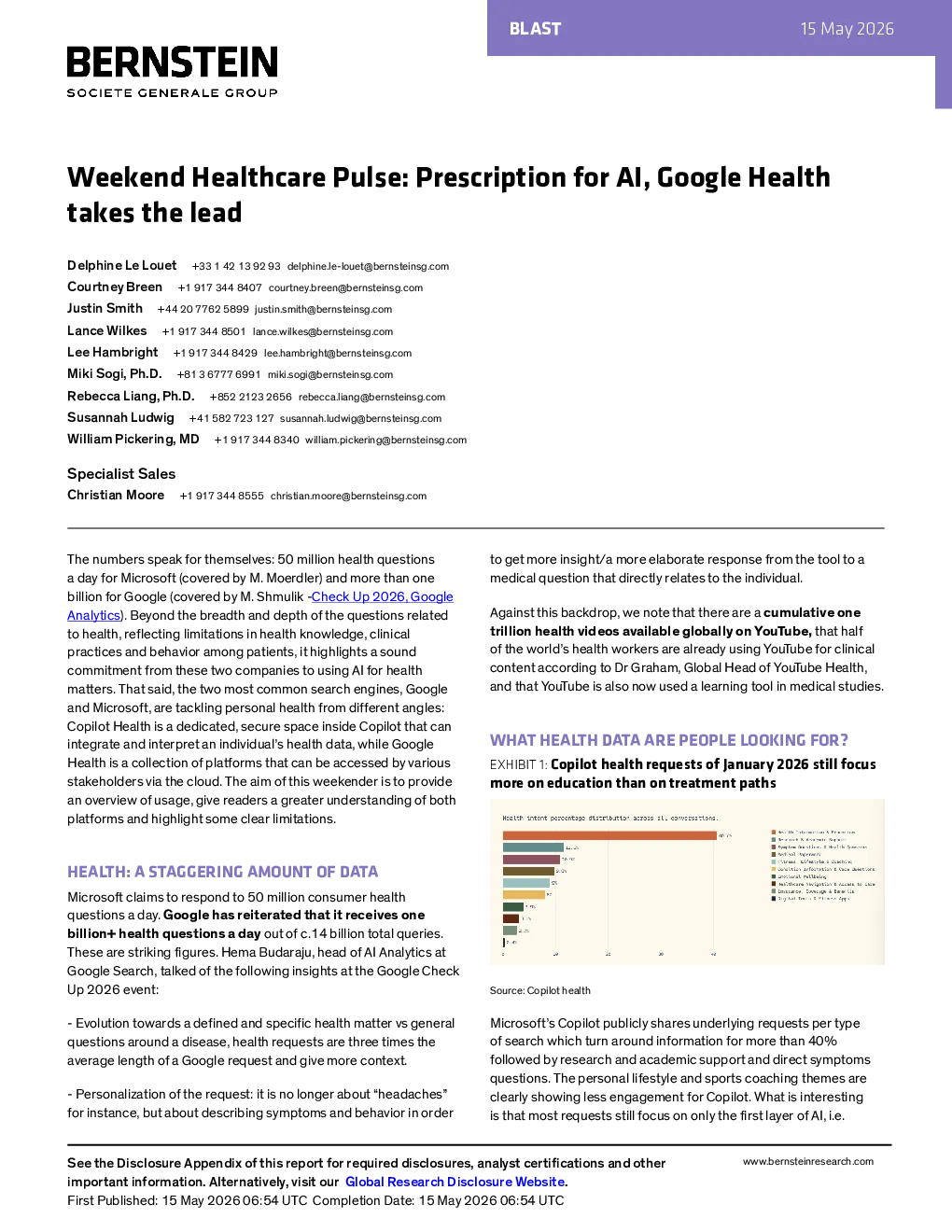
Delphine Le Louet+33 1 42 13 92 93delphine.le-louet@bernsteinsg.comCourtney Breen+1 917 344 8407courtney.breen@bernsteinsg.comJustin Smith+44 20 7762 5899justin.smith@bernsteinsg.comLance Wilkes+1 917 344 8501lance.wilkes@bernsteinsg.comLee Hambright+1 917 344 8429lee.hambright@bernsteinsg.comMiki Sogi, Ph.D.+81 3 6777 6991miki.sogi@bernsteinsg.comRebecca Liang, Ph.D.+852 2123 2656rebecca.liang@bernsteinsg.comSusannah Ludwig+41 582 723 127susannah.ludwig@bernsteinsg.comWilliam Pickering, MD+1 917 344 8340william.pickering@bernsteinsg.com Specialist Sales Christian Moore+1 917 344 8555christian.moore@bernsteinsg.com The numbers speak for themselves: 50 million health questionsa day for Microsoft (covered by M. Moerdler) and more than onebillion for Google (covered by M. Shmulik -Check Up 2026, GoogleAnalytics). Beyond the breadth and depth of the questions relatedto health, reflecting limitations in health knowledge, clinicalpractices and behavior among patients, it highlights a soundcommitment from these two companies to using AI for healthmatters. That said, the two most common search engines, Googleand Microsoft, are tackling personal health from different angles:Copilot Health is a dedicated, secure space inside Copilot that canintegrate and interpret an individual’s health data, while GoogleHealth is a collection of platforms that can be accessed by variousstakeholders via the cloud. The aim of this weekender is to providean overview of usage, give readers a greater understanding of bothplatforms and highlight some clear limitations. to get more insight/a more elaborate response from the tool to amedical question that directly relates to the individual. Against this backdrop, we note that there are acumulative onetrillion health videos available globally on YouTube,that halfof the world’s health workers are already using YouTube for clinicalcontent according to Dr Graham, Global Head of YouTube Health,and that YouTube is also now used a learning tool in medical studies. WHAT HEALTH DATA ARE PEOPLE LOOKING FOR? EXHIBIT 1:Copilot health requests of January 2026 still focusmore on education than on treatment paths HEALTH: A STAGGERING AMOUNT OF DATA Microsoft claims to respond to 50 million consumer healthquestions a day.Google has reiterated that it receives onebillion+ health questions a dayout of c.14 billion total queries.These are striking figures. Hema Budaraju, head of AI Analytics atGoogle Search, talked of the following insights at the Google CheckUp 2026 event: Microsoft’s Copilot publicly shares underlying requests per typeof search which turn around information for more than 40%followed by research and academic support and direct symptomsquestions. The personal lifestyle and sports coaching themes areclearly showing less engagement for Copilot. What is interestingis that most requests still focus on only the first layer of AI, i.e. - Evolution towards a defined and specific health matter vs generalquestions around a disease, health requests are three times theaverage length of a Google request and give more context. - Personalization of the request: it is no longer about “headaches”for instance, but about describing symptoms and behavior in order getting reliable and extensive data, as opposed to the next step ofdiscussing ways to alleviate symptoms. such as the one with Roche. All the data provides a baseline against which Google is nowdeploying a coordinated set of AI tools across search, wearables,clinical research, and genomic sequencing, to create a highlyadvanced multi-channel approach, as seen in the Exhibit 2, whichaims to accelerate B2B business while addressing B2C by everymeans available. WHAT THESE DATA MEAN FOR AI ENGINES ANDPLAYERS? We are witnessing a shift away from the compilation or linearapproach (tools/data), to a multi-modal approach that can solvequeries using multiple interfaces and inter-operabilities (wheredevices and AIs interact). In parallel, there is a need for more enriched data and more powerfulapps in the most common therapeutic areas, such as sleep apneaand metabolic syndrome/ diabetes, within FitBit’s Personal HealthCoach. New algorithms to be launched this year should increase theaccuracy of the sleep apnea data (nap detection, sleep interruptions,restlessness at night) by 15% and improve the prediction of insulinresistance by connecting continuous glucose monitoring (CGM) toGoogle's Health Connect for instance. The multi-modal approachalso incorporates access to medical records through Athenahealthand CMS as well as Health100 from CVS. And the more data there is, the higher the marketing fees the modelcan generate. So far, Google does not allow ads to appear alongsideits AI Health summary responses. While the regulation remainscomplex and country-specific, we can imagine a monetizationsystem based not on the number of queries but more on the degree ofsophistication, whereby the response sends more traffic to externalcommercial partners. It