在欧洲和中亚建立复原力和气候适应能力
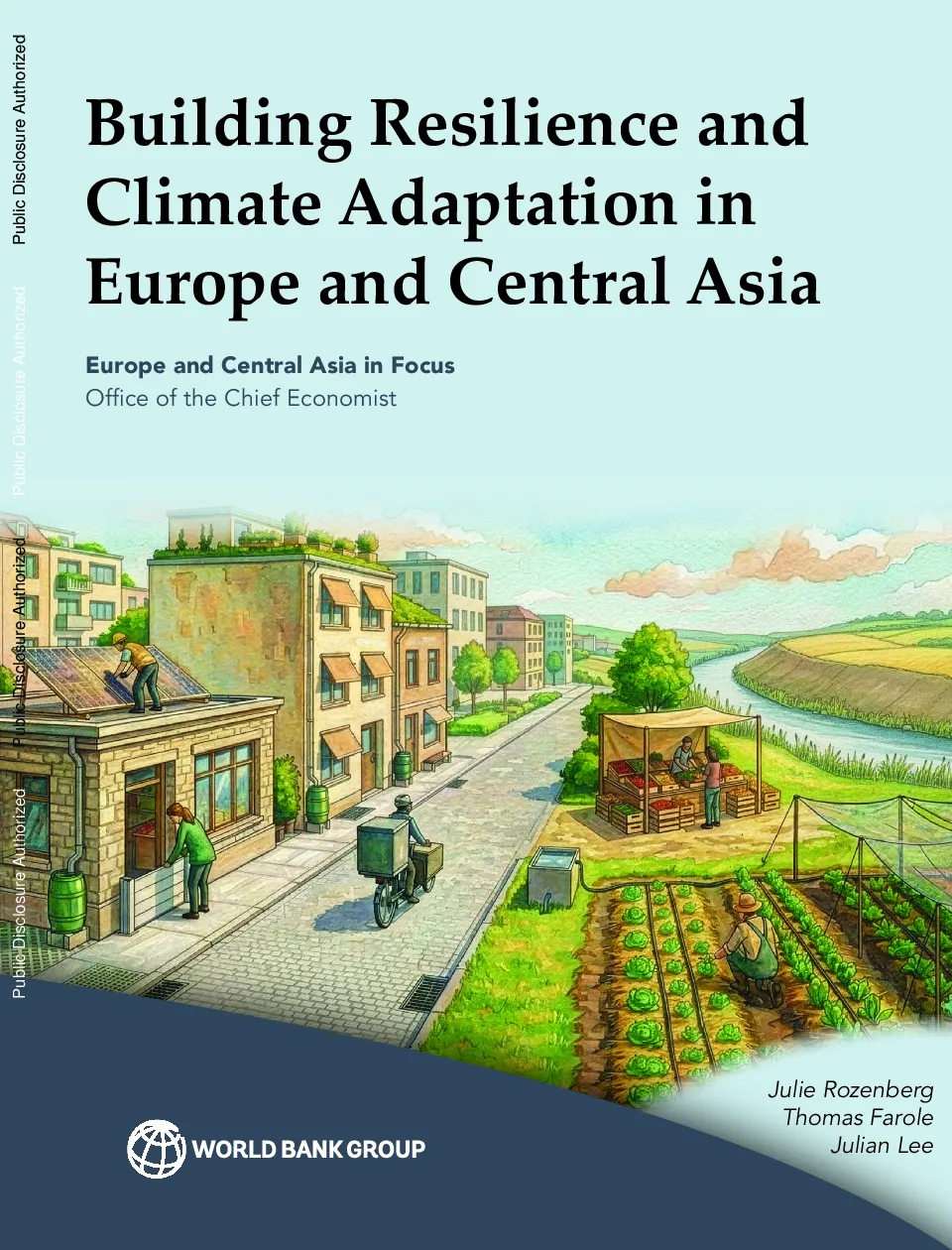
Europe and Central Asia in Focus Building Resilience andClimate Adaptation in Julie RozenbergThomas FaroleJulian Lee © 2026 International Bank for Reconstruction and Development / The World Bank1818 H Street NWWashington DC 20433 This work is a product of the staff of The World Bank with external contributions. The findings,interpretations, and conclusions expressed in this work do not necessarily reflect the views of The WorldBank, its Board of Executive Directors, or the governments they represent. The World Bank does not guarantee the accuracy, completeness, or currency of the data included in thiswork and does not assume responsibility for any errors, omissions, or discrepancies in the information,or liability with respect to the use of or failure to use the information, methods, processes, or conclusionsset forth. The boundaries, colors, denominations, links/footnotes and other information shown in this Nothing herein shall constitute or be construed or considered to be a limitation upon or waiver of theprivileges and immunities of The World Bank, all of which are specifically reserved. Rights and Permissions The material in this work is subject to copyright. Because The World Bank encourages dissemination ofits knowledge, this work may be reproduced, in whole or in part, for noncommercial purposes as long asfull attribution to this work is given. Any queries on rights and licenses, including subsidiary rights, should be addressed to World BankPublications, The World Bank Group, 1818 H Street NW, Washington, DC 20433, USA; fax: 202-522-2625;e-mail: pubrights@worldbank.org. Cover illustration: generated by Google Gemini, March 9, 2026, from the prompt “watercolor and inkillustration of a sunlit sustainable city district transitioning to regenerative farmland beside a river undera light blue sky with soft clouds. A cobblestone street with sidewalks runs diagonally past buildings—astone building where a worker installs solar panels and another with a vegetated green roof. Rainwaterbarrels and drainage grates support water conservation. A low-emission delivery scooter passes whilea woman adjusts the protective flood fence. Small street trees provide urban greening and carbon Contents Acknowledgmentsvi Introduction. . . . . . . . . . . . . . . . . . . . . . . . . . . . . . . . . . . . . . . . . . .1 Climate risks in ECA are rising. Economic impacts will bewidespread but poor places and people will bear the brunt.. . . . .2 While adaptation can avoid the worst climate impacts and enhancegrowth, it is lagging, especially in the poorest countries.. . . . . . . .11 Comprehensive strengthening of adaptation and resilienceinstruments can enable a more effective and sustainable response Conclusion: Advancing A&R Policy in ECA. . . . . . . . . . . . . . . . . . .30 References. . . . . . . . . . . . . . . . . . . . . . . . . . . . . . . . . . . . . . . . . . . .31 Boxes 1.World Bank A&R Framework: Overview and key results from ECA countries. . . . . . .172.People in ECA are aware of climate risks but have little information fromgovernments or faith in their support. . . . . . . . . . . . . . . . . . . . . . . . . . . . . . . . . . . . .22 Figures 1.Share of population exposed to climate hazards, 2021. . . . . . . . . . . . . . . . . . . . . . .22.Within-country range of population exposure to climate risk, 2021. . . . . . . . . . . . . .43.Climate-induced productivity change by 2030 for maize crops in Ukraine. . . . . . . .54.Climate impact on crop production by 2050 under alternative composite climatescenarios in Armenia and Poland. . . . . . . . . . . . . . . . . . . . . . . . . . . . . . . . . . . . . . . .65.Expected annual damages from hazards to roads and railways as a share of GDP. .76.Trade exposure to climate risk relative to country climate vulnerability. . . . . . . . . . .87.Difference in projected GDP in 2050 between a baseline scenario and anRCP 4.5 scenario. . . . . . . . . . . . . . . . . . . . . . . . . . . . . . . . . . . . . . . . . . . . . . . . . . . . .98.Hotspots for climate-induced migration in Tajikistan (2030 projection). . . . . . . . . . .119.Relative growth in built-up area exposed to flood risk (1985–2020). . . . . . . . . . . . .1410.Water use efficiency in ECA. . . . . . . . . . . . . . . . . . . . . . . . . . . . . . . . . . . . . . . . . . . .1511.Country ratings on ND-GAIN Readiness components. . . . . . . . . . . . . . . . . . . . . . . .1612.Comparison of ECA country-level scores across the A&R Assessment Pillars. . . . . .1813.Relationship between GDP per capita and the share of exposed populationsthat are resilient. . . . . . . . . . . . . . . . . . . . . . . . . . . . . . . . . . . . . . . . . . . . . . . . . . . . .19 Abbreviations A&RAdaptation and ResilienceASPAdaptive Social ProtectionCCDRCountry Climate and Development ReportCPIClimate Policy InitiativeECAEurope and Central AsiaEUEuropean UnionGDPGross Domestic ProductND-GAINNotre Dame Global Adapt