您的浏览器禁用了JavaScript(一种计算机语言,用以实现您与网页的交互),请解除该禁用,或者联系我们。 [世界银行]:土地管理现代化:数字化转型的覆盖优先议程 - 发现报告

土地管理现代化:数字化转型的覆盖优先议程

房地产 2026-05-08 世界银行 棋落
报告封面

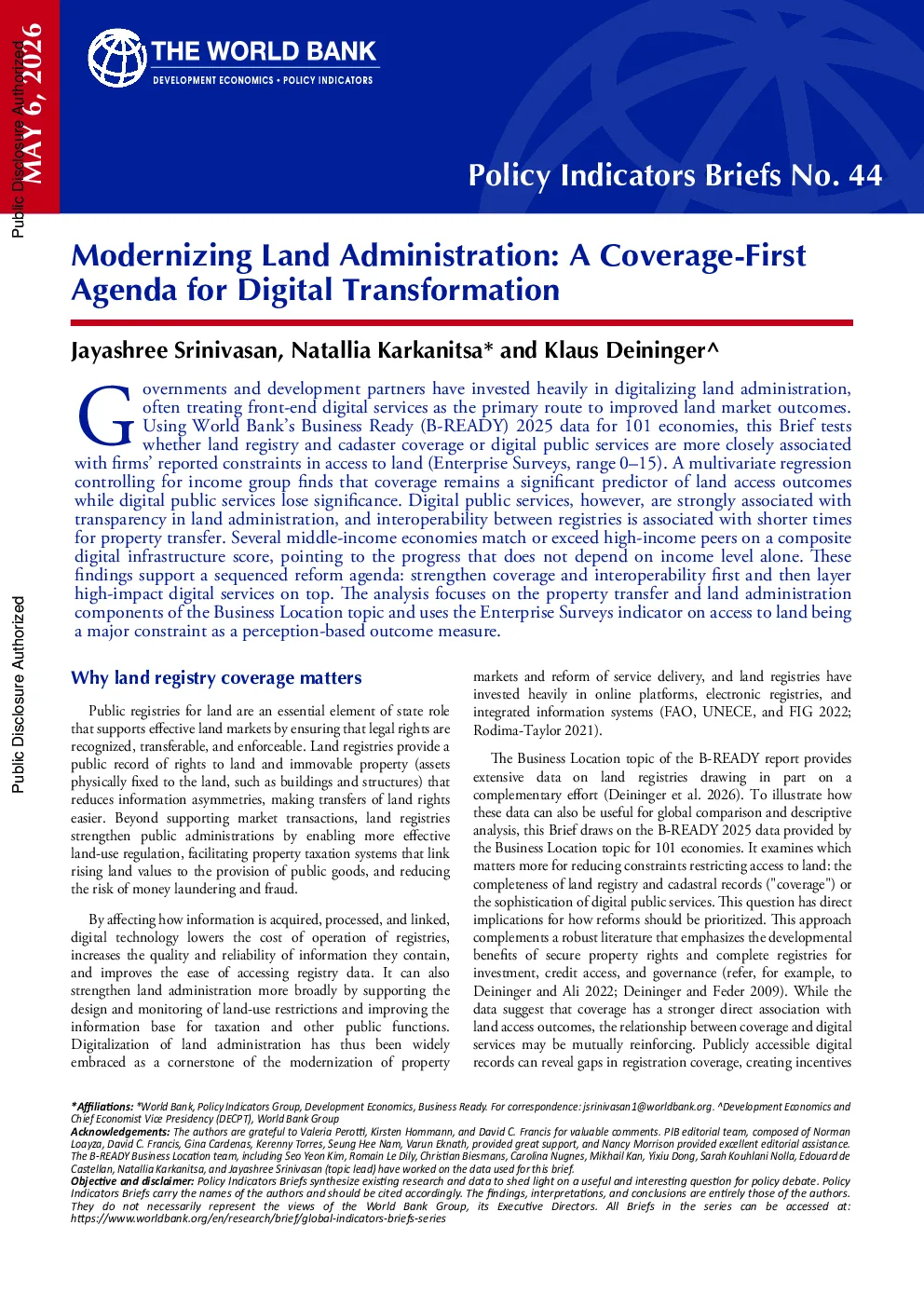
Jayashree Srinivasan, Natallia Karkanitsa* and Klaus Deininger^G with firms’ reported constraints in access to land (Enterprise Surveys, range 0–15). A multivariate regressioncontrolling for income group finds that coverage remains a significant predictor of land access outcomeswhile digital public services lose significance. Digital public services, however, are strongly associated withtransparency in land administration, and interoperability between registries is associated with shorter timesfor property transfer. Several middle-income economies match or exceed high-income peers on a compositedigital infrastructure score, pointing to the progress that does not depend on income level alone. Thesefindings support a sequenced reform agenda: strengthen coverage and interoperability first and then layerhigh-impact digital services on top. The analysis focuses on the property transfer and land administrationcomponents of the Business Location topic and uses the Enterprise Surveys indicator on access to land beinga major constraint as a perception-based outcome measure.Public Disclosure Authorized Why land registry coverage matters markets and reform of service delivery, and land registries haveinvested heavily in online platforms, electronic registries, andintegrated information systems (FAO, UNECE, and FIG 2022;Rodima-Taylor 2021). Public registries for land are an essential element of state rolethat supports effective land markets by ensuring that legal rights arerecognized, transferable, and enforceable. Land registries provide apublic record of rights to land and immovable property (assetsphysically fixed to the land, such as buildings and structures) thatreduces information asymmetries, making transfers of land rightseasier. Beyond supporting market transactions, land registriesstrengthenpublic administrations by enabling more effectivePublic Disclosure Authorized The Business Location topic of the B-READY report providesextensivedata on land registries drawing in part on acomplementary effort (Deininger et al. 2026). To illustrate howthese data can also be useful for global comparison and descriptiveanalysis, this Brief draws on the B-READY 2025 data provided bythe Business Location topic for 101 economies. It examines whichmatters more for reducing constraints restricting access to land: thecompleteness of land registry and cadastral records ("coverage") orthe sophistication of digital public services. This question has directimplications for how reforms should be prioritized. This approachcomplements a robust literature that emphasizes the developmentalbenefits of secure property rights and complete registries forinvestment, credit access, and governance (refer, for example, toDeininger and Ali 2022; Deininger and Feder 2009). While the By affecting how information is acquired, processed, and linked,digitaltechnology lowers the cost of operation of registries,increases the quality and reliability of information they contain,and improves the ease of accessing registry data. It can alsostrengthen land administration more broadly by supporting thedesign and monitoring of land-use restrictions and improving the for governments to expand registry completeness. The sequencingproposedhere should therefore be understood as a priorityemphasis rather than a strictly linear pathway. of digital public services (Subcategory 2.1.1) (r ≈ 0.382, p < 0.001).Coverage explains approximately 23 percent of the cross-countryvariation in land access constraints—nearly twice as much as digitalpublic services (14.6 percent), and considerably more than digitallandmanagement(Subcategory 2.1.2)(11.2 percent)or Data and measurement This analysis draws on three main variables from the B-READY2025 report. The outcome variable, major constraints on access toland, is a perception-based index derived from the World Bank’sEnterprise Surveys that captures the degree to which firms viewland access as a constraint on business operations (range 0–15,where higher values indicate fewer reported constraints). The firstkey explanatory variable is coverage of the land registry and cadaster(Subcategory 2.1.3), which measures the extent to which the landregistry and cadaster provide complete records of all registeredprivate land across the economy. This measure captures privatelyheld land plots specifically; it does not separately assess coverage ofpublic land, which involves different institutional arrangements.The second is digital public services (Subcategory 2.1.1), whichcaptureswhether secure online procedures are available forproperty-related transactions such as due diligence checks, propertytransfer, and complaints. Both are composite subcategories derived Figure 1 places each economy on a scatter plot according to itsscores on coverage and digital public services. The median score forcoverage (3.0) and for digital services (3.09) serve as dividing lines,creating four descriptive groups of economies. The comparisonbetween the two