苹果公司:因市场份额提升和平均售价上涨上调估值(但预计毛利率略降)- 维持跑赢大盘,目标价上调至350美元
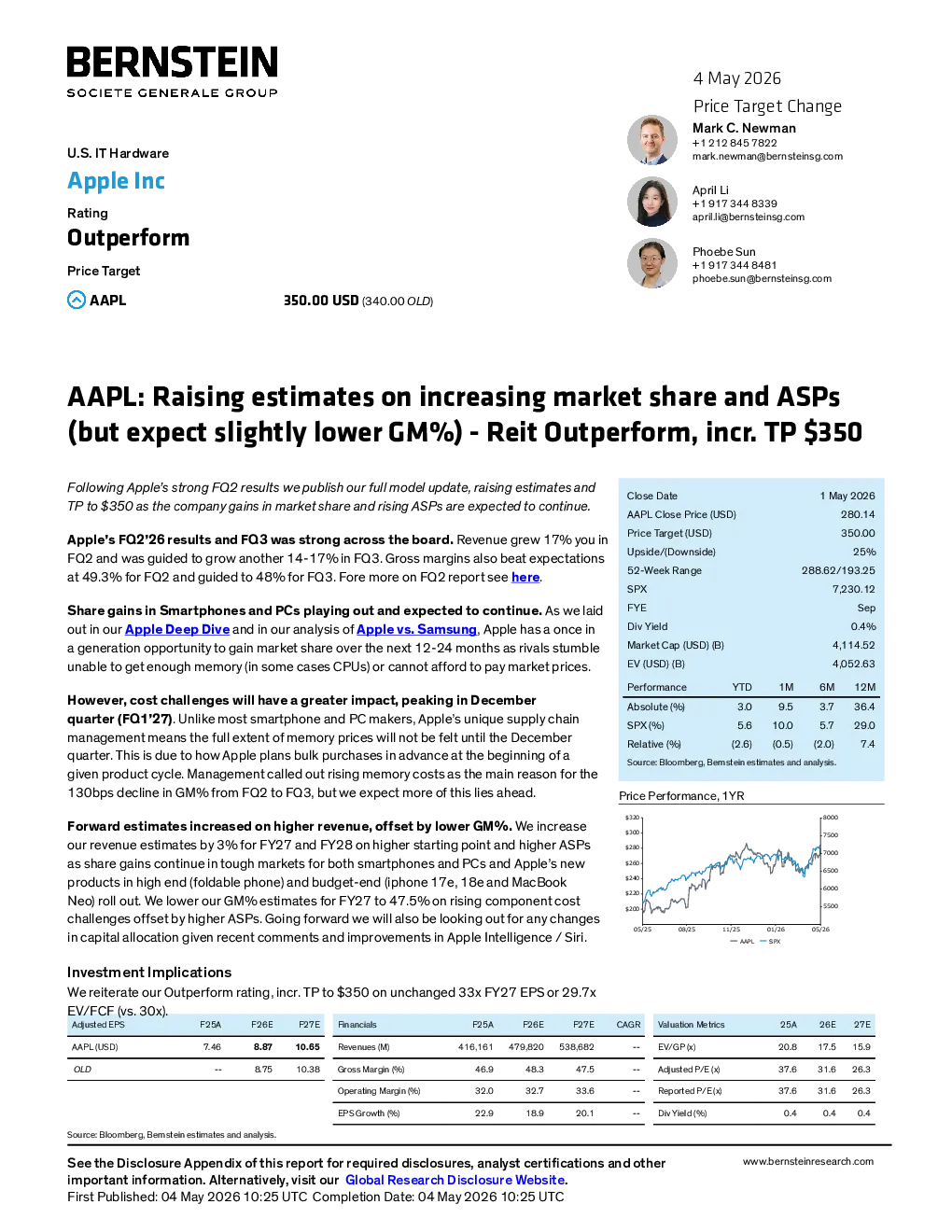
Mark C. Newman+1 212 845 7822mark.newman@bernsteinsg.com April Li+1 917 344 8339april.li@bernsteinsg.com Phoebe Sun+1 917 344 8481phoebe.sun@bernsteinsg.com Price Target AAPL: Raising estimates on increasing market share and ASPs(but expect slightly lower GM%) - Reit Outperform, incr. TP $350 Following Apple’s strong FQ2 results we publish our full model update, raising estimates andTP to $350 as the company gains in market share and rising ASPs are expected to continue. Close Date1 May 2026AAPL Close Price (USD)280.14Price Target (USD)350.00Upside/(Downside)25%52-Week Range288.62/193.25SPX7,230.12FYESepDiv Yield0.4%Market Cap (USD) (B)4,114.52EV (USD) (B)4,052.63 Apple’s FQ2’26 results and FQ3 was strong across the board.Revenue grew 17% you inFQ2 and was guided to grow another 14-17% in FQ3. Gross margins also beat expectationsat 49.3% for FQ2 and guided to 48% for FQ3. Fore more on FQ2 report seehere. Share gains in Smartphones and PCs playing out and expected to continue.As we laidout in ourApple Deep Diveand in our analysis ofApple vs. Samsung, Apple has a once ina generation opportunity to gain market share over the next 12-24 months as rivals stumbleunable to get enough memory (in some cases CPUs) or cannot afford to pay market prices. However, cost challenges will have a greater impact, peaking in Decemberquarter (FQ1’27). Unlike most smartphone and PC makers, Apple’s unique supply chainmanagement means the full extent of memory prices will not be felt until the Decemberquarter. This is due to how Apple plans bulk purchases in advance at the beginning of agiven product cycle. Management called out rising memory costs as the main reason for the130bps decline in GM% from FQ2 to FQ3, but we expect more of this lies ahead. Forward estimates increased on higher revenue, offset by lower GM%.We increaseour revenue estimates by 3% for FY27 and FY28 on higher starting point and higher ASPsas share gains continue in tough markets for both smartphones and PCs and Apple’s newproducts in high end (foldable phone) and budget-end (iphone 17e, 18e and MacBookNeo) roll out. We lower our GM% estimates for FY27 to 47.5% on rising component costchallenges offset by higher ASPs. Going forward we will also be looking out for any changesin capital allocation given recent comments and improvements in Apple Intelligence / Siri. Investment Implications We reiterate our Outperform rating, incr. TP to $350 on unchanged 33x FY27 EPS or 29.7xEV/FCF (vs. 30x). DETAILS Following Apple’s strong FQ2 results we publish our full model update, raising estimates and TP to $350 as the company gains inmarket share and rising ASPs are expected to continue. Apple’s FQ2’26 results and FQ3 was strong across the board.Revenue grew 17% you in FQ2 and was guided to growanother 14-17% in FQ3. Gross margins also beat expectations at 49.3% for FQ2 and guided to 48% for FQ3. Fore more onFQ2’26 report see reporthereand also more in bullets below: •Apple’s FQ2 results exceeded expectations.Revenue of $111.2B grew 17% YoY, above the high end of guidance, withFX providing a ~2.5pt tailwind. Segment breakdown: iPhone $57B (+22%), Services $31B (+16%), Mac $8.4B (+6%), iPad$6.9B (+8%), Wearables $7.9B (+5%). EPS came in at $2.01 (+22%); operating cash flow was $28.7B. Gross margin alsoexpanded 110bps sequentially on favorable mix and lower tariff costs vs. December, partially offset by seasonal deleverageand rising memory costs. Management was explicit that tariff costs were still absorbed in the quarter - just at a lower ratethan Q2. •Apple guided for strength to continue into FQ3’26.June-quarter revenue is guided to grow +14% to +17% YoY - asharp acceleration from the low-to-mid single digit pace of prior quarters - while gross margin of 47.5% to 48.5% implies80-180bps of sequential compression off the 49.3% Q2 print, reflecting memory cost flow-through partially offset bysavings elsewhere. Services growth is expected to track roughly in line with March's underlying rate ex-FX. The guideassumes current global tariff rates hold, and the macro outlook does not deteriorate. •Apple formally retired its net-cash-neutral target,with CFO Kevan framing the shift as a capital structure refinement- evaluating cash and debt independently to enable "more optimal economic decisions" - rather than a pullback on returns.The $100B+ buybackauthorization reaffirms the commitment to returning excess capital, but dropping the cash-neutralanchor removes the mechanical forcing function that has governed return pace since 2018, giving management greaterflexibility heading into the Cook-to-Ternus transition andpreserving dry powder for AI, silicon, or M&A opportunities. •Apple confirmed significant Siri and Apple Intelligence updates coming this year,though management offered littledetail - we view this as the next major catalyst for the stock. R&D stepped up meaningfully to $11.4B in FQ2, or 10.3%of revenue, vs. 7.6% in FQ1, reflecting Apple's increased inv