您的浏览器禁用了JavaScript(一种计算机语言,用以实现您与网页的交互),请解除该禁用,或者联系我们。 [美国银行]:高尔夫支出略高于平均水平 - 发现报告

高尔夫支出略高于平均水平

报告封面

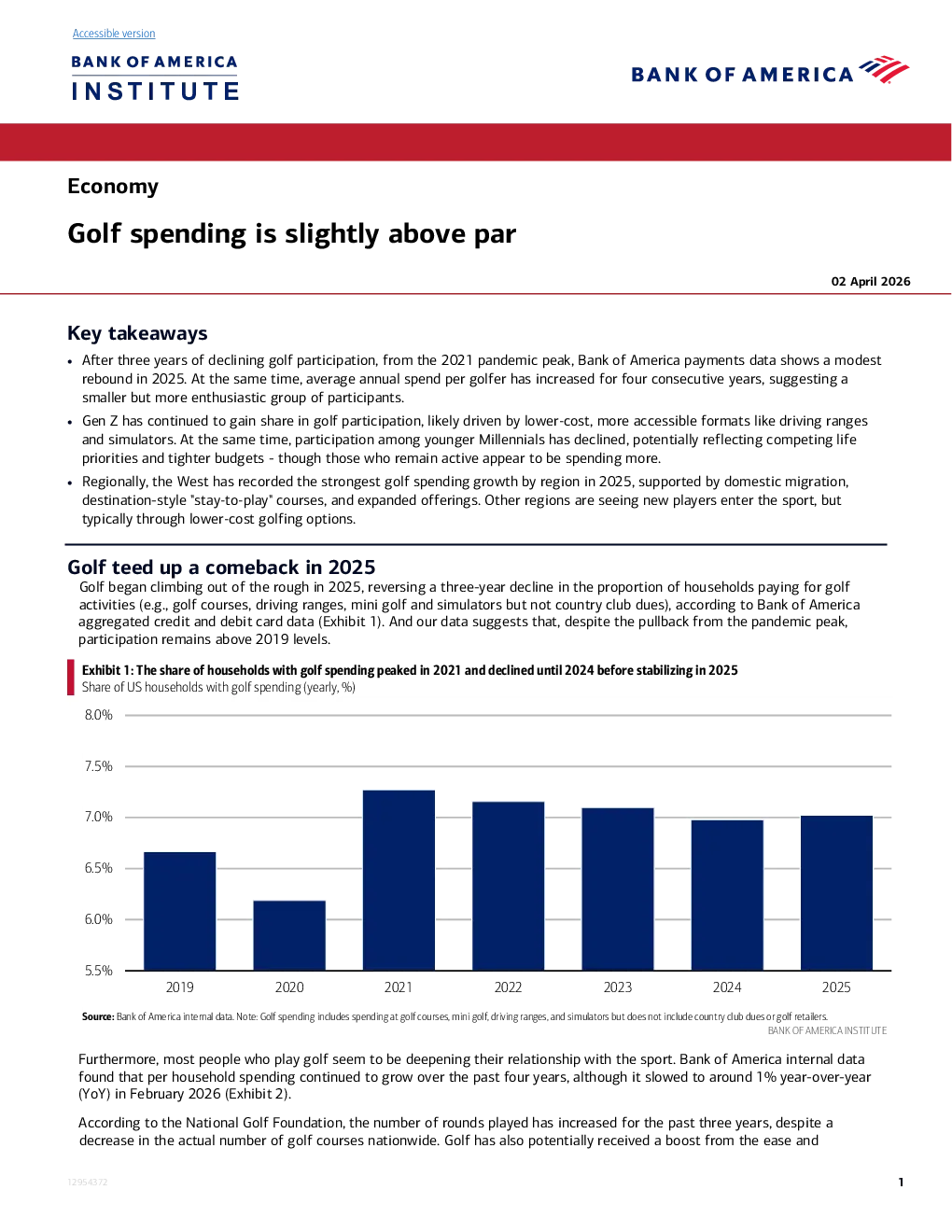
Golf spending is slightly above par Key takeaways After three years of declining golf participation, from the 2021 pandemic peak, Bank of America payments data shows a modestrebound in 2025. At the same time, average annual spend per golfer has increased for four consecutive years, suggesting a •Gen Z has continued to gain share in golf participation, likely driven by lower‑cost, more accessible formats like driving rangesand simulators. At the same time, participation among younger Millennials has declined, potentially reflecting competing lifepriorities and tighter budgets - though those who remain active appear to be spending more. Regionally, the West has recorded the strongest golf spending growth by region in 2025, supported by domestic migration,destination-style "stay‑to‑play" courses, and expanded offerings. Other regions are seeing new players enter the sport, but Golf teed up a comeback in 2025Golf began climbing out of the rough in 2025, reversing a three-year decline in the proportion of households paying for golf activities (e.g., golf courses, driving ranges, mini golf and simulators but not country club dues), according to Bank of Americaaggregated credit and debit card data (Exhibit 1). And our data suggests that, despite the pullback from the pandemic peak, Furthermore, most people who play golf seem to be deepening their relationship with the sport. Bank of America internal datafound that per household spending continued to grow over the past four years, although it slowed to around 1% year-over-year(YoY) in February 2026 (Exhibit 2). According to the National Golf Foundation, the number of rounds played has increased for the past three years, despite adecrease in the actual number of golf courses nationwide. Golf has also potentially received a boost from the ease and accessibility of driving ranges and indoor simulators. So overall, while the share of US households that play golf has held fairlysteady over the past two years, the households that do play seem to be playing a bit more often. Exhibit2:Of the householdsthatspend on golf, outlays haveincreasedthrough February 2026, although at a slightly slower rateGolf spending per household (3-month moving average, YoY%) Passing the club: Millennials ease, as Gen Z drives adoptionLooking at golf spending by age, there’s been a substantial drop in the share of younger Millennials participating in the sport, along with a smaller decrease among older Millennials since 2019 (Exhibit 3). Some in this generation may be pulling back asthey take on more life responsibilities, such as starting families or building their careers. Other may be pulling back on Conversely, there’s been a significant increase in the share of Gen Z households spending on golf. In our view, this could reflectthe somewhat recent popularity of driving ranges and indoor simulators, as well as their desire to participate in more healthyexperiences (read more inYounger generations move from barstools to barbells). It could also be that Gen Z came of age during Furthermore, looking just at households that spent on golf in 2025, golf spending growth was faster among Gen Z but stillslower than Gen X (Exhibit 4), likely reflecting the latter’s stronger overall financial position, allowing more spend and more time Golf heads WestLooking across the US, the West is clearly above par for golf. Spending increased around 7% and 9% YoY per customer in the Mountain (Arizona, Colorado, Utah–see Methodology for full list of states) and Pacific (California, Washington, etc.) divisions, In our view, more spending in the West may reflect some of the increases in domestic migration to the Western portion of theSunbelt (read more inOn the move: US migration patterns). Another part of the story may be the rise in“stay-to-play”policies, where golfers stay at the course and pay course fees. Also, some golf resorts in the region have added new courses that mightincentivize some golfers to expand their length of stay and spend more money. Other divisions including the West North Central (e.g., Minnesota, Nebraska, Missouri, etc.) and the West South Central (Texas,Louisiana, etc.) have experienced an increase in the number of residents playing golf, although new players are gravitating MethodologySelected Bank of America transaction data is used to inform the macroeconomic views expressed in this report and should be considered in the context of other economic indicators and publicly available information. In certain instances, the data mayprovide directional and/or predictive value. The data used is not comprehensive; it is based onaggregated and anonymized Any payments data represents aggregated spend from US Retail, Preferred, Small Business and Wealth Management clients witha deposit account or credit card. Aggregated spend include total credit card, debit card, ACH, wires, bill pay, business/peer-to- AnySmall Businesspayments data represents aggregate spend from Small Busin