雅高集团:需求未出现崩溃
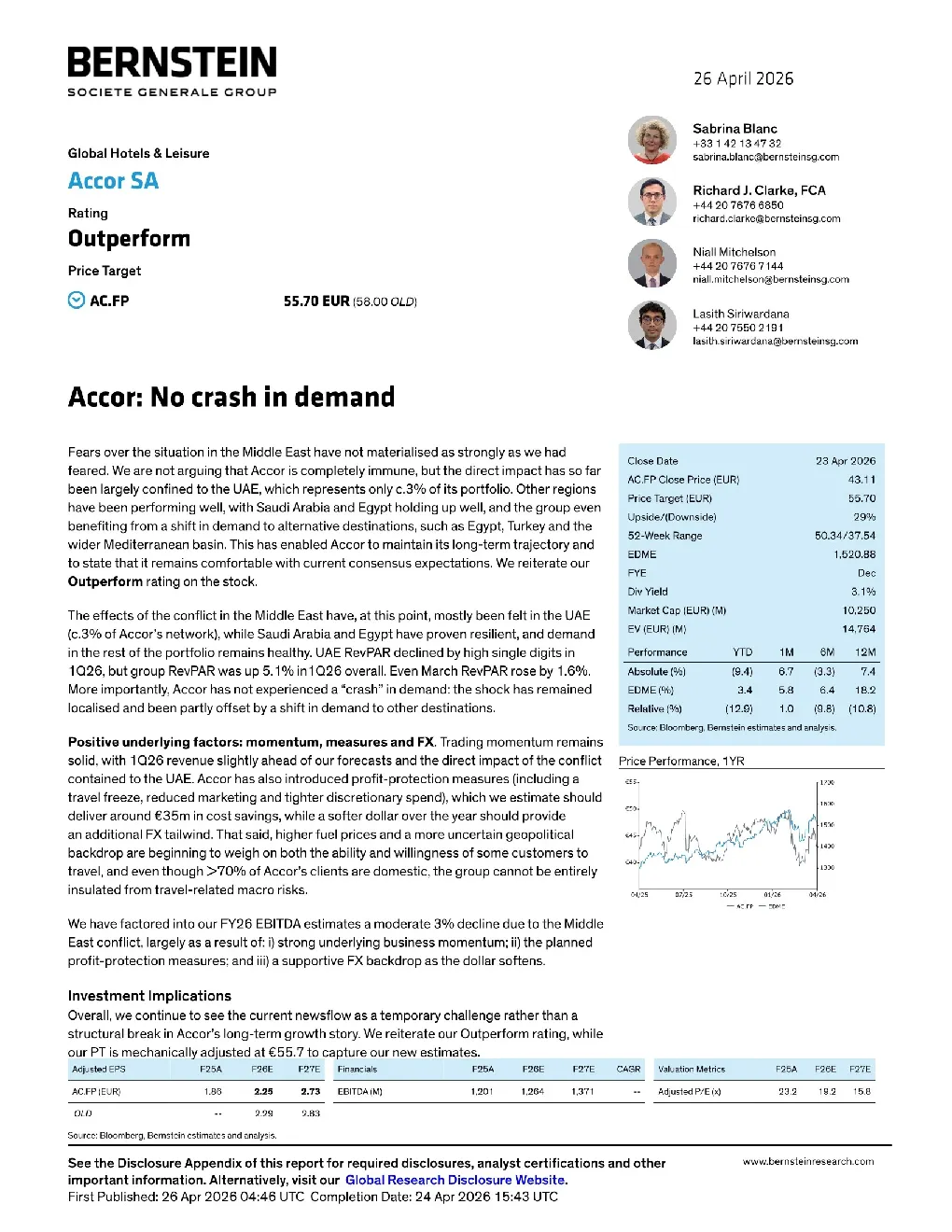
+33 1 42 13 47 32sabrina.blanc@bernsteinsg.comRichard J. Clarke, FCA Rating +44 20 76766850richard.clarke@bernsteinsg.comNiall Mitchelson +44 20 7676 7144niall.mitchelson@bernsteinsg.com OAC.FP +44 20 7550 2191lasith.siriwardana@bernsteinsg.com Accor: No crash in demand feared. Wearenot arguing that Accoris completely immune,butthe direct impact has so farbeen largely confined to the UAE, which represents only c.3% of its portfolio. Other regionsbenefiting from a shift in demand to alternative destinations, such as Egypt, Turkey andthewider Mediterranean basin.This has enabled Accortomaintain its long-term trajectoryandtostate that it remains comfortable withcurrentconsensus expectations.We reiterate ourOutperformrating on the stock. in the rest of the portfolio remains healthy. UAE RevPAR declined by high single digits in1Q26, but group RevPAR wasup5.1% in1Q26overall.Even MarchRevPARrose by1.6%.More importantly,Accorhas not experienceda"crash"in demand:the shockhas remainedlocalised and been partlyoffsetbya shift in demand to other destinations. Positiveunderlyingfactors:momentum,measures andFX.Tradingmomentum remainssolid, with 1Q26 revenue slightly ahead of our forecasts and the direct impact of the conflictcontainedto the UAE.Accorhas also introduced profit-protection measures (including atravel freeze, reduced marketing and tighter discretionary spend), which we estimate shoulddeliver around 35m in cost savings, while a softer dollar over the year should providean additional FX tailwind. That said,higher fuel prices and a more uncertain geopoliticalbackdroparebeginningtoweighon both theabilityand willingness ofsome customers totravel,and even though >70% of Accor's clients are domestic,the group cannot be entirelyinsulated from travel-related macro risks. We have factored into our FY26 EBITDA estimates a moderate 3%decline due to the MiddleEast conflict, largely as a result of: i)strong underlying business momentum; i) the plannedprofit-protection measures; and ii) a supportive FX backdrop as the dollar softens. InvestmentImplications Overall, we continue to see the current newsflow as a temporary challenge rather than astructural break in Accor's long-term growth story.Wereiterate our Outperform rating,whileourPTismechanicallyadjustedat55.7tocapture our newestimates.AdjustedEPSF25AF26EF27EFinancialsF25AF27E Among the market's key topics today, the Middle East remains at the top of the list, well ahead of the ongoing disposal of Essendi andthemeasurestakenfollowingtheGrizzlyreport.Accorsurprisedthemarket with the robustness of its modeldespiteMiddle East concerns regarding thefollowing points. ·Thedirectimpactondemand/RevPARintheregion.Asmentionedby Accor on itspost-results conference call,the direct impact of the conflict was mostly containedto the UAE(3% of the portfolio).Other geographical markets are performingwell, with Saudi Arabia and Egypt holding up well, and the group even benefiting from a shift in demand towards alternativedestinations,suchas Egypt, Turkey and the wider Mediterranean basin.1Q26 RevPAR growth came to 5.1%, driven by allgeographies, and in March, at the beginning of the conflict RevPAR slowed to 1.6%. our view,the situation could moderately deteriorate, with higherfuel prices and the conflict more broadly weighing on people'sability and willingness to travel. On this point, Accor is partly protected through its large percentage of domestic clients, whichaccount forover 80%of its client base in Europeand over70% in Southeast Asia.Exhibit 5 we assume that the Middle East contributed 0.7% of Accor's 3.7% NUG in 2025(<20%). We note that Accor's pipeline is veryhealthy, at 10.2% growth in 2026, the bulk of which from MEA APAC. In particular, more than 50% of the pipeline located in theAPAC region. · The indirect impact on international hotel construction (i.e.will higher energy and fuel prices weigh further on new hotelwhich should help it provemore resilient.Conversions have even skyrocketed to represent 67% of openings in the 1Q26. EXHIBIT1:Within our coverage,Accor is the most exposed to the Middle East, followed byIHG, whileall US hotelsgroups have more minimal esposure (2-3%). Egypt have likelybenefited from displaced/diverted demand OURNEWMIDDLEEASTSCENARIOPOINTSTOADECREASEINEBITDAOF3% Following nineweeks of conflictand thegroup's healthy guidance, we are lowering our EBITDA estimatesby3%. Our 2026 estimates nowfactorin amore cautious scenario,partly offsetby strongunderlyingbusinessmomentum;i)theplannedprofit-protectionmeasures;ili)asupportive Fxbackdropasthedollarsoftens.Overall,wedo notbelievetheMiddleEast conflict calls the group's long-term growth strategy into question but rather that it represents a temporary rebasing. EXHIBIT 14: Financial forecasts O - Outperform, M - Market-Perform, U - Underperform, NR - Not Rated, CS - Coverage Suspended Source:Bloomberg, Bernstein estimates and analysis. References to"Bernstein"orthe"Firm"inthesediscl