开局强劲,但前路仍有不确定性
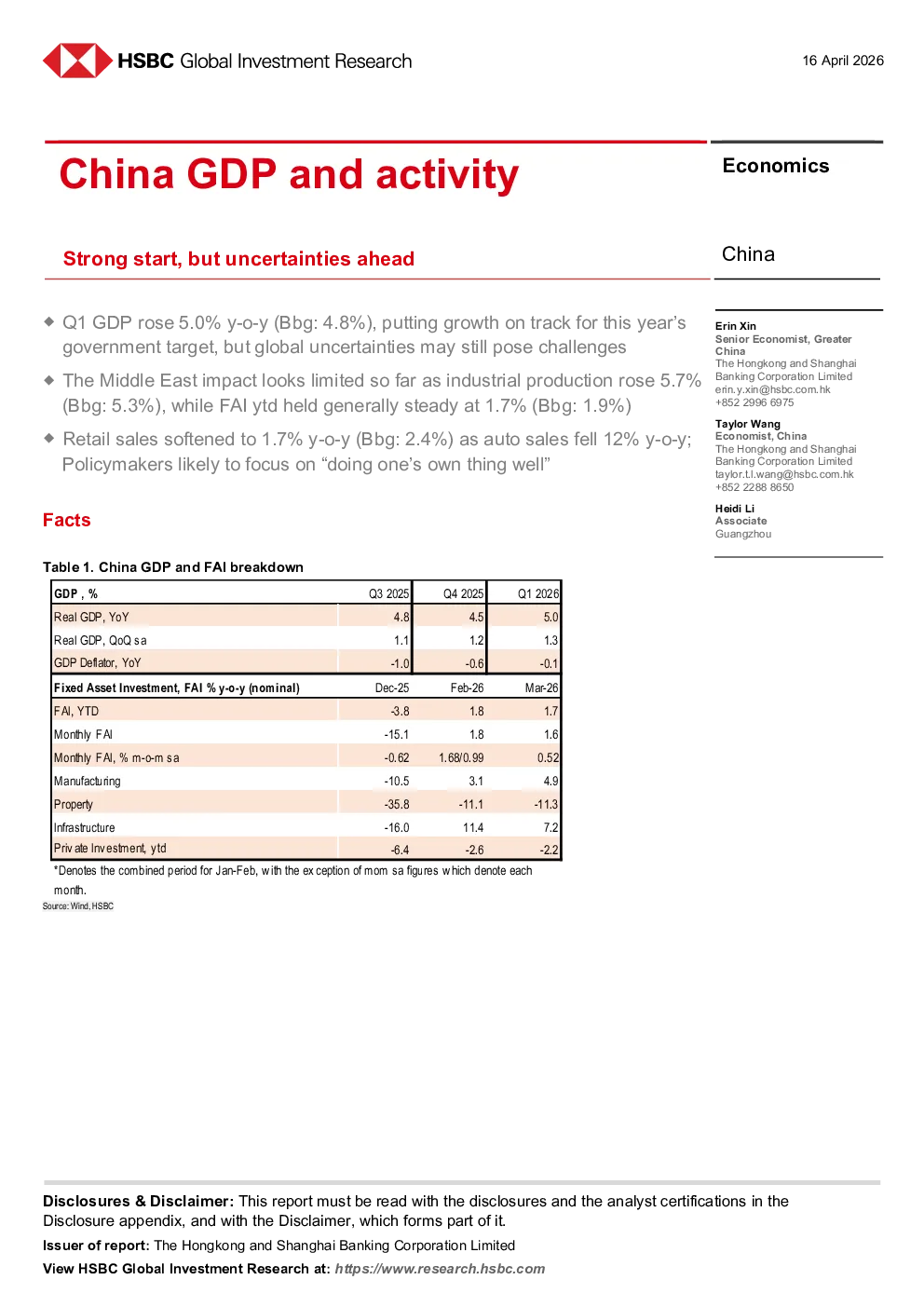
Economics China Strong start, but uncertainties ahead ◆Q1 GDP rose 5.0% y-o-y (Bbg: 4.8%), putting growth on track for this year’sgovernmenttarget, but global uncertainties may still pose challenges Erin XinSenior Economist, GreaterChinaThe Hongkong and ShanghaiBanking Corporation Limitederin.y.xin@hsbc.com.hk+852 2996 6975 ◆The Middle East impact looks limitedso farasindustrial productionrose5.7%(Bbg: 5.3%), while FAI ytd held generally steady at 1.7% (Bbg: 1.9%) Taylor WangEconomist, ChinaThe Hongkong and ShanghaiBanking Corporation Limitedtaylor.t.l.wang@hsbc.com.hk+852 2288 8650 ◆Retail sales softenedto 1.7% y-o-y(Bbg: 2.4%)as auto sales fell 12% y-o-y;Policymakers likely to focus on “doing one’s own thing well” Heidi LiAssociateGuangzhou Facts Implications China’s growth exceeded expectations in Q1, largely helped by outperforming exports in Jan-Feb,relativelylimitedimpact of theMiddle East conflict for nowand accelerated fiscal policy. GDP rose by 5% y-o-y (HSBC: 4.5%, Bbg: 4.8%). Arecentrecovery in PPIprices helped bythe anti-involution campaign and higher global energy prices(seeChina inflation,10 April)helped to narrow thedrag in the GDP deflator to 0.1% y-o-y.While recent news suggests some progress in ceasefire talks (Bloomberg, 16 April), thecontinued effective closure of the Strait of Hormuz continues to pose potential headwinds for growth. Nonetheless, we expectBeijingto keep its focus on “doing one’s own thing well” with continued policy support, primarily via fiscal policy and new spendingtools, tohelp cushion the impact. IP rose5.7% y-o-y in March,still a healthy reading, though softer than Jan-Feb owing tosofterexports in March, CNY effectsas wellas the start of the Middle East conflict.Sector data indicatesresilience in electronics and transport goods, which supported thebetter-than-expected headline growth(chart1).This continued to underscore China’s strong price and quality competitiveness acrossrelated sectors, alongsidethepolicy drive for innovation. Meanwhile, manufacturing investment growth accelerated to 4.9%y-o-y, likely supported by continued fiscal measures promotingequipment upgrades and high-tech industries.FAI in rail, ships,aerospace& other transport equipment and general equipment rosestrongly by 28% and 13% y-o-y in Q1, respectively. Going forward, the Middle East conflictposesuncertainties forIPand manufacturing investmentgrowth.On the one hand,despitethe global uncertainties,there may be potential silver linings.Due to China's diversified energy structure (c50% from coal,c20% fromoil,c10% from gas, and the rest from renewable energy), it could continue business as usual despite the fossil fuel energy crunch in relation to the Middle East conflict,allowingforsome reversal of the“China+1”theme back to a“Made in China” theme. Even forpetrochemical products, such as Urea, China has alternative supply from coal chemicals. Such resilience may attract somemanufacturers to consolidate production in China rather than relying on cross border supply chains. Meanwhile, upstream sectors may see stronger IP growth as higher profit margins provide support(chart2),butmid-and down-stream sectorscould face higherinput costs. That said, for the latter, we thinktheimpact will vary by sectordepending on iffirms canpass costs on to end customers, orifexport demand remains resilient,including as ordersmayshift back to China given its robustsupply chains(seeChina trade, 14 April). Domestically,theenergy shock may help to promotemore demand for renewablesand improve their capacity utilisation rate, and inturnreduce the need foraggressivemovestoimplementtheanti-involutioncampaign(such as through bankruptcies and layoffs).That said, the anti-involutioncampaignisusing other measures such asquality checks, standard setting and price regulations to helpachieve better balance(seeChina Macro Tracker, 15 April). FAI was generally steady, rising 1.6% y-o-y in March. Infrastructure investmentcontinued to be a bright spot, rising 7.4%, albeit asofter pace than Jan-Feb. The ongoing rollout of fiscal support as well as use of new financing policy tools combined with the launchof new projects on the back of the start of the 15thFYP are likely to keep the momentum strong.Local government special bondissuance has been front-loaded, with cRMB1trn used for project construction in Q1 (up RMB145bn compared with Q1 2025)(seeChina macro tracker, 15 April). Propertycontinued to drag on growth, as overall property investment still fell by 11% y-o-y. Nonetheless, some indicators improved atouch: New primary home sales by volume fell 10% y-o-y compared with a 16% decline in Jan-Feb,helped by demandin tier-1 cities.However, a more sustainable recovery in the property sector will likely still need largerpolicy moves (seeThe great rebalancing, 8January). Meanwhile, retail sales slowed to 1.7% y-o-y in March, mainly weighed down by a high base and a pullback in the scale of trade-insubsidies. By category,