您的浏览器禁用了JavaScript(一种计算机语言,用以实现您与网页的交互),请解除该禁用,或者联系我们。 [麦肯锡]:如何用AI更快更好地建立企业 - 发现报告

如何用AI更快更好地建立企业

建筑建材 2026-03-31 麦肯锡 高杨
报告封面

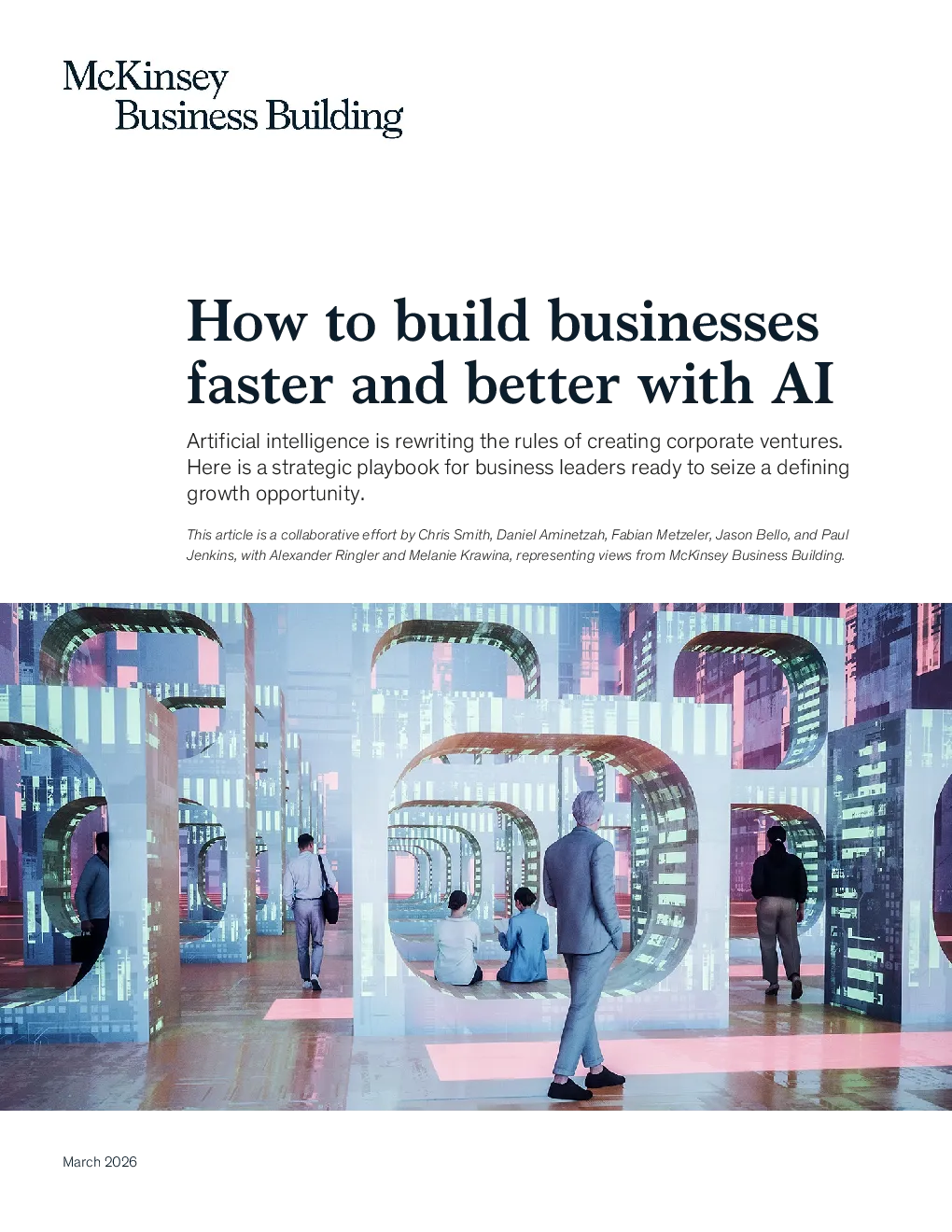
How to build businessesfaster and better with AI Artificial intelligence is rewriting the rules of creating corporate ventures.Here is a strategic playbook for business leaders ready to seize a defininggrowth opportunity. This article is a collaborative effort by Chris Smith, Daniel Aminetzah, Fabian Metzeler, Jason Bello, and PaulJenkins, with Alexander Ringler and Melanie Krawina, representing views from McKinsey Business Building. Imagine a worldin which billion-dollar companies are built by teams of fewer than a dozenpeople—or even by a single founder. What once seemed like science fiction is now becomingreality as artificial intelligence emerges as the new operating system of venture building. This is not a marginal improvement or an efficiency gain. It is a fundamental rewiring of howbusinesses are conceived, built, and scaled. Just as the shift from mainframes to personalcomputers transformed knowledge work and the internet reshaped commerce andcommunication, AI is resetting the assumptions that have governed business building fordecades. The constraints that once defined business creation—team size, capital requirements,and time to market—are being rapidly rewritten. AI creates value for venture builders along three dimensions: It improves innovation cycles,enabling teams to generate, test, and validate more—and often better—ideas faster than everbefore; it transforms productivity, allowing small teams to achieve what once required entiredepartments; and it accelerates velocity, shortening the time from concept to minimum viableproduct and reducing the capital required to reach market. Together, these gains make venturesthat once appeared too risky or too costly increasingly viable. For leaders, the question is no longer whether AI matters for business building but how to applyit in ways that deliver sustained performance. Those who treat AI as an add-on will captureincremental benefits at best. Those who rewire business building around AI as a foundationalcapability—with human expertise at the center—will pursue more ideas, validate them faster,and scale winners earlier, often with fundamentally different economics. This article offers a practical playbook for leaders seeking to capture this opportunity. It beginswith the evidence for AI’s impact on venture economics, explains how AI creates value acrossthe venture life cycle, and then lays out three strategic shifts that distinguish high-performingAI-first ventures. For executives ready to act, it closes with concrete steps to begin rewiringventure building around AI as the new operating system. The case for AI-first venture building Even amid economic uncertainty, corporate venture building remains a top strategic priority. InMcKinsey’s 2025 new-business building survey, 43 percent of leaders reported increasing theirfocus on venture building over the previous 12 months. At the same time, expectations havesharpened. With capital under greater scrutiny, leaders are under pressure to demonstratereturns more quickly and with greater capital efficiency. That pressure is reshaping how companies approach business building. Performanceexpectations are rising, along with the need to improve the underlying economics of venturecreation—reducing time to validation, accelerating time to revenue, and increasing output perdollar and per employee. Recent results suggest significant progress. In 2025, 61 percent of corporate venturesgenerated more than $10 million in revenue, up from 45 percent in 2023. Our business-buildingsurvey found that the time required for new businesses to reach those revenue levels fell from38 months in 2023 to 31 months in 2025. Among ventures that have already broken even, 61percent did so within two years. Artificial intelligence is a core driver of this performance shift. A McKinsey review of hundreds ofventures founded between 2018 and 2024 suggests that ventures launched in the AI era(2023–24) are achieving higher output with faster timelines, on both a per-person and per-dollar basis. While not every recent venture is AI native, the increasingly widespread use of AIappears to be materially compressing venture timelines and raising productivity. Other researchers have reached similar conclusions. In a recent survey by early-stage venturecapital firm Antler, 93 percent of companies reported that AI accelerated execution, with nearlyhalf citing speed increases of up to fivefold. AI is reshaping venture building not as a peripheral tool but as a practical driver of performance.When embedded in how ventures are designed and operated, AI creates value along threedimensions that matter most for venture economics: the breadth and quality of ideas that can beexplored, the speed at which ventures move from concept to market, and the productivity thatsmall teams can achieve. Below, we explore each of these dimensions in depth. Innovation and creativity AI can act as a creative amplifier, expanding both the range and quality