您的浏览器禁用了JavaScript(一种计算机语言,用以实现您与网页的交互),请解除该禁用,或者联系我们。 [汤森路透]:盛景下的隐忧 - 发现报告

盛景下的隐忧

综合 2026-01-09 汤森路透 表情帝
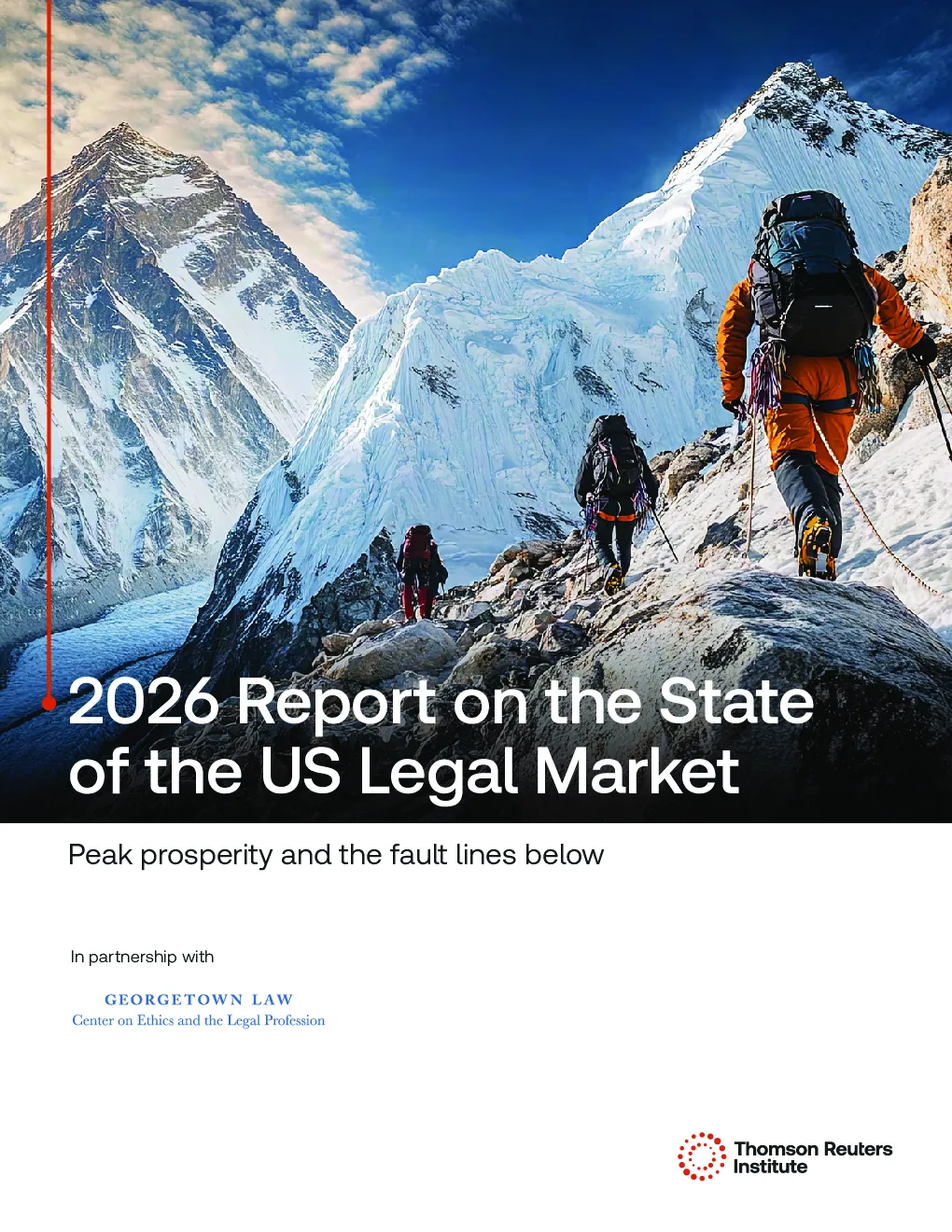
报告封面

Peak prosperity and the fault lines below In partnership with Firms in an unstable environment Fifty million years ago, the Indian subcontinent began its inexorable collision with the Eurasian plate;and in that grinding of tectonic forces, the earth did something extraordinary — it began to buildupward. Limestone that once rested on an ancient seabed was thrust skyward, folding and fracturingalong fault lines that would reshape the face of the planet. This wasn’t a gentle rising; rather, it wasa violent reorganization of matter, in which some sections of crust were pushed to unprecedentedheights while others remained relatively unchanged, creating the greatest peaks and deepest valleyson Earth. The Himalayas emerged from this chaos, and at their apex stood what the world would come to callMount Everest, standing at 29,032 feet notdespitethe fault lines, but because of them. Today, the US legal market is experiencing its own tectonicmoment, one in which fundamental forces — such asshifting client power, economic instability, and technologicaldisruption — are creating fault lines that are pushing some toextraordinary heights while others find themselves on moreunstable ground. The difference between the peaks and valleysthis time is no longer determined by traditional metrics ofsize and prestige alone, but by a complex interplay of factors:technological sophistication, practice mix, cost structurediscipline, and perhaps most critically, the ability to delivervalue to an increasingly pressured customer. What makes this momentparticularly treacherousis that the very forcescreating today’s peaksare simultaneouslyundermining the groundbeneath them. The numbers underscore the tectonic nature of the moment. While theaveragelaw firm celebrated13.0% profit growth in 2025, firms of different shapes and sizes found ways to capitalize on theopportunities of the moment. The profits per lawyer of the Am Law 100 firms have soared as they’veincreasingly concentrated on delivering on the highest-priced work. The Second Hundred is alsogrowing profits rapidly while expanding headcount and capturing increasingly substantial client work.Midsize firms, after years trapped in a vicious cycle of aggressive hiring and constrained pricing power,have finally broken free to capture historic demand growth. However, the threat of once again fallingback is growing rather than receding. What makes this moment particularly treacherous is that the very forces creating today’s peaks aresimultaneously undermining the ground beneath them. The surge in demand that’s lifting profits torecord heights stems not from economic health but from chaos — trade wars, regulatory upheaval,and geopolitical tensions – all of which require constant legal navigation. At the same time, many GCsare finding themselves squeezed, with stagnant budgets having to somehow withstand the increasedweight of the moment. This results in an accelerating migration of demand as clients move in search ofgreater value and lower prices. While the cause of this uplift is out of the average firm’s control, its reaction to it is not. Firms are racingto capitalize on the instability by loading up on talent and tech, with technology spending up nearly10% and talent costs rising 8.2% compared to 2024 levels. Using the gains of a prosperous year toreinforce one’s competitive edge is by no means a poor play; however, firms are spending like thecurrent revenue conditions represent a permanent shift rather than a temporary spike. History suggests otherwise. The legal industry has surged like this before — in 2007 before the GlobalFinancial Crisis (GFC), and in 2021 before an inflation crunch — and each time, firms that mistookaltitude for stability found themselves falling furthest when conditions shifted. Leaders of today’s high growth firms, standing atop their own Mount Everests of profitability, woulddo well to remember that the same forces which build mountains are capable of breaking down withsudden ferocity. How firms prepare for that moment, the decisions they make, and the foundations theyreinforce or abandon will determine where they stand once the ground inevitably shifts again. Key findings: Law firm performance in 2025 Any honest assessment of law firm performance in 2025 must begin with the extraordinary pressuresthat have reshaped the entire landscape. The second Trump administration’s arrival created aregulatory and geoeconomic shock that fundamentally altered global markets, with the United Statesas the epicenter. As tariffs escalated, trade wars intensified, and the federal government underwentradical restructuring. These mounting pressures saw clients swarm their law firms1for legal advice, andas a result, legal demand surged over the course of the year, averaging 2.5% but hitting as high as 4.4%growth in July.2 FIGURE 1: Weekday-adjusted (WDA) demand is a new metricthat accounts for: Weekday-adjusted demand growth Year-over-year change What began as a