美国股票因子洞察 - 2026年4月
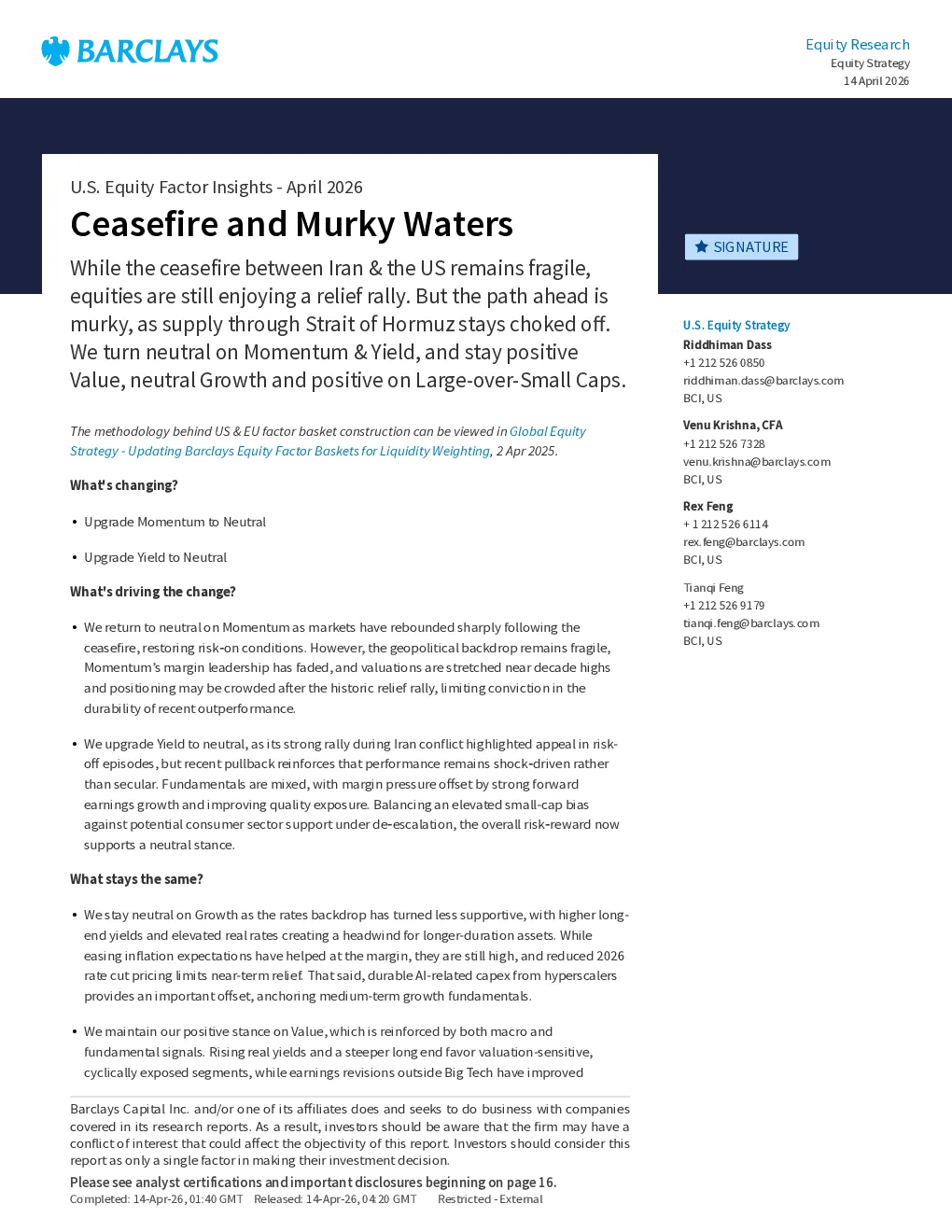
Ceasefire and Murky Waters While the ceasefire between Iran & the US remains fragile,equities are still enjoying a relief rally. But the path ahead ismurky, as supply through Strait of Hormuz stays chokedoff.We turn neutral on Momentum & Yield, and stay positiveValue, neutral Growth and positive on Large-over-Small Caps. U.S. Equity StrategyRiddhiman Dass+1 212 526 0850riddhiman.dass@barclays.comBCI, US Venu Krishna, CFA+1 212 526 7328venu.krishna@barclays.comBCI, US The methodology behind US & EU factor basket construction can be viewed in Global EquityStrategy - Updating Barclays Equity Factor Baskets for Liquidity Weighting, 2 Apr 2025. What's changing? Rex Feng+ 1 212 526 6114rex.feng@barclays.comBCI, US •Upgrade Momentum to Neutral•Upgrade Yield to Neutral Tianqi Feng+1 212 526 9179tianqi.feng@barclays.comBCI, US What's driving the change? •We return to neutral on Momentum as markets have rebounded sharply following theceasefire, restoring risk-on conditions. However, the geopolitical backdrop remains fragile,Momentum’s margin leadership has faded, and valuations are stretched near decade highsand positioning may be crowdedafterthe historic relief rally, limiting conviction in thedurability of recent outperformance. •We upgrade Yield to neutral, as its strong rally during Iran conflict highlighted appeal inrisk-offepisodes, but recent pullback reinforces that performance remains shock-driven ratherthan secular. Fundamentals are mixed, with margin pressureoffsetby strong forwardearnings growth and improving quality exposure. Balancing an elevated small-cap biasagainst potential consumer sector support under de-escalation, the overall risk-reward nowsupports a neutral stance. What stays the same? •We stay neutral on Growth as the rates backdrop has turned less supportive, with higher long-end yields and elevated real rates creating a headwind for longer-duration assets. Whileeasing inflation expectations have helped at the margin, they are still high, and reduced 2026rate cut pricing limits near-term relief. That said, durable AI-related capex from hyperscalersprovides an importantoffset,anchoring medium-term growth fundamentals. •We maintain our positive stance on Value, which is reinforced by both macro andfundamental signals. Rising real yields and a steeper long end favor valuation-sensitive,cyclically exposed segments, while earnings revisions outside Big Tech have improved Barclays Capital Inc. and/or one of itsaffiliatesdoes and seeks to do business with companiescovered in its research reports. As a result, investors should be aware that the firm may have aconflict of interest that couldaffectthe objectivity of this report. Investors should consider thisreport as only a single factor in making their investment decision. Please see analyst certifications and important disclosures beginning on page 16.Completed: 14-Apr-26, 01:40 GMTReleased: 14-Apr-26, 04:20 GMTRestricted - External materially versus pre-pandemic norms. Resilient consumer sentiment, improving marketbreadth, and the prospect of geopolitical normalization further support a broad-based,Value-friendly operating environment. •We stay positive on Large-over-Small Size as inflation risks and a higher-for-longer ratebackdrop disproportionately pressure small caps, given weaker balance sheets and elevatednegative earnings. Fundamentals continue to lag, with sharper EPS downgrades and asoftnear-term growth outlook. Small cap valuations appear less attractive than headline figuressuggest. •We stay neutral on Quality, as its defensive profile failed to deliver sustained outperformanceduring the Iran-related oil shock, with long/short returns remaining broadly flatafteraninitial uptick. Looking ahead, Quality could benefit if growth concerns re-emerge, but a risk-on backdrop would cap upside. Elevated relative valuations and the absence of a clearcatalyst reinforce neutral stance. •We stay negative on High-over-Low Volatility, as the style has delivered weak and unstableperformance in 2026, including a sharp drawdown during the Iran conflict and only partialgains since the ceasefire. While a risk-on impulse mayoffershort-term support, the truceremains fragile and sentiment vulnerable to reversal. With price appreciation outpacingearnings growth and valuations increasingly disconnected from fundamentals, therisk-reward is unfavorable. US factor analysis and views: April 2026 Equity market performance in March 2026: •March saw a sharp repricing across markets as geopolitical risk tied to the war in Iran and theclosure of the Strait of Hormuz drove elevated volatility and risk aversion. The S&P 500 fell bymore than 5%, while Brent crude briefly surged to nearly $118 per barrel before retracing toaround $110 by early April, underscoring the scale of the energy shock and its inflationaryimplications. •Style performance reflected a rapid reassessment of the macro backdrop, with Growthunderperforming Value across both large and