您的浏览器禁用了JavaScript(一种计算机语言,用以实现您与网页的交互),请解除该禁用,或者联系我们。 [Exegy]:动态再平衡准备始于基础设施 - 发现报告

动态再平衡准备始于基础设施

建筑建材 2026-04-01 Exegy 董亚琴
报告封面

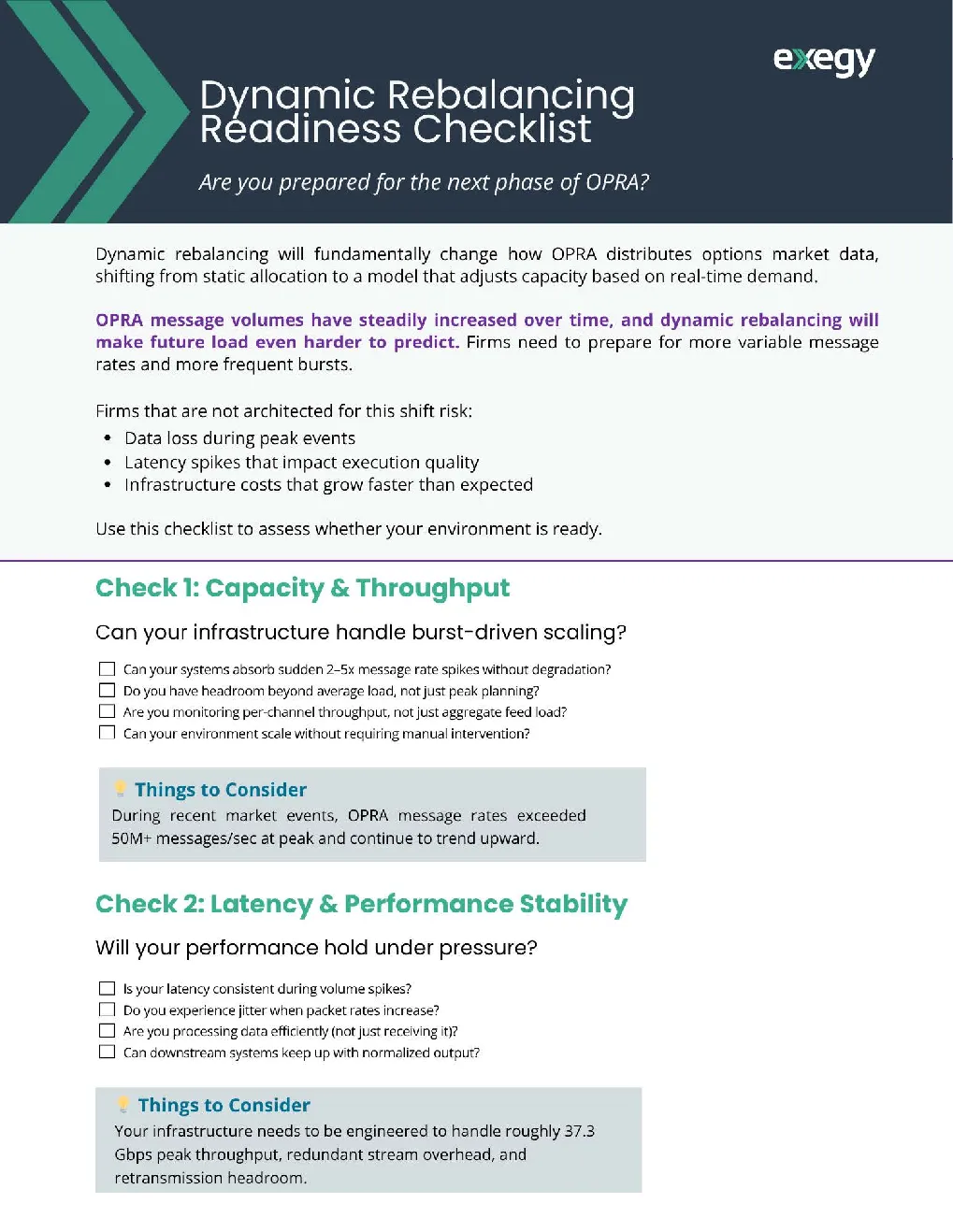
Are you prepared for the next phase of OPRA? Dynamic rebalancing will fundamentally change how OPRA distributes options market data,shiftingfromstaticallocationto a model thatadjustscapacitybasedon real-timedemand OpRA message volumes have steadily increased over time, and dynamic rebalancing willmake future load even harder to predict. Firms need to prepare for more variable messagerates and more frequent bursts. Firms that are not architected for this shift risk: .Datalossduringpeakevents.Latencyspikesthatimpactexecutionquality.Infrastructure costs that growfaster than expected Use this checklist to assess whether your environment is ready. Check1:Capacity&Throughput Canyourinfrastructurehandleburst-drivenscaling? Can your systems absorb sudden 2-5x message rate spikes without degradation?Do you have headroom beyond average load, not just peak planning?Areyou monitoring per-channel throughput, not justaggregatefeed load?Can your environment scale without requiring manual intervention? Thingsto Consider During recent market events,OPRA message rates exceeded5oM+messages/secatpeakandcontinuetotrendupward. Check2:Latency&PerformanceStability Willyourperformanceholdunderpressure? Is your latency consistent during volume spikes?Do you experience jitter when packet rates increase?Areyou processing data efficiently (not just receiving it)?Candownstreamsystemskeepupwithnormalized output? Thingsto Consider Your infrastructureneeds tobeengineeredtohandle roughly37.3Gbps peak throughput, redundant stream overhead, andretransmission headroom. Check3:InfrastructureEfficiency Are you solving the problem or adding to the problem? Are youaddingmoreservers tokeepupwithdata growth?Is CPUutilization spiking during peak periods?Are you duplicating infrastructure acrossdesks or strategies?Do power, rack space, or cooling constraints limit your scaling? Thingsto Consider OPRA recommends building in an additional 10% bandwidthheadroomto accountforpotential retransmissions. Check4:DataHandling&Resiliency Can you maintain data integrity at scale? Do you have robust gap detection and replaymechanisms?Canyourecoverquicklyfrompacket loss?Are yourfailoversystems tested under peak conditions?Can yourfeed handler handle channel rebalancing without disruption? Things to Consider Bandwidth requirements can double for firms receiving bothredundant multicast streams for fault tolerance. Check5:OperationalBurden Howmuchofthisdoesyourteamown? Doyou havededicated resourcesfor OPRA capacity planning?Are you constantly tuning infrastructure to keep up with growth?is your team reacting to issues instead of staying ahead of them?Do upgrades and changes introduce operational risk? Thingsto Consider Readiness is ongoing. Firms must monitor OPRA changes,validate failover and recovery, and keep pace with evolvingdistribution requirements. Scoring Section How did you score? . 0-5 checks: You're at risk under dynamic rebalancing6-12checks:Gaps exist that will surface understress13-20 checks: You're in a strong position, but ongoing investment is required Dynamicrebalancing doesn't just increasedatavolume; it changeshowfirms needto think aboutinfrastructureentirely Thechallengeisn't justkeepingupwithOPRA,it'sdoingsowithoutcontinuouslyexpandinginfrastructure, cost, and operational overhead. That's where managed approaches are gaining traction. SimplifyOPRAConsumptionwithAxiom DynamicrebalancingwillpushmorefirmstorethinkhowtheysourceandprocessOPRAdata.Asvolumes increase and infrastructure requirements grow more complex, many are moving away fromtraditional,server-heavyapproaches. Exegy's Axiom service is built to deliver OPRA market data without the operational burden ofmanaging it in-house. Fullymanaged,normalizedOPRAdeliveryacrossreal-timeandconflateddataoptions. Engineered for burst-driven volume, maintaining performance during peak message events· Reduce or eliminate market data processing infrastructure, lowering rack space, power, andhardwarecosts: Flexible consumption models, including filtered OPRA (NBBO-only) and configurable conflationintervals.Built-inresiliencyandfailover,with redundant infrastructuredesignedfor continuous availability Focusontrading,notinfrastructure