亚洲食品通胀观察
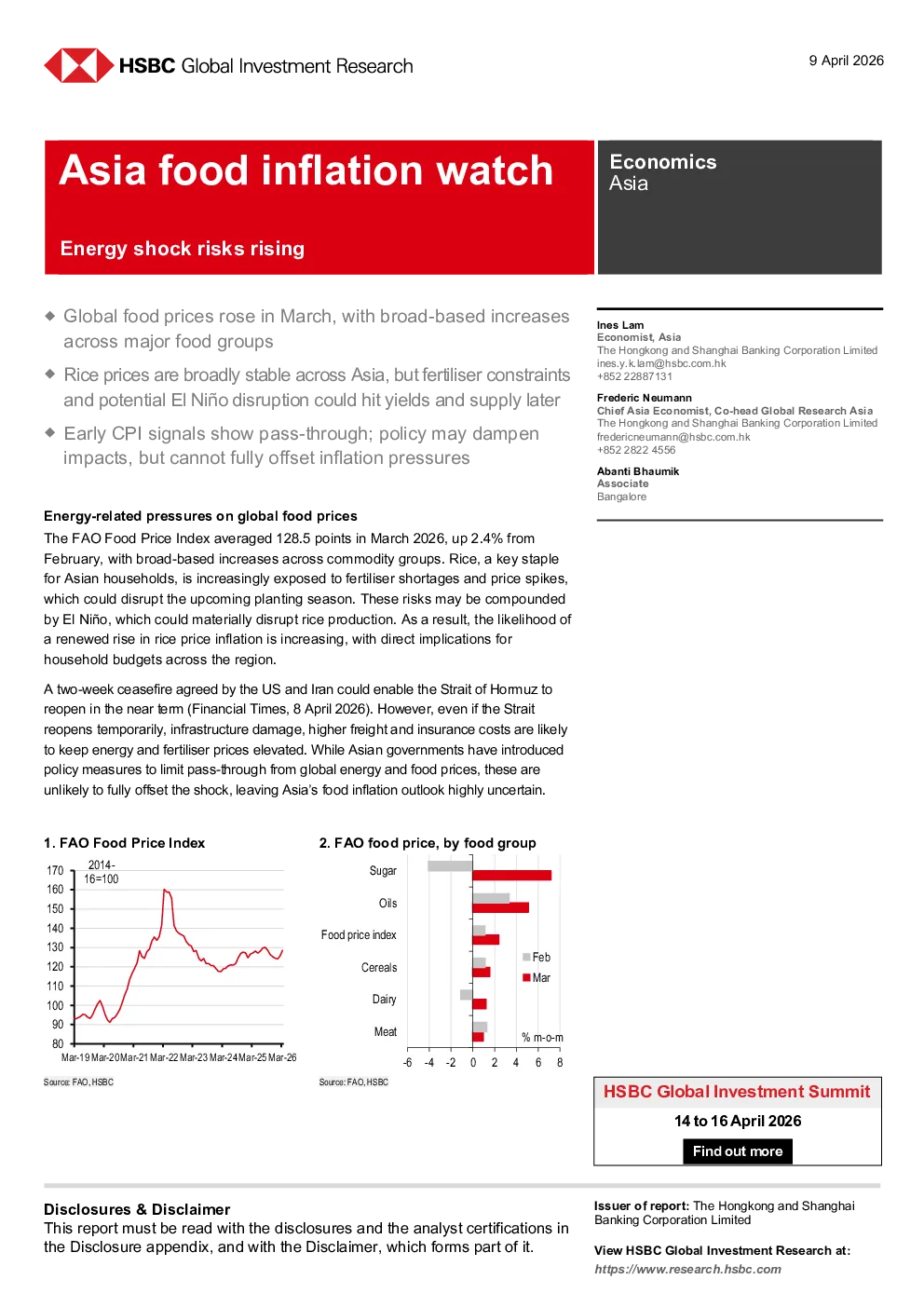
EconomicsAsia Energyshock risks rising ◆Global food prices rose in March, with broad-based increases Ines LamEconomist, AsiaThe Hongkong and Shanghai Banking Corporation Limitedines.y.k.lam@hsbc.com.hk ◆Rice prices are broadly stable across Asia, but fertiliserconstraintsand potential El Niño disruption could hit yields and supply later Frederic NeumannChief Asia Economist, Co-head Global Research AsiaThe Hongkong and Shanghai Banking Corporation Limitedfredericneumann@hsbc.com.hk ◆Early CPI signals show pass-through; policy may dampenimpacts, but cannot fully offset inflation pressures Abanti BhaumikAssociateBangalore Energy-related pressures on global foodprices The FAO Food Price Index averaged 128.5 points in March 2026, up 2.4% fromFebruary, with broad-based increases across commodity groups. Rice, a key staplefor Asian households, is increasingly exposed to fertiliser shortages and price spikes,which coulddisrupt the upcoming planting season. These risks may be compounded A two-week ceasefire agreed by the US and Iran could enable the Strait of Hormuz toreopen in the near term (Financial Times, 8 April 2026). However,even if the Straitreopens temporarily, infrastructure damage, higherfreightand insurance costsare likelyto keepenergy and fertiliserprices elevated. While Asian governments have introduced Source:FAO, HSBC HSBC Global Investment Summit 14 to 16 April 2026 Find out more Disclosures & Disclaimer This report must be read with thedisclosures and the analyst certifications inthe Disclosure appendix, and with the Disclaimer, which forms part of it. View HSBC Global Investment Research at:https://www.research.hsbc.com Global price update Apart from the FAO, the World Bank has released its first full set of March commodity pricedata, providing an earlyread on how the Strait of Hormuz closure is affecting energy markets. The results broadly align withourviewsintheCommodity Prices Snapshot: Sharply higher onMiddle East conflict shock(1 April 2026). Shipping constraints arequickly feeding into supply In March, the overall fertiliser group rose26.2% month-on-month (Chart 3). Urea, the mostwidelyused nitrogen fertiliser globally, saw the sharpest move, with prices spiking 54% versusFebruary. The Gulf countries accounted for roughly 35% of global urea exports, with Iran and The Persian Gulf is also akeyproduction hub for phosphate fertilisers, (alongsidepotash as thethirdmajornutrient). However, prices for phosphate products such as DAP and TSP haverisen Nitrogen hit hardest Rice stable now, risks rising into H2 2026 This matters particularly for Asia, where urea is heavily used in rice cultivation,with plantingtypically occurringinMay-July during the monsoon season.Urea is also widely applied towheat, sugarcane, vegetables, and fruit, raising the risk of broader foodsupply impacts. Highercosts and potentialavailability constraints, together withexport restrictionsfrom China (the Urea shock hits Asia’s The good news is that Asian rice markets have largelynormalised after the 2023/24 spikes. Inits February report, the US Department of Agriculture estimated that global rice supplies in Rice prices stablefor now,but downside risks rising Chart4showsrecent pricing trends remain soft.Thai 5% rice prices rose modestly for a few monthsinlate 2025 but fell in March, while Vietnamese prices continued to trendlower. The FAO All RicePrice Index declined by 3% in March,reflectingharvest pressure, weaker import demand and currency depreciations against the USD among major rice producers such as India, Thailand and However,fertiliser shortages now pose a clear downside risk. Lower nutrient use during thecurrent spring/early planting season is expected to weigh on yields later in 2026, particularly for Meanwhile, in the Philippines, rice CPI rose 3.6% y-o-y in March, after14 months of decline (Philippine CPI: 3-in-1 inflation, 7 April 2026).Given itshigh reliance on Gulf energy supplies,the Philippines has become the first country to declare a national energy emergency since theMiddle Eastconflictbegan,highlighting itsvulnerabilityto the energy-driven inflation shock. With inflationin India beinghighly sensitive to food prices, the governmenthas stated that it hasstocked upsufficient fertilisers for the kharif seasonthatbeginsin May/June(The Economic Surging oil and sugar prices Edible oils recorded the second-largest m-o-m increase among food groups in Marchin theFAO food price release.The FAO vegetable oil price index increased by 5.1% m-o-m. Edible oils: sharp March In the World Bank’sMarch release(Chart5) ,soybean oil prices jumped 17% m-o-m, followinga 10% rise in February. Higher crude oil prices havestrengthened expectations for biofuel-related demand, supporting prices. Key exporters,including China, Indonesia, Malaysia, India, At the same time, palm oil and palm kernel oil prices rose by 6% and 12%, respectively. Giventheirextensiveuse inhouseholdcooking and food manuf