您的浏览器禁用了JavaScript(一种计算机语言,用以实现您与网页的交互),请解除该禁用,或者联系我们。 [依隆大学]:2026 AI时代构建人类韧性基础设施研究报告 - 发现报告

2026 AI时代构建人类韧性基础设施研究报告

建筑建材 2026-04-05 依隆大学 张博卿
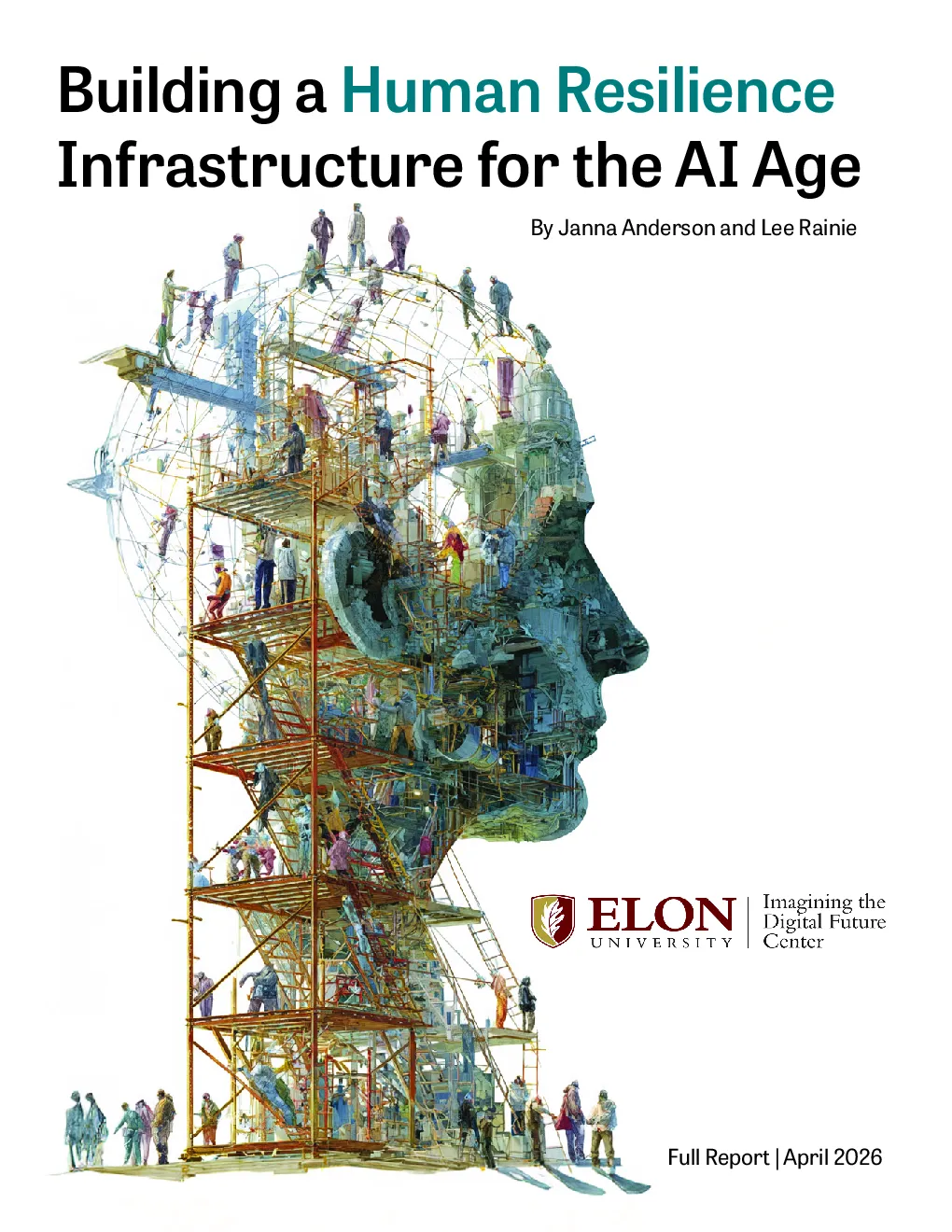
报告封面

By Janna Anderson and Lee Rainie Building a Human ResilienceInfrastructure for the AI Age ExpertsCall forRadical Change Across Institutions andSocial Structures, Warning That AI Will Be SignificantlyMore Influential in the Next 10 Years or Less By Janna Anderson and LeeRainieImagining the Digital Future CenterElon University April 2026 About Elon University’s Imagining the Digital Future Center Imagining the Digital Futureis a non-partisan, public-good research initiative at Elon Universityfocusedon the digital revolution’s impact and what may lie ahead.The center was established as the“Imaginingthe Internet Center”at Elon in 2000 and expanded and renamed in 2023.Its mission is to discover andbroadly share a diverse range of opinions and ideas about the potential future impact of digital change,informing important conversations and policy formation and helping to promote a positive future forhumanity.The center draws on insights gathered through canvassings of thoughtful and far-sightedexperts in a wide range of fields. Those qualitative contributions are complemented by a range ofmethodologies, including public opinion polling, computational analysis and other data-driven research. How we did this This report shares results of our 52nd“Future of Digital Life”report. It builds on previous efforts thatwere jointly conducted byElon’s Imagining the Digital Future Center(previously known as“Imaginingthe Internet”)andPew Research Center’s Internet Project.Forty-nine reports were generated by thatpartnership between 2004 and 2023. This report centers on written responses to questions about howartificial intelligence (AI) systems might affect human resilience. Experts’ analyses and predictions reported here came inanon-scientific canvassing (based on anonrandom sample) conducted between Dec. 26, 2025 and Feb. 12, 2026.The Imagining the DigitalFuture Centerinvited more than 4,000 experts to respond, collecting a broad array of opinions abouthow humans might respond in a world where artificial intelligence (AI) systems play asignificantly largerrole than they do today in people’s everyday activities and in making decisions affecting them.Participants represent a wide range of fields, including technology innovators, analysts and policyinfluencers based in various businesses, nonprofits, think tanks and government agencies, as well asacademics,independent researchers and professional commentators. In all, 386 experts responded to atleast one aspect of the canvassing; 251 of them provided written answers to an open-ended question.The respondents’remarks reflect their personal positions and arenot the positions of their employers.Some responses were lightly edited for clarity. The authors of this report used large language models (LLMs) to help identify broad themes inrespondents’answers and assist in organizing the report’s structure. LLMswere used by the authors inspell-checking and punctuation of the text but were not used in direct writing or more substantiveediting. Respondents were asked about their use of LLMs in writing their essays for this canvassing. Of the 197essay writers who responded to that question, 74% replied,“My response was fully generated out of myown mind, with no LLM assistance”; 19%replied,“I used one or more LLMs somewhat in crafting myresponse, but most of it was written with no LLM assist”; 7%replied,“Iused one or more LLMs to makea significant difference in enhancing my honest, personal response.” Full details on the methodology underlying this canvassing of experts can be foundon Page347. Table of Contents ExecutiveSummary–Building a Human Resilience Infrastructure for the AI Age4Chapter1–Cultivating Human Agency: Prioritizing Autonomy18Chapter2–Institutions Must Lead Nowin Restructuring for Resilience75Chapter3–The Ultimate Team-Up: Humans and AIWorkingTogether130Chapter4–Existential Literacy:Rewiring Human Behaviorforthe AI Age156Chapter5–Work Quake: Navigating Labor Shifts and Pursuit of Meaning178Chapter6–The Great Divide: Broadening Differences and Inequities204Chapter7–Heart & Soul:SeekingHuman Connection and Calm227Chapter8–OvercomingComplacency and the Lure of Convenience251Chapter9–Epistemic Vigilance: Discerning Truth, Illusion and Misinformation271Chapter10–Additional Observations: Broader Insights297Chapter11–Closing Thoughts: Making Our Way on the Path to Human Flourishing324Research Methodology and Topline Findings347Appendix: Chapter-By-Chapter List of Authors and Titles353 Executive summary Building a Human Resilience Infrastructure for the AI Age Hundreds of global technology experts call for radical change led by institutions The vast majority of expert respondents in a 2026 survey by the Imagining the Digital Future Centersaidhumans need to build a highly coordinated resilience infrastructure for the AI Age to counterbalance thehuman and systemic challenges posed by widespread AI adoption. Some 82% said AI will play asignificantly larger role in shaping