2026未来前瞻:或将影响社会的三大科技趋势研究报告
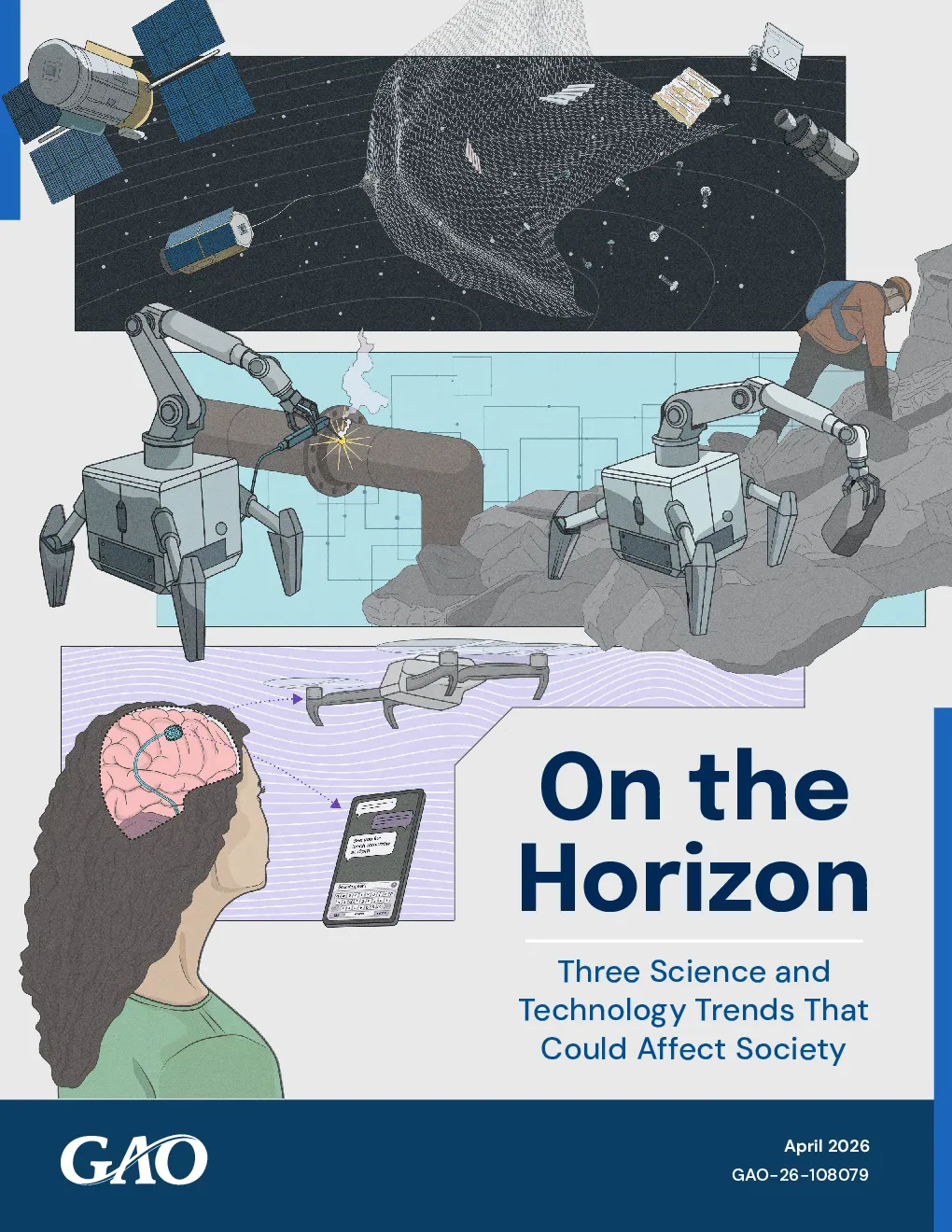
Three Science andTechnology Trends That Table of Contents 1Foreword3Neural Implants for Human Augmentation10General Purpose Robotics21Remediation of Orbital Debris32Endnotes35GAO Contact and Staff Acknowledgments36Additional information Cover: Illustrated depiction of examples of orbital debris mitigation, general robotics, and neural implant technology. Source: GAO. | GAO-26-108079 Foreword Science and technology (S&T) are constantlyevolving, and there is a need for analysisof emerging trends to help prepare us for bring. To address this need, we developed a reportseries focused on technologies that may developsignificantly over the next 10 years. Our goal is toprovide foresight into developing technologies that Sterling Thomas, PhDGAO’s Chief Scientist For this second annual edition of our S&T trends report, weidentified and monitored developments in science, technology,and engineering that may grow over time as the United Statescontinues to innovate. As there are many possible future trends,we did not take an exhaustive approach but identified three Many methods exist to identify emerging technologies, butmost do not work well for our ten-year time horizon. Commonmethods that appear in popular literature use frequency analysisto identify trending terms. These methods can be valuable for Our specific method leverages the expertise of GAO scientistsand engineers to identify developing technologies that maynot yet have gained popular attention but show significant in another. For example, orbital debris mitigationsystems, robotics, and neural implants all depend onadvances in control algorithms, sensors, materialsscience, and energy storage. Additionally, progress inartificial intelligence (AI) informs development across Each of these elements plays an important rolein maturing a technology and creating marketconditions that can bring an innovation to theAmerican public. Innovations do not live in a vacuum, One important form of technological innovation is themove from specialized use in specific applicationsto general use across a broader range of tasks.The three technologies we selected for this year’sreport—neural implants for human augmentation,general purpose robotics, and orbital debrismitigation systems—are examples of such innovation.For example, neural implants have been developedto treat specific conditions, and researchers areexploring how to move beyond that to develop To conduct this work, we relied on a review ofscientific literature from academic journalsand position papers and held semi-structuredinterviews with 11 experts across the three identifiedtechnologies. The experts were selected based onthe results of our literature review, previous GAOreports, and the expertise and judgment of GAOscientists and engineers. To help identify trends, weconsulted internal specialists with a wide variety ofscientific and technological backgrounds. We reliedon our collective judgment and consideration of Neural Implants for of neural implants can send electrical signals tocertain areas of the brain, altering brain activity toestablish normal function (e.g., to reduce tremorsin people with Parkinson’s disease). While thesetypes of neural implants are more mature relativeto those that measure and decode a user’s trials. These implants may offer quality-of-lifeimprovements for people living with disabilitiesdue to neurological disorders, stroke, or injuries.For example, some implants can measure auser’s brain signals and decode the intent ofthose signals to allow for hands-free control of yEnable real-time seamless translation betweenlanguages, eliminating language barriers to Although the use of neural implants is currentlylimited to people with medical needs, theiradvancement through technological hurdlescould enable development of neural implants Allow users to quickly develop new skills and yEnable direct brain-to-brain communication yAllow military service members to control However, policies, regulations, and societalinterest and concerns could affect the extent to yEnable development of new types of videogames that provide a competitive edge to Developments on the Horizon Technological advancements in the following three areas could shape the 1Researchers are using AI to predict the intent of users via their brainsignals in real-time, allowing faster and more flexible control of devices.This contrasts with prior efforts in which neural implant use required 2Advanced materials allow neural implants to measure brain signalswith higher resolution while reducing risk to users. High-resolutionmeasurement of brain signals allows researchers to more accuratelydecode the user’s intended action. Some neural implants in developmentare becoming smaller and, unlike others, do not require open brain surgery. 3While neural implants have required wired attachment to large externalpieces of equipment, researchers are developing neural implants that These and other advances have already