您的浏览器禁用了JavaScript(一种计算机语言,用以实现您与网页的交互),请解除该禁用,或者联系我们。 [翰宇国际律师事务所]:大型雇主的强制性种族和残疾工资差距报告获得绿灯 - 发现报告

大型雇主的强制性种族和残疾工资差距报告获得绿灯

2026-03-31 翰宇国际律师事务所 张博卿
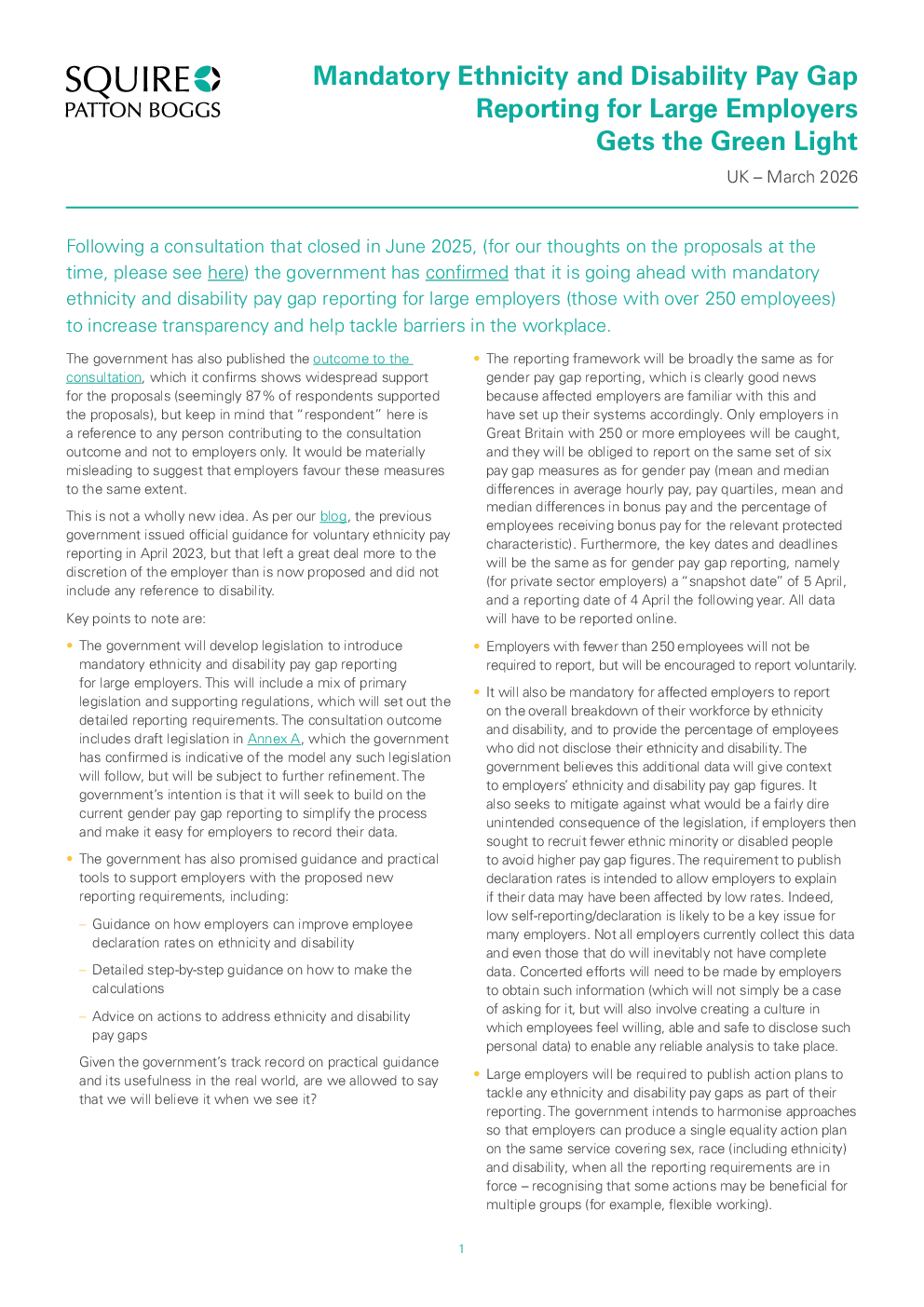
报告封面

UK – March 2026 Following a consultation that closed in June 2025, (for our thoughts on the proposals at thetime, please see here) the government has confirmed that it is going ahead with mandatoryethnicity and disability pay gap reporting for large employers (those with over 250 employees)to increase transparency and help tackle barriers in the workplace. •The reporting framework will be broadly the same as forgender pay gap reporting, which is clearly good newsbecause affected employers are familiar with this andhave set up their systems accordingly. Only employers inGreat Britain with 250 or more employees will be caught,and they will be obliged to report on the same set of sixpay gap measures as for gender pay (mean and mediandifferences in average hourly pay, pay quartiles, mean andmedian differences in bonus pay and the percentage ofemployees receiving bonus pay for the relevant protectedcharacteristic). Furthermore, the key dates and deadlineswill be the same as for gender pay gap reporting, namely(for private sector employers) a “snapshot date” of 5 April,and a reporting date of 4 April the following year. All datawill have to be reported online. The government has also published the outcome to theconsultation, which it confirms shows widespread supportfor the proposals (seemingly 87% of respondents supportedthe proposals), but keep in mind that “respondent” here isa reference to any person contributing to the consultationoutcome and not to employers only. It would be materiallymisleading to suggest that employers favour these measuresto the same extent. This is not a wholly new idea. As per our blog, the previousgovernment issued official guidance for voluntary ethnicity payreporting in April 2023, but that left a great deal more to thediscretion of the employer than is now proposed and did notinclude any reference to disability. Key points to note are: •The government will develop legislation to introducemandatory ethnicity and disability pay gap reportingfor large employers. This will include a mix of primarylegislation and supporting regulations, which will set out thedetailed reporting requirements. The consultation outcomeincludes draft legislation in Annex A, which the governmenthas confirmed is indicative of the model any such legislationwill follow, but will be subject to further refinement. Thegovernment’s intention is that it will seek to build on thecurrent gender pay gap reporting to simplify the processand make it easy for employers to record their data. •Employers with fewer than 250 employees will not berequired to report, but will be encouraged to report voluntarily. •It will also be mandatory for affected employers to reporton the overall breakdown of their workforce by ethnicityand disability, and to provide the percentage of employeeswho did not disclose their ethnicity and disability. Thegovernment believes this additional data will give contextto employers’ ethnicity and disability pay gap figures. Italso seeks to mitigate against what would be a fairly direunintended consequence of the legislation, if employers thensought to recruit fewer ethnic minority or disabled peopleto avoid higher pay gap figures. The requirement to publishdeclaration rates is intended to allow employers to explainif their data may have been affected by low rates. Indeed,low self-reporting/declaration is likely to be a key issue formany employers. Not all employers currently collect this dataand even those that do will inevitably not have completedata. Concerted efforts will need to be made by employersto obtain such information (which will not simply be a caseof asking for it, but will also involve creating a culture inwhich employees feel willing, able and safe to disclose suchpersonal data) to enable any reliable analysis to take place. •The government has also promised guidance and practicaltools to support employers with the proposed newreporting requirements, including: –Guidance on how employers can improve employeedeclaration rates on ethnicity and disability –Detailed step-by-step guidance on how to make thecalculations –Advice on actions to address ethnicity and disabilitypay gaps Given the government’s track record on practical guidanceand its usefulness in the real world, are we allowed to saythat we will believe it when we see it? •Large employers will be required to publish action plans totackle any ethnicity and disability pay gaps as part of theirreporting. The government intends to harmonise approachesso that employers can produce a single equality action planon the same service covering sex, race (including ethnicity)and disability, when all the reporting requirements are inforce – recognising that some actions may be beneficial formultiple groups (for example, flexible working). –Disability data– For disability pay gap reporting, thegovernment is also proposing to take a binary approachand require employers to compare the pay of disabledemployees with non-disabled emplo