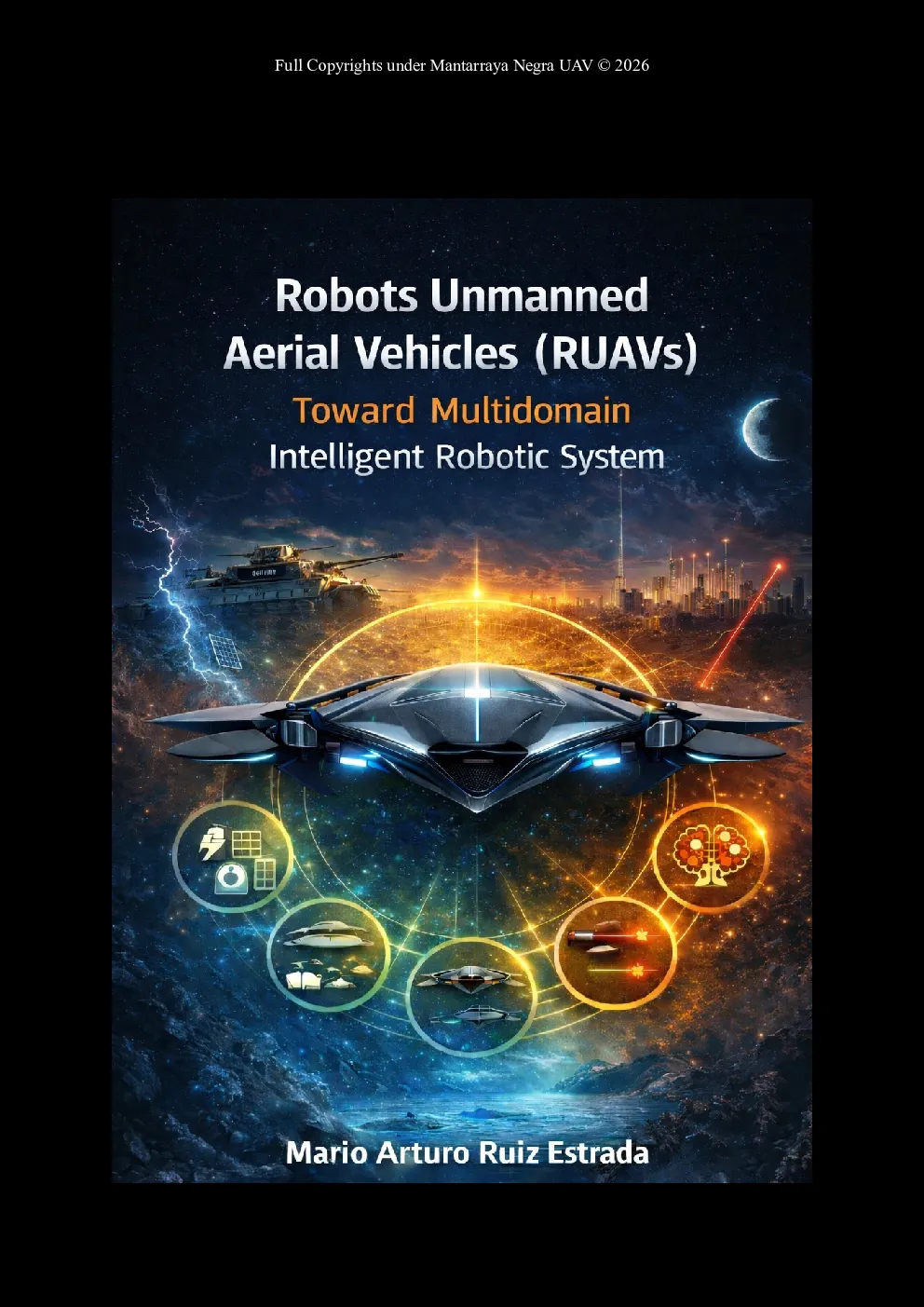
RobotsUnmanned Aerial Vehicles (RUAVs)Toward MultidomainIntelligent Robotic System BY MARIO ARTURO RUIZ ESTRADA Robots Unmanned Aerial Vehicles (RUAVs) represent a fundamental transformation in theevolution of unmanned systems, moving beyond conventional remotely piloted or semi-autonomous drones toward fully intelligent robotic platforms. RUAVs integrate advancedartificial intelligence, autonomous decision-making, adaptive control mechanisms, and multi-domain operational capabilities within a unified robotic architecture. Unlike traditional UAVs,RUAVs are capable of perceiving complex environments, learning from real-time data, andindependently executing mission-critical decisions under uncertain and high-risk conditions.This theoretical paper develops a conceptual framework for RUAVs, defining their corestructural,cognitive,and operational characteristics.The study examines the role ofautonomous reasoning systems, energy-adaptive mechanisms, and robotic self-optimization inenabling persistent autonomy across aerial and hybrid operational environments. Emphasis isplacedon RUAVs as decision-centric systems rather than platform-centric machines,highlighting their ability to dynamically adapt mission strategies without continuous humanintervention. By positioning RUAVs as autonomous robotic agents, this paper contributes to adeeper theoretical understanding of next-generation unmanned aerial technologies. Theproposed framework provides strategic and technological insights relevant to future systemdesign, defense and security applications, and the broader development of intelligent roboticaviation systems. The findings aim to support policymakers, engineers, and researchers inanticipating the operational, ethical, and technological implications of RUAV deployment incomplex real-world scenarios. Keywords:Stealth UAV, Experimental Military Drone, Black Carbon Structure, AutonomousAerial Systems, Robots Unmanned Aerial Vehicles (RUAVs). 1. Introduction to Robots Unmanned Aerial Vehicles (RUAVs) Therapid evolution of unmanned systems has marked a fundamentaltransformation in modern aerospace, defense, and autonomous technologies.Among these developments, Robots Unmanned Aerial Vehicles (RUAVs) (SeeFigure 1) represent a critical next step beyond conventional UAV platforms(Austin,2010),integrating artificial intelligence,adaptive behavior,andautonomous decision-making into a single operational system. Unlike traditionalremotely piloted or semi-autonomous drones, RUAVs are designed to operate asintelligent robotic (Yang, et al., 2018) entities capable of perceiving, learning,adapting, and responding independently to dynamic and uncertain environments(Floreano & Wood, 2015). The emergence of RUAVs is driven by the increasing complexity of modernoperationalscenarios,where real-time human intervention is limited bycommunication delays, hostile environments, or mission scale (Gupta, Jain, &Vaszkun, 2016). In such contexts, autonomous robotic platforms are required toexecute missions with minimal external control while maintaining high levels ofprecision, reliability, and situational awareness. RUAVs address these challengesbycombining advanced sensor fusion,onboard artificial intelligence,autonomous navigation, and adaptive control architectures that enable self-directed operational behavior. From an engineering perspective, RUAV development involves the convergenceof multiple disciplines, including aerodynamics, robotics, artificial intelligence,materials science, energy systems, and control theory. Structural innovations,intelligentpropulsion layouts,adaptive surfaces,and multi-source energyintegrationare increasingly essential to extend endurance,enhancemaneuverability, and ensure survivability across diverse operational domains. Asaresult,RUAVs are no longer limited to aerial missions alone but areprogressively expanding into multi-domain platforms capable of operating acrossair, land, and underwater environments. In the defense and security context, RUAVs introduce a paradigm shift in missionexecution,enabling autonomous surveillance,reconnaissance,precisionengagement, and rapid-response operations without continuous human oversight.Their ability to function in contested or denied environments, adapt to changingthreats, and execute complex decision-making processes in real time positionsRUAVs as strategic assets in future military architectures (Ruiz Estrada, 2024b). At the same time, these systems raise important considerations related toautonomy levels, ethical deployment, system resilience, and operational control. The evolution of unmanned aerial systems is approaching a decisive inflectionpoint.Traditional UAVs—once conceived as remotely piloted platformsdesigned to extend human reach—are rapidly giving way to a new class ofintelligent, self-directed machines: Robot Unmanned Aerial Vehicles (RUAVs).These systems are not merely aircraft without pilots; they represent a fundamentalshift toward autonomo