您的浏览器禁用了JavaScript(一种计算机语言,用以实现您与网页的交互),请解除该禁用,或者联系我们。 [美股招股说明书]:蒙特利尔银行美股招股说明书(2026-03-27版) - 发现报告

蒙特利尔银行美股招股说明书(2026-03-27版)

2026-03-27 美股招股说明书 杨建江
报告封面

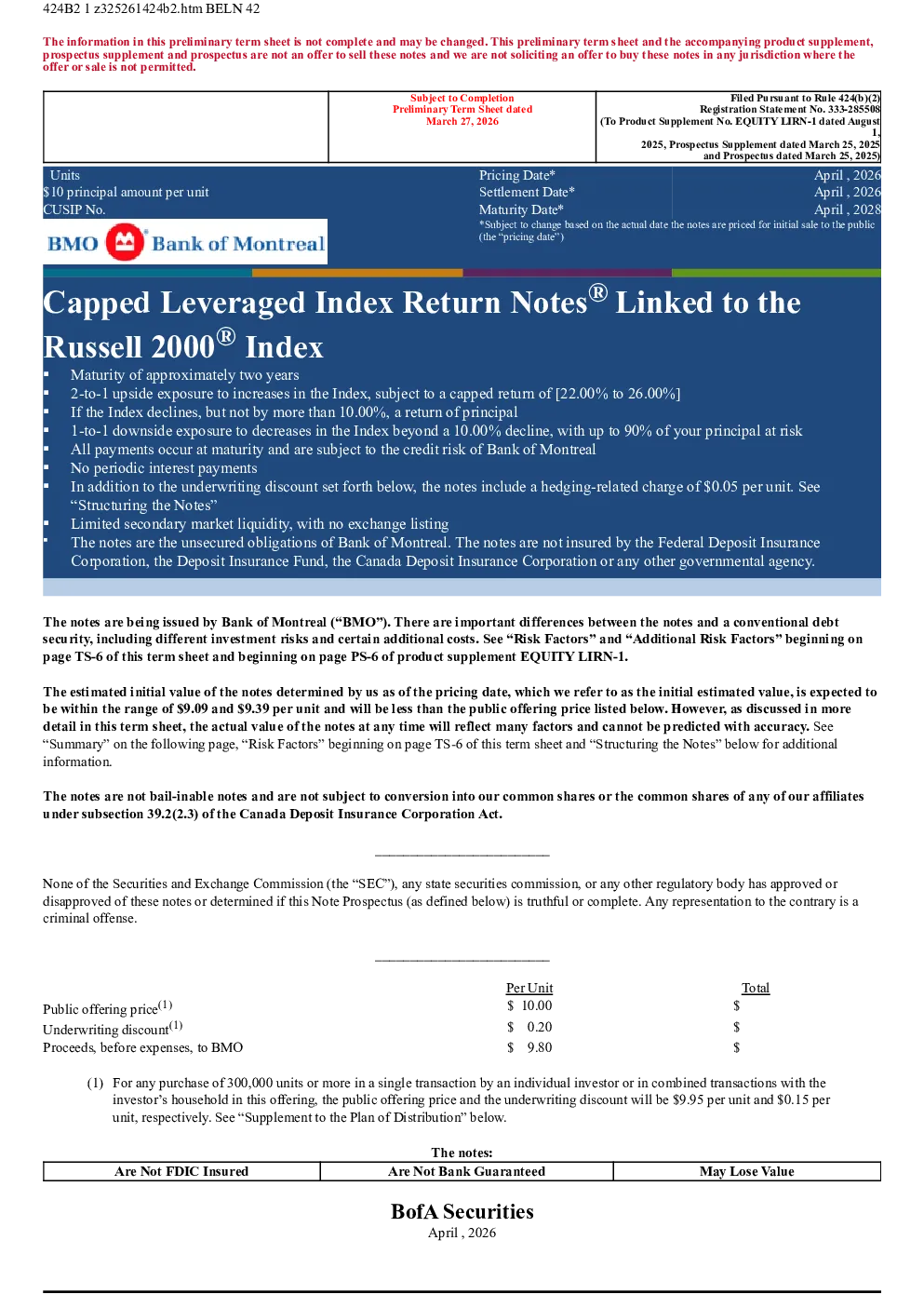
Capped Leveraged Index Return Notes®Linked to theRussell 2000®Index 2-to-1 upside exposure to increases in the Index, subject to a capped return of [22.00% to 26.00%]If the Index declines, but not by more than 10.00%, a return of principal1-to-1 downside exposure to decreases in the Index beyond a 10.00% decline, with up to 90% of your principal at riskAll payments occur at maturity and are subject to the credit risk of Bank of MontrealNo periodic interest payments In addition to the underwriting discount set forth below, the notes include a hedging-related charge of $0.05 per unit. See“Structuring the Notes”Limited secondary market liquidity, with no exchange listingThe notes are the unsecured obligations of Bank of Montreal. The notes are not insured by the Federal Deposit Insurance The notes are being issued by Bank of Montreal (“BMO”). There are important differences between the notes and a conventional debtsecurity, including different investment risks and certain additional costs. See “Risk Factors” and “Additional Risk Factors” beginning on The estimated initial value of the notes determined by us as of the pricing date, which we refer to as the initial estimated value, is expected tobe within the range of $9.09 and $9.39 per unit and will be less than the public offering price listed below. However, as discussed in moredetail in this term sheet, the actual value of the notes at any time will reflect many factors and cannot be predicted with accuracy.See The notes are not bail-inable notes and are not subject to conversion into our common shares or the common shares of any of our affiliatesunder subsection 39.2(2.3) of the Canada Deposit Insurance Corporation Act. None of the Securities and Exchange Commission (the “SEC”), any state securities commission, or any other regulatory body has approved ordisapproved of these notes or determined if this Note Prospectus (as defined below) is truthful or complete. Any representation to the contrary is a Capped Leveraged Index Return NotesLinked to the Russell 2000®Index, due April , 2028 Summary The Capped Leveraged Index Return Notes® Linked to the Russell 2000®Index, due April , 2028 (the “notes”) are our senior unsecured debt securities. The notes arenot insured by the Canada Deposit Insurance Corporation or the Federal Deposit Insurance Corporation, or secured by collateral. The notes rank equally with all of ourother unsecured senior debt from time to time outstanding.Any payments due on the notes, including any repayment of principal, are subject to our credit risk. The notes provide you a leveraged return, subject to a cap, if the Ending Value of the Market Measure, which is the Russell 2000®Index (the “Index”), is greater thanthe Starting Value. If the Ending Value is equal to or less than the Starting Value but greater than or equal to the Threshold Value, you will receive the principal amountof your notes. If the Ending Value is less than the Threshold Value, you will lose a portion, which could be significant, of the principal amount of your notes. Anypayments on the notes will be calculated based on the $10 principal amount per unit and will depend on the performance of the Index, subject to our credit risk. See“Terms of the Notes” below. Our initial estimated value of the notes equals the sum of the values of the following hypothetical components: a fixed-income debt component with the same tenor as the notes, valued using our internal funding rate for structured notes; and one or more derivative transactions relating to the economic terms of the notes. The internal funding rate used in the determination of the initial estimated value generally represents a discount from the credit spreads for our conventional fixed-ratedebt. The value of these derivative transactions is derived from our internal pricing models. These models are based on factors such as the traded market prices ofcomparable derivative instruments and on other inputs, which include volatility, dividend rates, interest rates and other factors. As a result, the initial estimated value of The economic terms of the notes (including the Capped Value) are based on our internal funding rate described above. Our internal funding rate is typically lower thanthe rate we would pay when we issue conventional fixed or floating rate debt securities. This difference in funding rate, as well as the underwriting discount and thehedging related charge described below, will reduce the economic terms of the notes to you and the initial estimated value of the notes on the pricing date. Due to thesefactors, the public offering price you pay to purchase the notes will be greater than the initial estimated value of the notes. For more information about the initial estimated value and the structuring of the notes, see “Risk Factors” and “Structuring the Notes” below. Redemption Amount Determination Terms of the Notes On the maturity date, you will receive a cash payment per un