能源与电力:新规则.关闭带来的长期影响
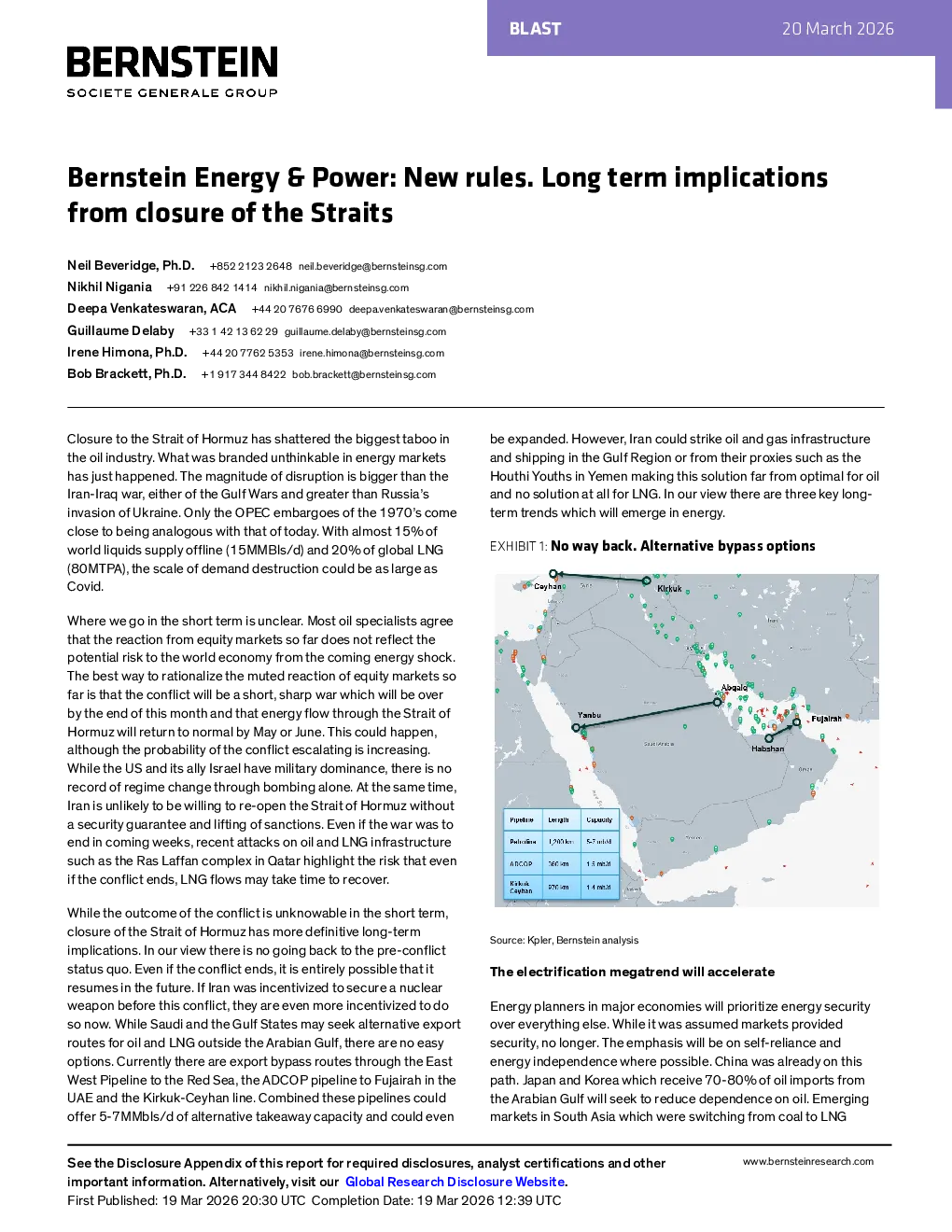
Neil Beveridge, Ph.D.+852 2123 2648neil.beveridge@bernsteinsg.comNikhil Nigania+91 226 842 1414nikhil.nigania@bernsteinsg.comDeepa Venkateswaran, ACA+44 20 7676 6990deepa.venkateswaran@bernsteinsg.comGuillaume Delaby+33 1 42 13 62 29guillaume.delaby@bernsteinsg.comIrene Himona, Ph.D.+44 20 7762 5353irene.himona@bernsteinsg.comBob Brackett, Ph.D.+1 917 344 8422bob.brackett@bernsteinsg.com Closure to the Strait of Hormuz has shattered the biggest taboo inthe oil industry. What was branded unthinkable in energy marketshas just happened. The magnitude of disruption is bigger than theIran-Iraq war, either of the Gulf Wars and greater than Russia’sinvasion of Ukraine. Only the OPEC embargoes of the 1970’s comeclose to being analogous with that of today. With almost 15% ofworld liquids supply offline (15MMBls/d) and 20% of global LNG(80MTPA), the scale of demand destruction could be as large asCovid. be expanded. However, Iran could strike oil and gas infrastructureand shipping in the Gulf Region or from their proxies such as theHouthi Youths in Yemen making this solution far from optimal for oiland no solution at all for LNG. In our view there are three key long-term trends which will emerge in energy. Where we go in the short term is unclear. Most oil specialists agreethat the reaction from equity markets so far does not reflect thepotential risk to the world economy from the coming energy shock.The best way to rationalize the muted reaction of equity markets sofar is that the conflict will be a short, sharp war which will be overby the end of this month and that energy flow through the Strait ofHormuz will return to normal by May or June. This could happen,although the probability of the conflict escalating is increasing.While the US and its ally Israel have military dominance, there is norecord of regime change through bombing alone. At the same time,Iran is unlikely to be willing to re-open the Strait of Hormuz withouta security guarantee and lifting of sanctions. Even if the war was toend in coming weeks, recent attacks on oil and LNG infrastructuresuch as the Ras Laffan complex in Qatar highlight the risk that evenif the conflict ends, LNG flows may take time to recover. While the outcome of the conflict is unknowable in the short term,closure of the Strait of Hormuz has more definitive long-termimplications. In our view there is no going back to the pre-conflictstatus quo. Even if the conflict ends, it is entirely possible that itresumes in the future. If Iran was incentivized to secure a nuclearweapon before this conflict, they are even more incentivized to doso now. While Saudi and the Gulf States may seek alternative exportroutes for oil and LNG outside the Arabian Gulf, there are no easyoptions. Currently there are export bypass routes through the EastWest Pipeline to the Red Sea, the ADCOP pipeline to Fujairah in theUAE and the Kirkuk-Ceyhan line. Combined these pipelines couldoffer 5-7MMbls/d of alternative takeaway capacity and could even The electrification megatrend will accelerate Energy planners in major economies will prioritize energy securityover everything else. While it was assumed markets providedsecurity, no longer. The emphasis will be on self-reliance andenergy independence where possible. China was already on thispath. Japan and Korea which receive 70-80% of oil imports fromthe Arabian Gulf will seek to reduce dependence on oil. Emergingmarkets in South Asia which were switching from coal to LNG will rethink these plans given high dependence on LNG fromQatar. As will Europe which has been hit by the double whammyof Russia and now the Middle East. Without fossil fuels the onlyway these countries can become more energy independent, isthrough investment in solar, wind and massive build out of batteryenergy storage and grid capacity to support this. Electrificationof transport will get a new lease of life. China will seek to electrifynot just EV’s, but also commercial vehicles, aviation and shipping.Other countries are likely to see an acceleration in electric vehiclesales as gasoline prices rise (assuming power prices don’t rise evenmore). Nuclear power, which was regaining momentum, will alsoexperience a renaissance as a source of baseload power supply.Coal, which is not a long-term solution to the energy transition,could benefit as countries switch back from LNG to lower cost coal. rise. LNG-Ex Middle East and Russian Gas The US and Qatar are the largest LNG exporters in the world. Qatarwhich produces about 80MTPA (20% of world supply) and is ontrack to expand this to 140MTPA. With the potential risk of closurethrough Straits of Hormuz, it is increasingly likely that countries willseek to diversify their supply away from the Middle East. The largestalternative to the Middle East of course is the US, which will be anoption for many countries, although not for counties such as China.While some of these alternatives are higher cost, they are likely tosee renewed interest. Possibl