黄金是避风港,白银是通配符
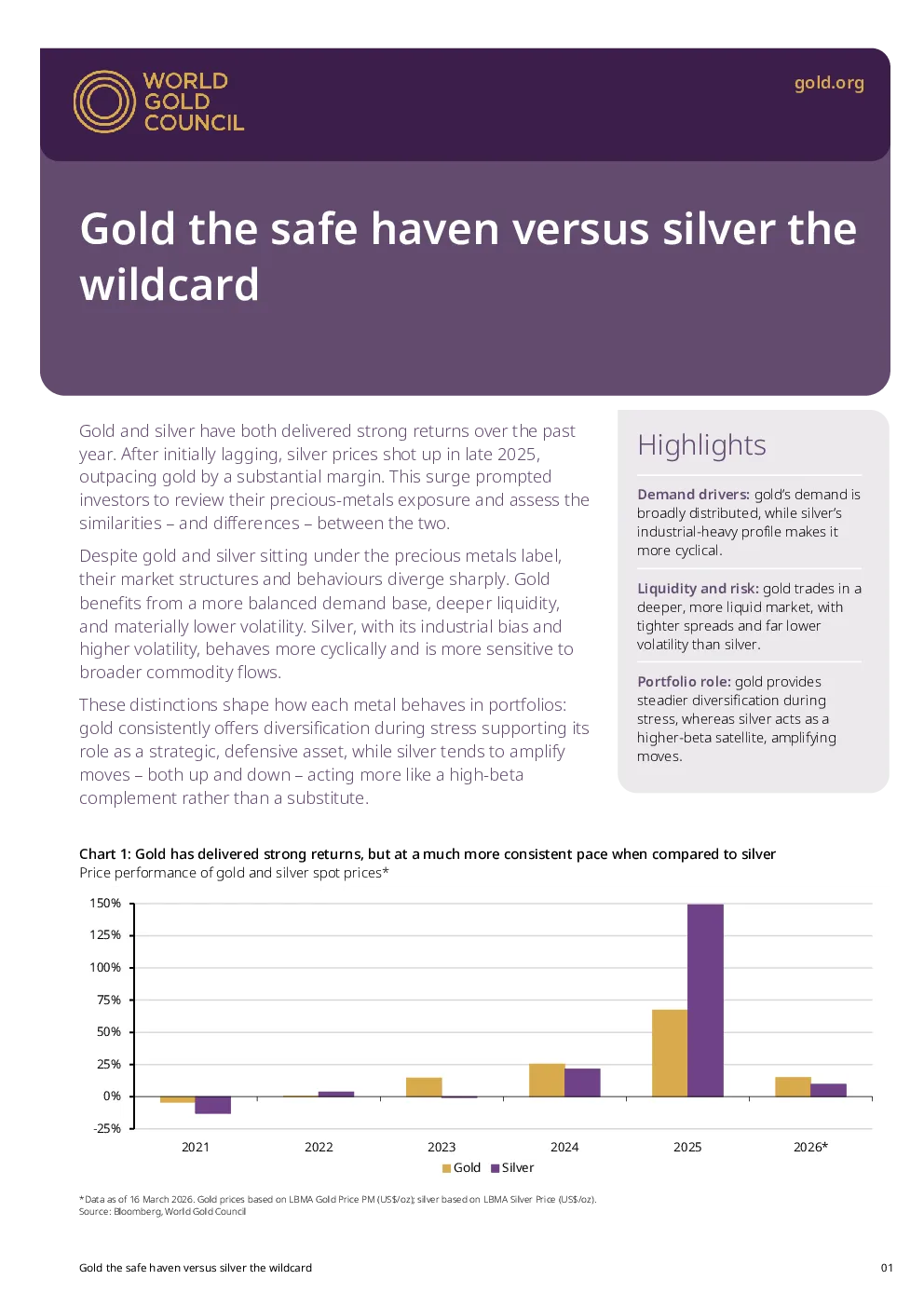
Gold the safe havenversussilver thewildcard Gold and silver havebothdelivered strong returnsover thepastyear.After initiallylagging, silver pricesshot upinlate 2025,outpacinggold by a substantial margin. Thissurgepromptedinvestorstoreviewtheir precious-metals exposureandassessthesimilarities–and differences–between the two. Highlights Demand drivers:gold’sdemand isbroadly distributed, while silver’sindustrial-heavy profile makes itmore cyclical. Despitegold and silver sittingunder the precious metals label,their market structures and behaviours diverge sharply. Goldbenefits from a more balanced demand base, deeper liquidity,and materially lower volatility. Silver, with its industrial bias andhigher volatility, behaves more cyclically and is more sensitive tobroader commodity flows. Liquidityand risk:goldtrades in adeeper, more liquid market,withtighter spreads and far lowervolatility than silver. Portfolio role:goldprovidessteadier diversificationduringstress, whereas silver acts as ahigher‑beta satellite, amplifyingmoves. These distinctions shape how each metal behaves in portfolios:gold consistently offers diversification during stresssupporting itsrole as a strategic,defensive asset, while silver tends to amplifymoves–both up and down–acting more like a high‑betacomplementratherthan a substitute. Mexico alone producing nearly twice as much as China (2nd).This makes silver more susceptible to supply shocks. Market structure: Contrasting supply anddemand forces Chart4: Gold production is more geographically diverseNumber of top 10 producers by region Gold’s dispersed demand vs silver’s cyclical sensitivity Gold and silver are often put into the same bucket, but eachis characterised by unique attributes and drivers. One keydistinction between the two is their end-demand mix. Gold has a well-balanced dual nature, as both a consumergood and an investment asset(Chart2). Gold is also anintegral component to central bank foreign reserves, a trendthat has picked up steam in recent years. And while goldinvestment demand dominates during periods of risk,consumer demand tends to step in during periods ofeconomic growth.Gold’s investment share helps explain whyit can behave more like a financial asset–sensitive to policydecisions and credit conditions–often supporting its role asa hedge. Silver demand, on the other hand, is dominated by industrydemand(Chart3). The metal’s dominant industrial shareincreases its exposure to pro-cyclical risk sentiment–raisingthe odds of it trading closer to industrial metals and riskyassets during periods of market stress and economicdeceleration. Recycling also plays a much larger role in gold supply than insilver. Gold recycling contributes roughly one‑third of globalsupply, while silver recycling covers only about19% ofdemand.2Because so much silver is dispersed acrosselectronics, solar panels and industrial applications, recoveryis often uneconomical. As a result, gold benefits from a morestable secondary supply, whereas silver faces structurallytighter physical market conditions. Gold a primary product, silver a by-product From a supply perspective, gold and silver differsharply.Goldis predominantly mined as a primary product,while 70–80% of silver comes as a by‑product of copper, lead and zinc,making silver supply more exposed to disruptions in thosesectors.1Gold productionis also more geographicallydiverse(Chart4), whereas silver output is concentrated inLatin America–withMexico (1st), Peru (3rd), Bolivia (4th) andChile (6th)all ranking among the top ten producers. Chart2:Gold has a dual nature… Percentage of total gold demand* Percentage of total silver demand* Volatility–silver requires a different risk budget Market dynamics:the goldmarketissubstantiallylarger andmore liquid The by-product of wider spreads is higher volatility. Silver’svolatility is roughly twice that of gold(Chart6). Trading volumes–gold’s trading volumes far exceedsilver’s Thishas direct implications forinvestors, particularly in risk-parity frameworks:to targetequal risk contribution, thenotional allocation to silver typicallyneedsto be materiallysmaller thanforgold. The size and liquidity of the gold and silver markets differmarkedly. Gold is a deep market with an estimated US$15trillion in financial form–mostly physical bullion. It’s also anextremely liquid global asset, with trading activitycomparable to major bond and currency markets, whilesilver’s market is considerably smaller. Chart6: Silver’s higher volatility has implications forportfolio construction Dailyannualised volatility* As a proxy, we compare average daily trading volumes forthe two largest US-based physically-backed ETFs for eachmetal as well as COMEX futures and LBMA OTC activity. Overthe past five years, gold ETFs have averaged US$2.3bn perday versus US$0.7bn for silver, and the gap widens in futures(US$55bn vs. US$11bn) and OTC trading (US$97bn vs.US$13bn). Recent averages have been lifted by a surge in