您的浏览器禁用了JavaScript(一种计算机语言,用以实现您与网页的交互),请解除该禁用,或者联系我们。 [科法斯]:南非陷入了困境:如何摆脱经济停滞的陷阱? - 发现报告

南非陷入了困境:如何摆脱经济停滞的陷阱?

2025-10-22 科法斯 洪雁
报告封面

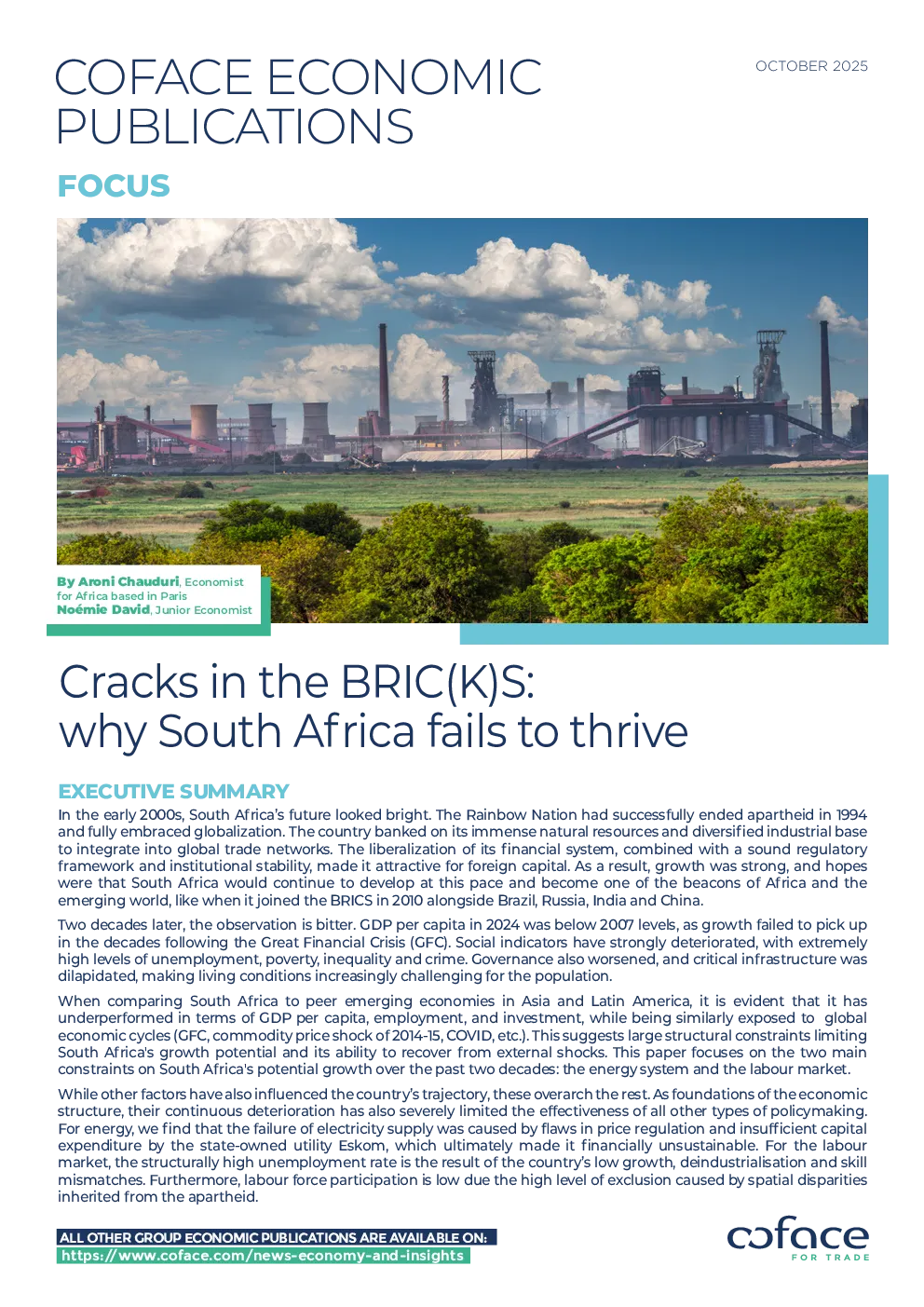
FOCUS By Aroni Chauduri,Economistfor Africa based in ParisNoémie David,Junior Economist Cracks in the BRIC(K)S:why South Africa fails to thrive EXECUTIVE SUMMARY In the early 2000s, South Africa’s future looked bright. The Rainbow Nation had successfully ended apartheid in 1994and fully embraced globalization. The country banked on its immense natural resources and diversified industrial baseto integrate into global trade networks. The liberalization of its financial system, combined with a sound regulatoryframework and institutional stability, made it attractive for foreign capital. As a result, growth was strong, and hopes Two decades later, the observation is bitter. GDP per capita in 2024 was below 2007 levels, as growth failed to pick upin the decades following the Great Financial Crisis (GFC). Social indicators have strongly deteriorated, with extremelyhigh levels of unemployment, poverty, inequality and crime. Governance also worsened, and critical infrastructure was When comparing South Africa to peer emerging economies in Asia and Latin America, it is evident that it hasunderperformed in terms of GDP per capita, employment, and investment, while being similarly exposed toglobaleconomic cycles (GFC, commodity price shock of 2014-15, COVID, etc.). This suggests large structural constraints limiting While other factors have also influenced the country’s trajectory, these overarch the rest. As foundations of the economicstructure, their continuous deterioration has also severely limited the effectiveness of all other types of policymaking.For energy, we find that the failure of electricity supply was caused by flaws in price regulation and insufficient capitalexpenditure by the state-owned utility Eskom, which ultimately made it financially unsustainable. For the labour When South Africa entered the BRICS in 2010, there were hopes that it would continue to develop at the pace of the previous decade. Itsstrengths were many: a plethora of natural resources, a developed and diverse industrial base, a large and well capitalized financial sector,stable institutions and infrastructure far more advanced than most of its peers. However, it did not happen. The country has been stuck When compared to similar emerging economies1- such as Brazil, Colombia, Chile, and Malaysia - only South Africa experienced a decline inGDP per capita relative to 2007 levels(Chart 1). Brazil, which also underperformed until 2019, began to rebound after the global pandemic2. Source: World Bank, Macrobond, Coface BOX 1:An economic structure built around mineral resources While the South African mining industry’s weight in real terms has declined from around 20% of GDP in the 1960s to below 4.5% currently,it remains a core component of the economy. This is linked to the economic structure that resulted from the country’s industrializationprocess. Indeed, it had been largely driven by the development of an industrial system centred around the extraction of natural resources This was accompanied by the development of processing industries such as metals (basic iron & steel, non-ferrous basic metals, etc.),chemicals (fertilizers, basic chemicals, etc.), petroleum & coke (liquid fuels from coal). This industrial structure, characterized by theconcentration of the economy in specific sectors highly linked to each other and the concentration of the ownership of capital, meant that Moreover, as large amounts of financing were required by the mining industry, this promoted the expansion of the domestic financialsector. In essence, the backbone of the South African economy was established during this phase. In the post-apartheid period, capitalwas liberalized and deregulated, allowing corporates to relist overseas, leading to the restructuring of these large conglomerates and the In economic literature, some advocate that this configuration, known as the “minerals-energy complex”6, went beyond the economicsphere and has shaped South Africa’s trajectory since the beginning of the 20th century. This framework assumes that large private sectorconglomerates, supported by state monopolies (thus the public authorities), were able to direct capital flows towards their own industries by rising disposable incomes, lower inflation, relativelylow interest rates, and wealtheffects from increasinghousing and equity prices(Chart 4). linked to the electoral calendar. The Cape Town watercrisis4, which peaked in 2017–2018, further strained theeconomy by reducing agricultural output. In early 2020, the COVID-19 pandemic and lockdownsseverelydisrupted economic activity and publicfinances. Then, from 2023 onwards, GDP growth wasconstrainedby massive load-shedding and severedisruptionsto rail and port operations,stemmingfrom operational and financial issues in key state- Constraints on potential growth Part of South Africa’s underperformance can be explainedby external shocks, but the stagnation of per capita GDPand erosion of investment for ov