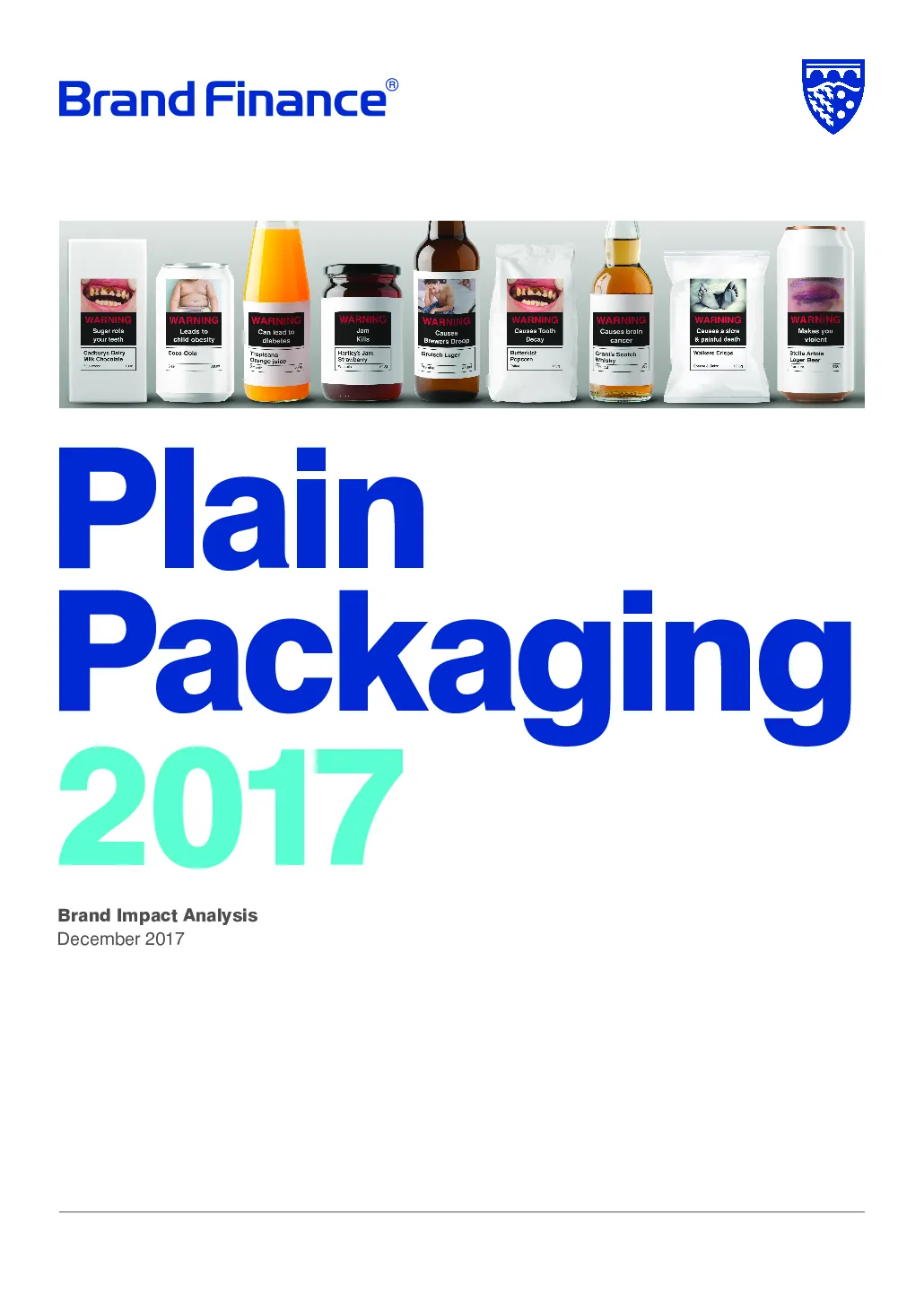
PlainPackaging2017 Executive Summary Contents Following the introduction of plain packaging for tobacco products and calls to extend the legislation toother sectors, Brand Finance has analysed the potential impact of such a policy on food and beveragebrands in four categories: alcohol, confectionery, savoury snacks, and sugary drinks. Brand Finance’s 8major brand-owning companies were analysed (sample based predominantly on the Fortune $187 billionof total implied loss in value as a result of reduced brand strength and Companies with alcohol and sugary drinks brands are most at risk: PepsiCo has the largest proportion of enterprise value at stake -27%The Coca-Cola Company would lose most in absolute terms -$47 billion Because of the observed vulnerability of the beverage industry to plain packaging, the resultswere then extrapolated across all alcohol and sugary drinks brands valued by Brand Finance in At least$293 billionof total implied loss across the beverage industry Background “It is not unimaginable thatbottles of Château MoutonRothschild, which once borethe artwork of Salvador Dalí and drinks since the 1930s and in the intervening decadesdozens of countries have followed suit; the UK and Ireland have legislation set to come into force in 2018. Scotland willbecome the first country in the world to introduce minimum Activists are increasingly advocating more intrusivemeasures than taxation, minimum pricing, and regulationof advertising, and the prospect of further applications ofplain packaging looks increasingly likely. Already in 2015,the WHO-backedTobacco Atlas, called for extending plainpackaging to alcohol and some food and drink products in The Lancet, November 2017 In March this year, Cambridge academic Wolfram Schultz,winner of the €1 million Brain Prize for the understandingof decision-making, made a widely publicised call for plainpackaging to be applied to fatty, salty foods to improvepublic health. In June, ahead of their annual conference,the British Medical Association called for cigarette-stylelabels on sweets “to help wean children off sugar.” Inthe same week, a lobby group in Australia, the Obesity Plain packaging is often referred to as a branding ban orbrand censorship. By imposing strict rules and regulations,the legislator requires producers to remove all branded 20 years. In addition, demand for the cheapest optionsof all, counterfeit or trafficked cigarettes, has increased,empowering criminals and increasing the burden on Philosophical debates about whether it is even the place ofthe state to ‘nudge’ citizens towards healthier decisions or Australia, France, the UK, and Ireland have alreadyimplemented plain packaging for tobacco productswhile many others, including Norway, Georgia, Slovenia,Hungary, and New Zealand have legislated for it. However, Despite the ongoing disagreement, it appears as thoughplain packaging in the tobacco sector may have setlegislators on a slippery slope that could see more productssubject to similar measures. Alcohol, confectionery, savourysnacks, and sugary drinks can all have negative health To apply plain packaging to alcohol, confectionery, savourysnacks, and sugary drinks would render some of theworld’s most iconic brands unrecognisable, changing the Advocates claim that plain packaging removes the visualcues that prompt existing users to purchase the productand that it prevents children or other potential new We have therefore felt it pertinent to examine the potentialfinancial impact of such a policy and conducted a study tomodel the brand and business value impact of a broader On the other hand, opponents suggest that, despite havingbeen in place in Australia since December 2012, there isstill no reliable evidence that plain packaging works toachieve such aims. They claim that the removal of brandinghas merely led to commoditisation with well-established Today, this view is being challenged worldwide as moreand more countries introduce regulations in an attemptto prevent obesity and lifestyle diseases. Numerousjurisdictions apply restrictions on the times when certain A comprehensive examination of every affected brand ata global level would of course be impractical. However,a look at just a handful of the world’s biggest and most of the brand strength of each of the 907 brands ownedby these eight firms indicates a loss to enterprise value of Brand Finance’s latest research points to potential losses of$186.7 billion for eight major food and drink brand-owningcompanies, if plain packaging legislation were to be applied The contribution of the analysed brands to their parentcompanies would fall 33.9% from $551.0 billion to $364.3billion, seeing overall enterprise value fall 16.5% from$1.133 trillion to $946.6 billion (Fig.1). To put this intocontext, this loss, from just a handful of companies, is Due to concerns over the health impacts of smoking, plainpackaging for cigarettes has already been introduced orlegisl