您的浏览器禁用了JavaScript(一种计算机语言,用以实现您与网页的交互),请解除该禁用,或者联系我们。 [美国银行]:债务在哪里增长? - 发现报告

债务在哪里增长?

金融 2025-08-01 美国银行 记忆待续
报告封面

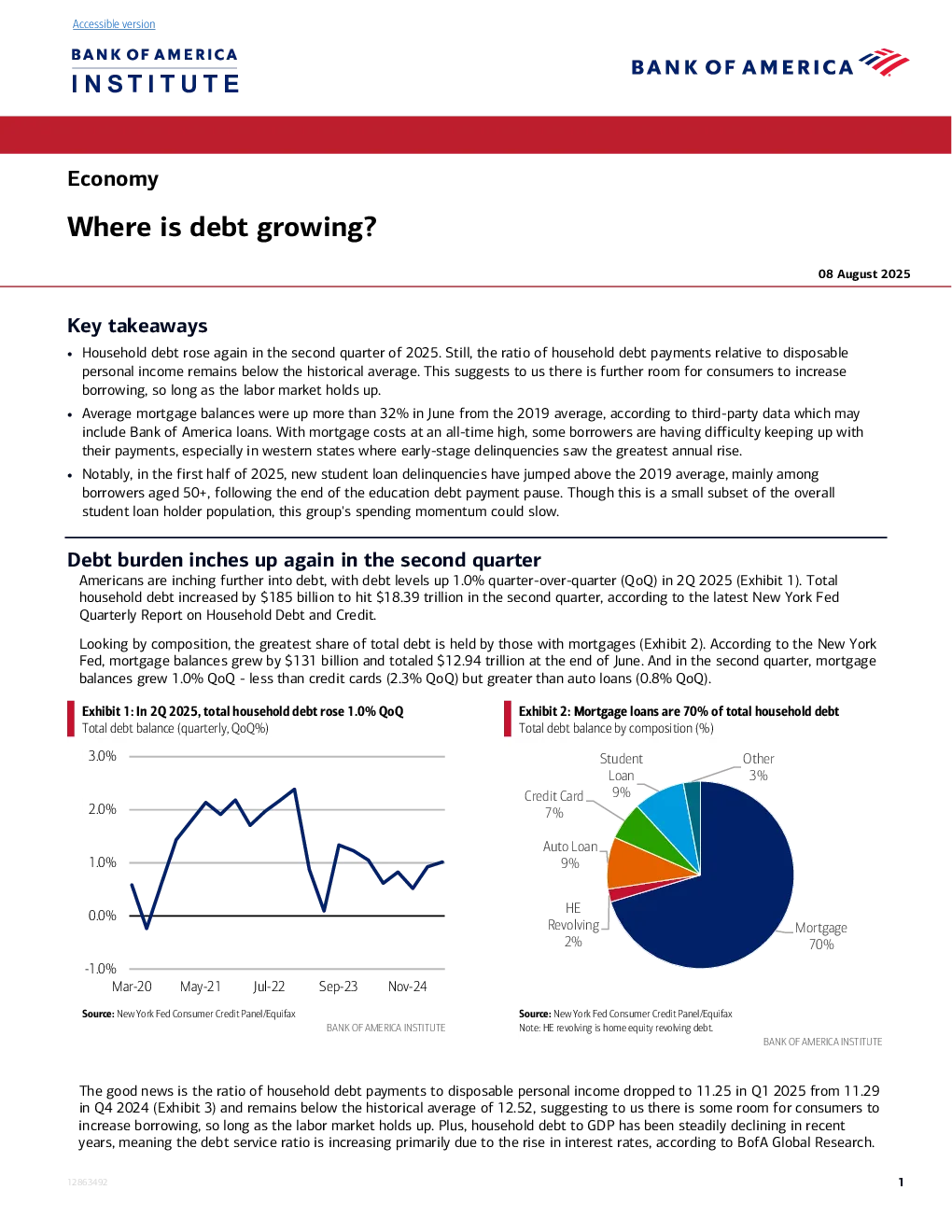
Where is debt growing? Key takeaways •Household debt rose again in the second quarter of 2025. Still, the ratio of household debt payments relative to disposablepersonal income remains below the historical average. This suggests to us there is further room for consumers to increaseborrowing, so long as the labor market holds up. •Average mortgage balances were up more than 32% in June from the 2019 average, according to third-party data which mayinclude Bank of America loans. With mortgage costs at an all-time high, some borrowers are having difficulty keeping up withtheir payments, especially in western states where early-stage delinquencies saw the greatest annual rise. •Notably, in the first half of 2025, new student loan delinquencies have jumped above the 2019 average, mainly amongborrowers aged 50+, following the end of the education debt payment pause. Though this is a small subset of the overallstudent loan holder population, this group's spending momentum could slow. Debt burden inches up again in the second quarterAmericans are inching further into debt, with debt levels up 1.0% quarter-over-quarter (QoQ) in 2Q 2025 (Exhibit 1). Total household debt increased by $185 billion to hit $18.39 trillion in the second quarter, according to the latest New York FedQuarterly Report on Household Debt and Credit. Looking by composition, the greatest share of total debt is held by those with mortgages (Exhibit 2). According to the New YorkFed, mortgage balances grew by $131 billion and totaled $12.94 trillion at the end of June. And in the second quarter, mortgagebalances grew 1.0% QoQ - less than credit cards (2.3% QoQ) but greater than auto loans (0.8% QoQ). Total debt balance by composition (%) The good news is the ratio of household debt payments to disposable personal income dropped to 11.25 in Q1 2025 from 11.29in Q4 2024 (Exhibit 3) and remains below the historical average of 12.52, suggesting to us there is some room for consumers toincrease borrowing, so long as the labor market holds up. Plus, household debt to GDP has been steadily declining in recentyears, meaning the debt service ratio is increasing primarily due to the rise in interest rates, according to BofA Global Research. Household debt service ratio (quarterly, seasonally adjusted) Mortgage market mattersAccording to third-party loan account data, in June, the average mortgage loan balance was almost 32% above the 2019 average (Exhibit 4). Note that this data is representative of overall industry loans, and not specifically mortgage loans issued by Bank ofAmerica (see methodology for further details). While the rate of acceleration has slowed, the increased payment level could posecost pressures for some homeowners. Home sales remain lackluster amid high mortgage ratesMany people still have low mortgage rates from the pandemic era, making the overall debt service ratio still very low. For future homeowners, however, rising mortgage costs–driven both by higher mortgage rates and higher house prices–can pose risks. While the 2025 Bank of America Homebuyer Insights Report suggested more people expect better buying conditions this year(read more on this in ourMay On the Move publication), the National Association of Realtors data for June showed that year-over-year (YoY) there was no change in existing home sales–and month-over-month existing home sales fell 2.7%. So for nowthese higher costs, potentially combined with broader economic uncertainty, are contributing to a stagnant housing market. Exhibit5: In June,theaverage amount formortgages 60-149 dayspast due was up 21.3%Average amount for mortgages 60-149 days past due (3-month moving Exhibit4:In June, the average mortgage balance was more than32% above the 2019 averageAverage industry mortgage balance (monthly, indexed, 2019 average = average, monthly, YoY%) 100) Housing affordability has deteriorated by 28% since December 2021, before Fed rate hikes in 2022, and since then, new andexisting home sales have declined 24% and 37% respectively in June, according to BofA Global Research. Additionally, BofA Global Research expects little change in mortgage rates, staying in the 6.5%-7.0% range at least through 2026, inferring that astagnant housing market may be with us for some time to come. Mortgage delinquency rates are down from last yearSince the post-pandemic housing boom, homebuyers have taken out larger mortgages amid rising home prices, and for some, it has now become harder to keep up with those payments. And according to BofA Global Research, the challenge is most acute forthose who got mortgages in the past couple of years at high home prices and high mortgage rates, especially lower-incomeFederal Housing Administration borrowers. In fact, according to third-party data on industry loan account trends, the rate of mortgages 60-149 days past due was up 21.3%YoY in June, having come down significantly from September 2024’s peak of more than 33% YoY (Exhibit 5). P