您的浏览器禁用了JavaScript(一种计算机语言,用以实现您与网页的交互),请解除该禁用,或者联系我们。 [美国银行]:跳槽者点击暂停 - 发现报告

跳槽者点击暂停

文化传媒 2025-08-01 美国银行 小烨
报告封面

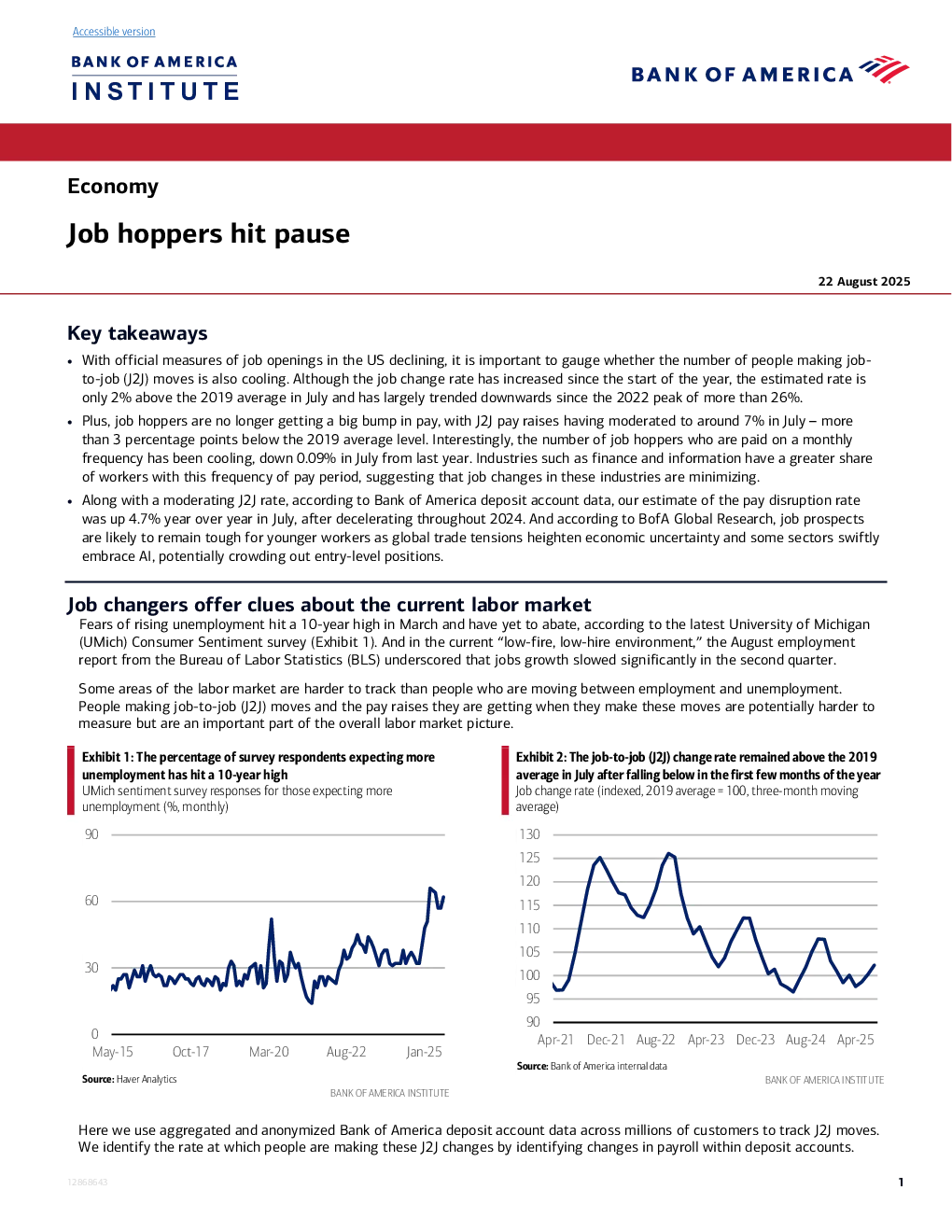
Job hoppers hit pause Key takeaways •With official measures of job openings in the US declining, it is important to gauge whether the number of people making job-to-job (J2J) moves is also cooling. Although the job change rate has increased since the start of the year, the estimated rate isonly 2% above the 2019 average in July and has largely trended downwards since the 2022 peak of more than 26%. •Plus, job hoppers are no longer getting a big bump in pay, with J2J pay raises having moderated to around 7% in July–morethan 3 percentage points below the 2019 average level. Interestingly, the number of job hoppers who are paid on a monthlyfrequency has been cooling, down 0.09% in July from last year. Industries such as finance and information have a greater shareof workers with this frequency of pay period, suggesting that job changes in these industries are minimizing. •Along with a moderating J2J rate, according to Bank of America deposit account data, our estimate of the pay disruption ratewas up 4.7% year over year in July, after decelerating throughout 2024. And according to BofA Global Research, job prospectsare likely to remain tough for younger workers as global trade tensions heighten economic uncertainty and some sectors swiftlyembrace AI, potentially crowding out entry-level positions. Job changers offer clues about the current labor marketFears of rising unemployment hit a 10-year high in March and have yet to abate, according to the latest University of Michigan (UMich) Consumer Sentiment survey (Exhibit 1). And in the current“low-fire, low-hire environment,”the August employmentreport from the Bureau of Labor Statistics (BLS) underscored that jobs growth slowed significantly in the second quarter. Some areas of the labor market are harder to track than people who are moving between employment and unemployment.People making job-to-job (J2J) moves and the pay raises they are getting when they make these moves are potentially harder tomeasure but are an important part of the overall labor market picture. Exhibit1: The percentage ofsurveyrespondents expecting moreunemployment has hit a 10-year highUMich sentiment survey responses for those expecting more Exhibit2: The job-to-job (J2J) change rate remainedabove the 2019average in July after falling below in the first few months of the yearJob change rate (indexed, 2019 average = 100, three-month moving unemployment (%, monthly) average) Here we use aggregated and anonymized Bank of America deposit account data across millions of customers to track J2J moves.We identify the rate at which people are making these J2J changes by identifying changes in payroll within deposit accounts. Exhibit 2shows an estimated J2J change rate from Bank of America data. The job change rate has improved since the start ofthe year. The estimated rate was only 2% above the 2019 average in July and has largely trended downwards since the 2022peak of more than 26%. White-collar job hopping comes to a haltBank of America deposit data also shows that wage disparities are widening (read more on this in theAugust Consumer Checkpoint). In fact, we see that the gap between higher- and lower-income wage growth has now reached the highest sinceFebruary 2021. Thus, the labor market appears to have deteriorated most significantly for lower-income workers. Within the J2J data, we also found that there has been some divergence among job changers by pay frequency type (Exhibit 3).According to the Bureau of Labor Statistics (BLS), in 2023, biweekly was the most common length of pay period, around 43%,followed by weekly pay periods (27%). Interestingly, job hoppers with monthly pay have been cooling, with the rate down 0.09%, while weekly pay is strongest, up0.13% in July on a three-month moving average. Industries with the greatest share of monthly pay are financial activities,professional & business services, and information, all of which skew towards higher-income jobs.1This suggests that fewerpeople are changing jobs in these industries compared to industries such as construction and manufacturing, where weekly payis more heavily concentrated and labor supply issues are already at play (read more on this in ourAugust Small BusinessCheckpoint). Job hopping has become less lucrativeWith signs that J2J moves are gradually moderating, we also find that job hoppers are getting smaller pay increases from their new employers.Exhibit 4shows an estimate using Bank of America data of the median pay raises of J2J switchers. Though therehas been a bounce-back from June, the increase declined to around 7% in July from more than 20% when the Great Resignationwas in full swing in 2022. It is notable that last month’s figure is below 2019 levels and, so far this year, has fallen further from the 2024 annual average.This is in line with data from the Atlanta Fed, which shows that in May, for the first time since 2010, wage growth for jobswitchers equaled that of those who remained wi