您的浏览器禁用了JavaScript(一种计算机语言,用以实现您与网页的交互),请解除该禁用,或者联系我们。 [美国银行]:薪水到薪水:放缓但增长 - 发现报告

薪水到薪水:放缓但增长

文化传媒 2025-11-01 美国银行 喜马拉雅
报告封面

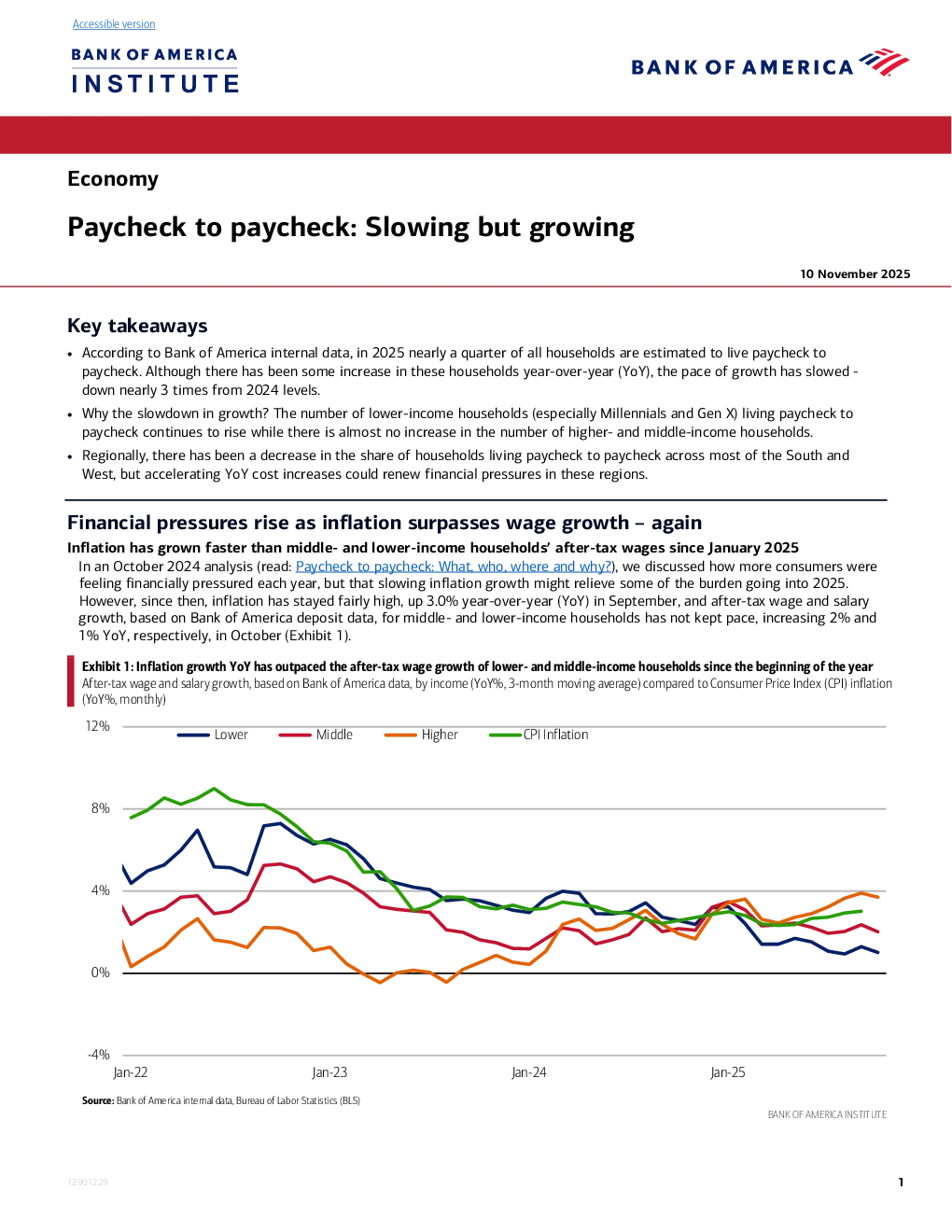
Paycheck to paycheck: Slowing but growing 10 November 2025 Key takeaways •According to Bank of America internal data, in 2025 nearly a quarter of all households are estimated to live paycheck topaycheck. Although there has been some increase in these households year-over-year (YoY), the pace of growth has slowed -down nearly 3 times from 2024 levels. •Why the slowdown in growth? The number of lower-income households (especially Millennials and Gen X) living paycheck topaycheck continues to rise while there is almost no increase in the number of higher- and middle-income households.•Regionally, there has been a decrease in the share of households living paycheck to paycheck across most of the South andWest, but accelerating YoY cost increases could renew financial pressures in these regions. Financial pressures rise as inflation surpasses wage growth – again Inflation has grown faster than middle- and lower-income households’after-tax wages since January 2025In an October 2024 analysis (read:Paycheck to paycheck: What, who, where and why?), we discussed how more consumers were feeling financially pressured each year, but that slowing inflation growth might relieve some of the burden going into 2025.However, since then, inflation has stayed fairly high, up 3.0% year-over-year (YoY) in September, and after-tax wage and salarygrowth, based on Bank of America deposit data, for middle- and lower-income households has not kept pace, increasing 2% and1% YoY, respectively, in October (Exhibit 1). Exhibit1:Inflation growth YoY has outpaced theafter-taxwage growth of lower-and middle-income households since the beginning of the yearAfter-tax wage and salary growth, based on Bank of America data, by income (YoY%, 3-month moving average) compared to Consumer Price Index (CPI) inflation(YoY%, monthly) Although more people are living paycheck to paycheck, the rate of growth has slowed year-over-yearOne way to measure how slowing wages and sticky inflation levels are pressuring consumers’wallets is to estimate the proportion of households living“paycheck to paycheck,”using Bank of America internal consumer deposit and spending data. We define living“paycheck to paycheck”using a fairly broad definition of necessity spending (see Methodology for details),covering areas such as housing, gasoline, groceries, utility bills, internet service provider subscriptions, public transportation, andchildcare. We then identify the proportion of households in which necessity spending is more than 95% of their household income, leavingthem relatively little or nothing left over for“nice-to-have”discretionary spending or savings. We use this as our centralindicator.Exhibit 2shows that nearly 24% of households so far in 2025 would be classified as living“paycheck to paycheck”based on our central indicator. This is a 0.3 percentage point increase on 2024, but a growth rate nearly three times lower thanlast year. And in case this definition is too restrictive, we also evaluate the share of households where necessity spending is more than90% of their household income. This alternative measure moved similarly. So, on both measures, more households are feeling the strain, but the rate of increase in their numbers has slowed. Exhibit2:The rate of growth in the share of households living paycheck to paycheck was three times higher in 2024 than in 2025Proportion of households where necessity spending exceeds 95% and 90% of theirhouseholdincome (%) Lower-income and middle-aged households bear the brunt of rising prices Higher-income households’ average wage growth is accelerating compared to that of lower-income householdsBank of America internal data shows that the rise in households living paycheck to paycheck is primarily driven by lower-income households. In fact, 29% of lower-income households are living paycheck to paycheck, up from 28.6% in 2024 and 27.1% in2023 (Exhibit 3). However, there has been little to no increase in the share of middle- or higher-income households livingpaycheck to paycheck. Why are we only seeing an increase in lower-income households? In our view, it’s likely due to slowingwage growth for this cohort. In fact, wages for lower-income earners have been easing relative to their higher-income counterparts since the beginning of2025 (Exhibit 4), after having risen much faster in 2021-22, before cooling in 2023-24 and falling this year. Exhibit4: Lower-income households’ wages areeasing relative totheir higher-income counterpartsIndexed ratio of higher- and lower-income terciles of after-tax wages and Exhibit3:Lower-income households have the highest share andlargest increase of households living paycheck to paycheckProportion of households where necessity spending is above 95% of salaries, based on Bank of America customer data (index 2019 = 1,monthly, seasonally adjusted) their income, by income range (%, yearly) Lower-income Millennials and Gen X have seen the largest increases in financial pressu