您的浏览器禁用了JavaScript(一种计算机语言,用以实现您与网页的交互),请解除该禁用,或者联系我们。 [美国银行]:汽车:挂在低档? - 发现报告

汽车:挂在低档?

交运设备 2026-02-01 美国银行 玉苑金山
报告封面

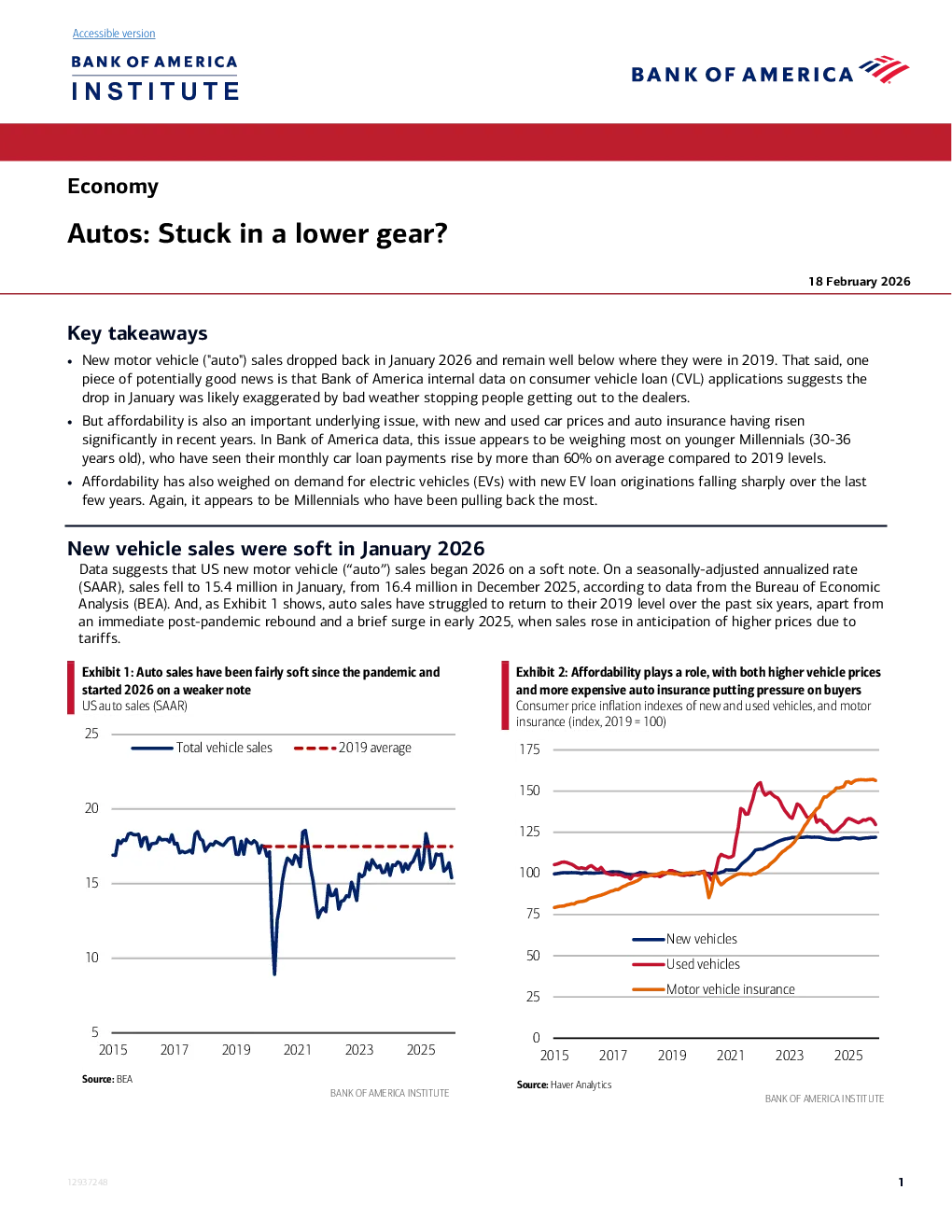
Autos: Stuck in a lower gear? Key takeaways •New motor vehicle ("auto") sales dropped back in January 2026 and remain well below where they were in 2019. That said, onepiece of potentially good news is that Bank of America internal data on consumer vehicle loan (CVL) applications suggests thedrop in January was likely exaggerated by bad weather stopping people getting out to the dealers. •But affordability is also an important underlying issue, with new and used car prices and auto insurance having risensignificantly in recent years. In Bank of America data, this issue appears to be weighing most on younger Millennials (30-36years old), who have seen their monthly car loan payments rise by more than 60% on average compared to 2019 levels. •Affordability has also weighed on demand for electric vehicles (EVs) with new EV loan originations falling sharply over the lastfew years. Again, it appears to be Millennials who have been pulling back the most. New vehicle sales were soft in January 2026Data suggests that US new motor vehicle (“auto”) sales began 2026 on a soft note. On a seasonally-adjusted annualized rate (SAAR), sales fell to 15.4 million in January, from 16.4 million in December 2025, according to data from the Bureau of EconomicAnalysis (BEA). And, asExhibit 1shows, auto sales have struggled to return to their 2019 level over the past six years, apart froman immediate post-pandemic rebound and a brief surge in early 2025, when sales rose in anticipation of higher prices due totariffs. USautosales(SAAR) Consumer price inflation indexes of new and used vehicles, and motorinsurance (index, 2019 = 100) We think affordability is a key factor likely driving weaker auto sales. Car prices have risen significantly over the past six years(Exhibit 2), though that rise appears to have largely stopped for now. New car prices are up around 22% on 2019 levels, whileused car prices have jumped around 30%, according to data from the Bureau of Labor Statistics (BLS). At the same time, thecost of insuring a vehicle has risen significantly. When combined, these hikes may have curbed vehicle demand, especiallycompared with other areas of consumer discretionary spending. Drop-off in car sales in January may largely have been a weather story…What does Bank of America internal data tell us about the car market currently? Well, one piece of potentially good news from our data on consumer vehicle loan (CVL) applications is that the drop-off in car sales in January may largely have been a weatherstory.Exhibit 3shows that CVL applications fell sharply in the final week of January, when some prospective buyers perhapscouldn’t get to their dealership due to winter weather. Aside from this period, CVL applications actually look ahead of January2025 levels. Exhibit3:Loan applications data suggests the soft start in 2026may have partially been a weather storyAverage daily Bank of America CVL applications for 2024, 2025 and 2026 Exhibit4:Demand appears to have been weakest among Millennialsover the past few yearsThe share of large* auto loan payments by generation (%) (7-day moving average, index, January 2024=100 ) We can also get a perspective on market dynamics by looking at weekly data on the number of Bank of America customersmaking large payments (above $2,000) to auto firms and vehicle finance providers. This data serves as a proxy for both new andused sales.Exhibit 4shows how the share of these payments has been changing across generations. Over the past five years, we have seen a rise in the share of Gen Z making these payments. This is not surprising, as many Gen Zconsumers are starting their careers and are at a life stage where they are likely purchasing a car. …but the broader story is affordability weighing on younger consumersMore interestingly, however, is that the share of Millennials making these large payments has been falling, rather than older (Gen X, Baby Boomers and Traditionalists) buyers.Why? In our view, affordability could be a big part of the story. Exhibit 5shows that the average auto loan payment from Bank of America customer accounts has risen most for youngerMillennials (ages 30-36), with the average auto loan payment from this cohort up nearly 60% from 2019. Older Millennials andGen Z have also experienced sizeable increases, each exceeding 40%. In some respects, it makes sense that younger Millennials have seen the largest rises in average loan payments. In the early2020s, many were likely engaged in household formation and potentially having children, all of which can precipitate the needfor a new or used–often larger–car. And they were doing this at a time when car prices were elevated and auto loan financingrates had risen as a result of Federal Reserve rate hikes. Averagehouseholdauto loan payment by generation (monthly, index, 2019=100) When we look at the distribution of auto loan payments, we see a rise in the share of larger monthly loan payments acrossgenerations refle