您的浏览器禁用了JavaScript(一种计算机语言,用以实现您与网页的交互),请解除该禁用,或者联系我们。[招银国际]:China Economy:Edging out of deflation - 发现报告

China Economy:Edging out of deflation

2026-03-10Frank Li招银国际落***
China Economy:Edging out of deflation

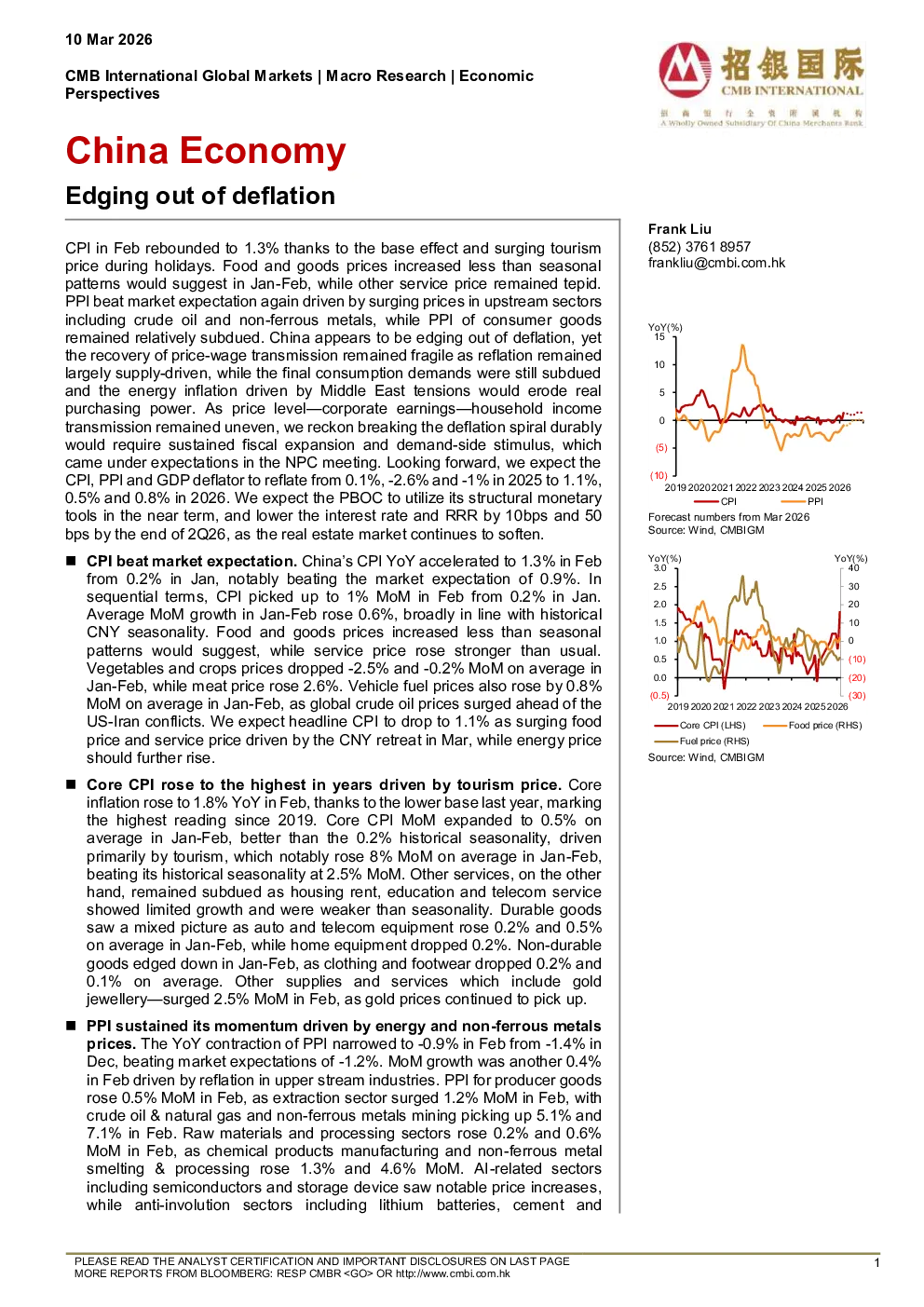
CMB International Global Markets |MacroResearch | EconomicPerspectives China Economy Edging outof deflation Frank Liu(852)3761 8957frankliu@cmbi.com.hk CPI in Feb rebounded to 1.3% thanks to the base effect and surging tourismprice during holidays. Food and goods prices increased less than seasonalpatterns would suggest in Jan-Feb, while other service price remained tepid.PPI beatmarket expectation again driven by surging pricesin upstream sectorsincluding crude oil and non-ferrous metals, while PPI of consumer goodsremained relatively subdued. China appears to be edging out of deflation, yetthe recovery of price-wage transmission remained fragile as reflation remainedlargely supply-driven, while the final consumption demands were still subduedand the energy inflation driven by Middle East tensions would erode realpurchasing power. As price level—corporate earnings—household incometransmission remained uneven, we reckon breaking the deflation spiral durablywould require sustained fiscal expansionanddemand-side stimulus, whichcame under expectations in the NPC meeting. Looking forward, we expect theCPI, PPI and GDP deflator to reflate from 0.1%,-2.6% and-1% in 2025 to 1.1%,0.5% and 0.8% in 2026. We expectthePBOC to utilize its structural monetarytools in the near term, and lower the interest rate and RRR by 10bpsand 50bps by the end of 2Q26, asthereal estate market continuesto soften. Forecast numbers from Mar 2026Source: Wind, CMBIGM CPI beat market expectation.China’s CPIYoY accelerated to 1.3% in Febfrom 0.2% in Jan, notably beating the market expectation of 0.9%. Insequential terms, CPIpicked up to 1% MoM in Feb from 0.2% in Jan.Average MoM growth inJan-Feb rose 0.6%, broadly in line with historicalCNY seasonality. Food and goods prices increased less than seasonalpatternswould suggest, while service price rose stronger than usual.Vegetables and crops pricesdropped-2.5% and-0.2% MoM on averageinJan-Feb, while meat price rose 2.6%.Vehicle fuel prices alsorose by 0.8%MoMon average in Jan-Feb,as global crude oil prices surged ahead of theUS-Iran conflicts. We expect headline CPIto drop to 1.1% as surging foodprice and service price driven bytheCNY retreat in Mar, while energy priceshould further rise. Core CPIrose tothehighest in yearsdriven by tourism price.Coreinflation rose to 1.8% YoY in Feb, thanks to the lower base last year, markingthe highest reading since 2019.Core CPI MoM expanded to 0.5%onaverage in Jan-Feb, better than the 0.2% historical seasonality, drivenprimarily by tourism, which notably rose 8% MoM on average in Jan-Feb,beating its historicalseasonality at 2.5% MoM. Other services, on the otherhand, remained subdued as housing rent, education and telecom serviceshowed limited growth and wereweaker than seasonality.Durable goodssawamixedpictureas auto and telecom equipmentrose 0.2% and 0.5%on average in Jan-Feb, while home equipmentdropped 0.2%. Non-durablegoods edged down in Jan-Feb, as clothing and footwear dropped 0.2% and0.1%on average.Other supplies and services which include goldjewellery—surged 2.5% MoMin Feb,as gold pricescontinued to pick up. PPIsustained its momentum driven by energy and non-ferrous metalsprices.The YoY contraction ofPPI narrowed to-0.9% in Feb from-1.4% inDec, beating market expectations of-1.2%. MoM growthwasanother 0.4%in Febdriven byreflation in upper stream industries.PPI for producer goodsrose 0.5% MoM in Feb, as extractionsector surged 1.2% MoM in Feb,withcrude oil & natural gas and non-ferrous metals mining pickingup 5.1% and7.1% in Feb. Raw materials and processing sectorsrose 0.2% and 0.6%MoM in Feb, as chemical products manufacturing and non-ferrous metalsmelting&processing rose 1.3%and 4.6%MoM.AI-related sectorsincluding semiconductors and storage device saw notable price increases,whileanti-involution sectors including lithium batteries,cement and photovoltaic equipment continued to see price reflation.However,downstream sectors remained subdued, as PPI of consumer goods stayednearlyflat at 0% MoM. Household necessities and clothing dropped by 0.4%and 0.2%MoMrespectively, while durable goods rebounded 0.3% in Feb. China is edging out of deflation, yet reigniting a sustained price-wagespiralremainsan uphill task.China appears to be edging out of deflation,with policymakers committed to returning CPIto positive territory. Yet,therecovery of price-wage transmission remained fragile: price gains in CPIwere largely driven by food and gold jewellery, while energy inflation drivenby Middle East tensions would erode real purchasing power rather thanstimulating it. The PPI divergence between resilient upstream energy andmetal pricesdriven by international commodities prices,against still-weakdownstreamconsumer goods,shows a possible broken transmissionmechanism,where rising input costs compress mid-and downstreammarginsrather than lifting them.Without a self-reinforcing wage-consumption cycle, this structural price uptick is better read as a mode