日本经济笔记
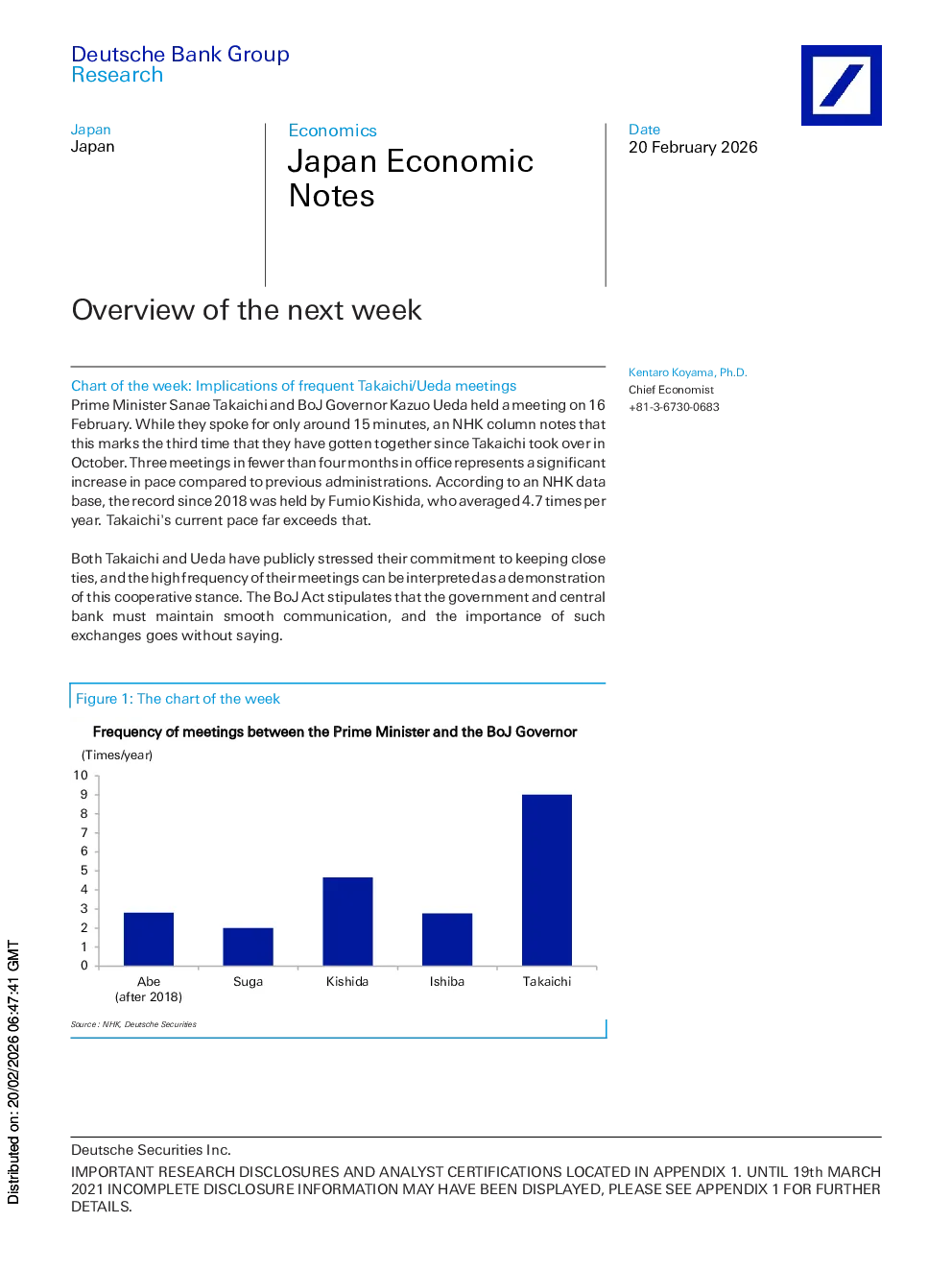
Overview of the next week Kentaro Koyama, Ph.D.Chief Economist Chart of the week: Implications of frequent Takaichi/Ueda meetings Prime Minister Sanae Takaichi and BoJ Governor Kazuo Ueda held a meeting on 16February. While they spoke for only around 15 minutes, an NHK column notes thatthis marks the third time that they have gotten together since Takaichi took over inOctober. Three meetings in fewer than four months in office represents a significant Both Takaichi and Ueda have publicly stressed their commitment to keeping closeties, and the high frequency of their meetings can be interpreted as a demonstrationof this cooperative stance. The BoJ Act stipulates that the government and central However, there is another perspective. Some financial market participants harbordeep concern over the independence of the BoJ in determining monetary policy.These concerns were magnified by an incident in January when it was reported that Thus, while the numerous meetings between the prime minister and central bankgovernor showcase a spirit of cooperation, we believe they could also heightenmarket anxiety that the bank’s independence is being compromised. Indeed, Next week’s indicators nService Producer Price Index for January (25 February):We expect theindex to be up 2.6% YoY in January, unchanged from the previous month.Large companies have been offering greater wage hikes than last yearduring the springshuntolabor talks, putting upward pressure on laborcosts. Service industries, where labor costs account for a high portion of nTokyo CPI for February (27 February):We anticipate core CPI inflationexcluding fresh food of 1.7% YoY (January: +2.0%) and core-core CPIinflation excluding fresh food and energy of 2.4% (+2.4%). Governmentsubsidies for electricity and gas, which resumed in January, should be fullyreflected in the figures in February and should be the primary factor pushingdown core inflation via lower energy prices. Core-core inflation is not nIndustrial production for January (27 February):We expect a robust 4.5%MoM gain. The Lunar New Year fell in mid-February this year, later thanusual, resulting in a considerable increase in export shipments in January.Thus, the projected rise is due to temporary factors and is unlikely to prove Monetary policy events nBoJ policy board member appointment (25 February):A candidate tosucceed BoJ policy board member Asahi Noguchi, whose term expires atend-March, is expected to be submitted to the Diet as early as 25 February.A replacement for Junko Nakagawa, who will step down in June, may benominated at the same time. These appointments offer a good chance forthe Takaichi administration to demonstrate its stance on economic andmonetary policy to the world and will have crucial implications for the future only one of the board’s nine members to propose a rate hike at the bank’sJanuary meeting. He can be expected to call for an increase again in March,so market interest is likely to be keen regarding his views on the pace of Figure 3: Important schedule 25 Feb 2026Submission of the nomination for the BoJ's policy board member to the Diet5 Mar 2026Shunto survey on wage hike requests from labor unions Note: Shading denotes recessions.Sources: METI, Deutsche Securities Sources: METI, Deutsche Securities Sources: MoF, Deutsche Securities Note: Excluding shipbuilding and electricity.Sources: Cabinet Office, Deutsche Securities Note: Excluding the consumption tax hike effectSources: MIC, Deutsche Securities Source: Deutsche Securities Sources: MoF, Deutsche Securities Sources: BoJ, Deutsche Securities Sources: Bloomberg Finance LP, Deutsche Securities Sources: Bloomberg Finance LP, Deutsche Securities Note: Excluding effects from consumption tax hike.Sources: Bloomberg Finance LP, Deutsche Securities Sources: Haver Analytics, Deutsche Securities Sources: Haver Analytics, Deutsche Securities Sources: Haver Analytics, Deutsche Securities Appendix 1 Important Disclosures *Other information available upon request *Prices are current as of the end of the previous trading session unless otherwise indicated and are sourced from localexchanges via Reuters, Bloomberg and other vendors . Other information is sourced from Deutsche Bank, subject companies,and other sources. For further information regarding disclosures relevant to Deutsche Bank Research, please visit our globaldisclosure look-up page on our website at https://research.db.com/Research/Disclosures/FICCDisclosures. Aside from withinthis report, important risk and conflict disclosures can also be found at https://research.db.com/Research/Disclosures/ Analyst Certification The views expressed in this report accurately reflect the personal views of the undersigned lead analyst(s). In addition, theundersigned lead analyst(s) has not and will not receive any compensation for providing a specific recommendation or view Additional Information The information and opinions in this report were prepared b