您的浏览器禁用了JavaScript(一种计算机语言,用以实现您与网页的交互),请解除该禁用,或者联系我们。[罗兰贝格]:主权指南针 - 发现报告

主权指南针

AI智能总结
查看更多
主权指南针

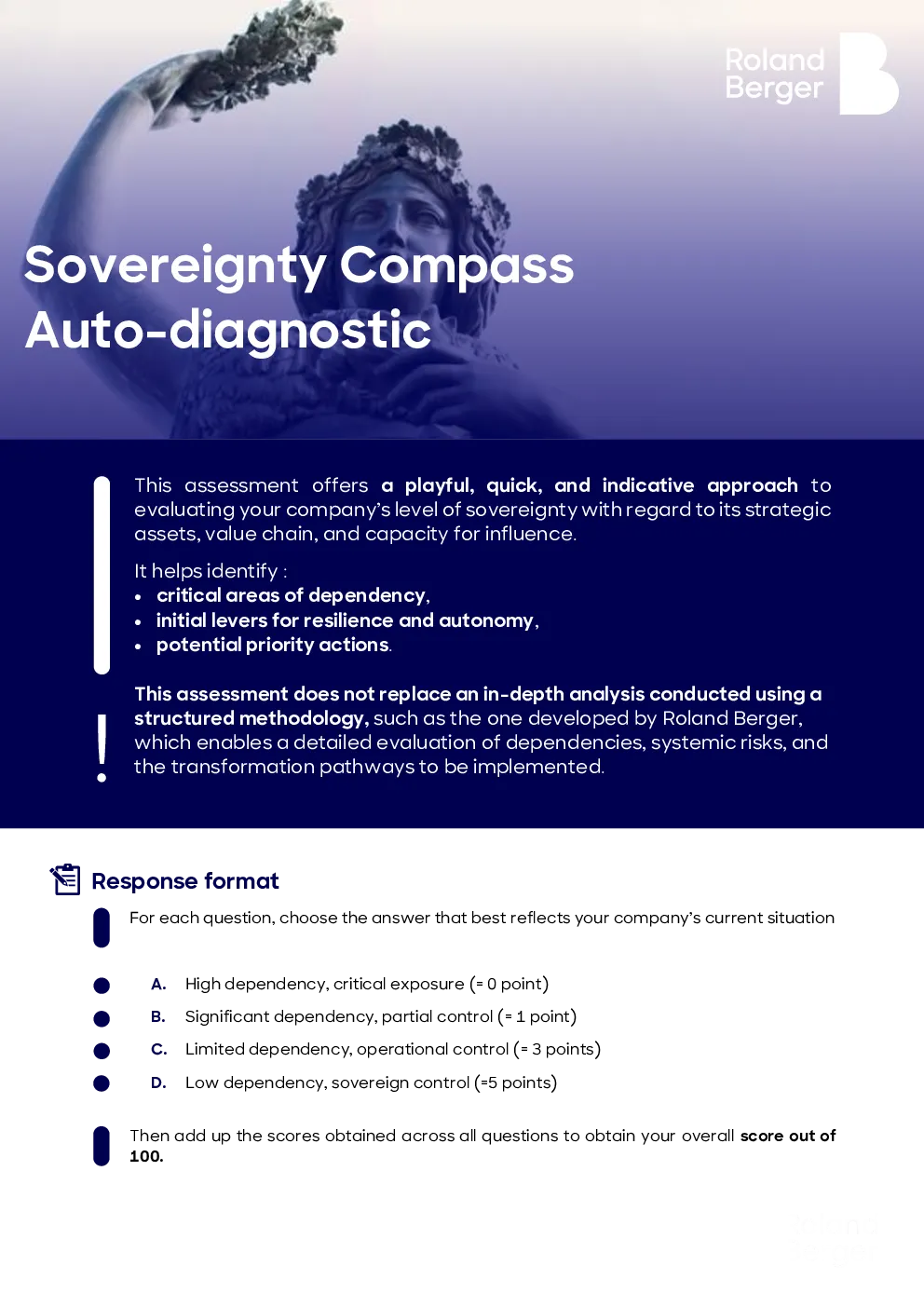
Thisassessment offers a playful,quick,and indicative approach toevaluating your company’s level of sovereignty with regard to its strategicassets, value chain, and capacity for influence. It helps identify:critical areas of dependency, ••initial levers for resilience and autonomy,•potential priority actions. This assessment does not replace an in-depth analysis conducted using astructured methodology,such as the one developed by Roland Berger,which enables a detailed evaluation of dependencies, systemic risks, andthe transformation pathways to be implemented. Response format For each question, choose the answer that best reflects your company’s current situation A.High dependency, critical exposure(= 0 point)B.Significant dependency, partial control(= 1 point)C.Limited dependency, operational control(=3points)D.Low dependency, sovereign control(=5 points) Then add up the scores obtained across all questions to obtain your overallscore out of100. DIMENSION 1 1.Physical assets Q1.How many independent sites do the majority of our critical operations (production, datacenters, logistics, etc.) rely on? A.1 single site[0 POINT]B.2sites, but located in the same country or dependent on the same criticalinfrastructure[1 POINT]C.3 to 4 truly independent sites (different countries and infrastructures)[3POINTS]D.≥5 independent sites spread across multiple countries[5POINTS] Q2.For how long, and to what extent, can operations continue if one site is shut down? A.Near-total shutdown within a few days–critical disruption to customer deliveries[0 POINT]B.<50% of activity maintained for a few weeks–severe degradation in quality andlead times[1 POINT]C.50–80% of activity maintained for several months, with the ability to switch to asecond site not exposed to the same risks–limited but tangible customer impact[3 POINTS]D.>80% of activity sustainably maintained[5 POINTS] 2.Intangible assets (technologies & intellectual property) Q3.Do we control the technologies that are essential to our activities? A.Key technologies dependent on third parties (vendors, partners)[0 POINT]B.A mix of proprietary components and external components[1 POINT]C.Key technologies that are predominantly proprietary, with residualdependencies under control[3 POINTS]D.Full ownership and autonomous ability to modify or substitute[5 POINTS] Q4.Could we continue to operate if access to technologies or licensing conditions were tochange? A.No–shutdown or major loss of capacity[0 POINT]B.Yes–with high costs and extended timelines (>12 months)[1 POINT]C.Yes–with controlled adaptation (<12 months), with no major customer impactand no significant cost or time implications[3 POINTS]D.The question does not arise–the company controls the conditions of access totechnologies or licenses[5 POINTS] 3.Human capital Q5.To what extent would we face difficulties if one or more key profiles were to leave thecompany? A.Immediate blockage of a critical activity[0 POINT]B.Significant disruption for several months[1 POINT]C.Transition possible with limited loss of efficiency[3 POINTS] D.Smooth replacement with no major customer impact[5 POINTS] Q6. CHow do we ensure backup / succession for key individuals in critical skill areas? A.No formalization, strong individual dependency[0 POINT]B.Informal backup / succession[1 POINT]C.Partiallystructuredorganization(buddysystem,successionplanning,documentation)[3 POINTS]D.Systematic backup / succession[5 POINTS] 4. Innovation & R&D Q7.How are innovation priorities defined? How is technology scouting organized? A.Priorities dictated by partners or funders; opportunistic or non-existenttechnology scouting[0 POINT]B.Shared governance; partial technology scouting (trade shows, suppliers, weaksignals)[1 POINT]C.Internal governance; structured technology scouting (roadmaps, benchmarks,identified owners)[3 POINTS]D.Internal governance; technology scouting and R&D innovation integrated intoExecutive Committee priorities[5 POINTS] Q8.Are the technologies developed contractually protected? A.Rights held primarily by external partners[0 POINT]B.Shared rights or contractually fragile arrangements[1 POINT]C.Rights largely secured by the company[3 POINTS]D.Rights fully controlled[5 POINTS] 5.Data governance Q9.Which regulations do our critical data fall under? A.High regulatory exposure (e.g:U.S. Cloud Act)[0 POINT]B.Significant regulatory exposure[1 POINT]C.Controlled regulatory exposure (e.g:EU jurisdiction)[3 POINTS]D.Low regulatory exposure[5 POINTS] Q10.Who controls physical access to the company’s data? A.Service providers/ hyperscalers[1POINT]B.Shared control with contractual commitment[3POINTS]C.Tooled, audited, and traceable internal control[5 POINTS] DIMENSION 2 6.Sources of fouding Q11.Does one of our financial partners have the ability to limit or condition certain of ourtactical or strategic decisions? A.Dominant shareholder, majority investor, or a restricted banking pool withrestrictive covenants[0