您的浏览器禁用了JavaScript(一种计算机语言,用以实现您与网页的交互),请解除该禁用,或者联系我们。 [-]:美国的算法治理:联邦、州及市级政府人工智能部署的多层级案例分析 - 发现报告

美国的算法治理:联邦、州及市级政府人工智能部署的多层级案例分析

信息技术 2026-02-09 - - 飞鹤萘酚
报告封面

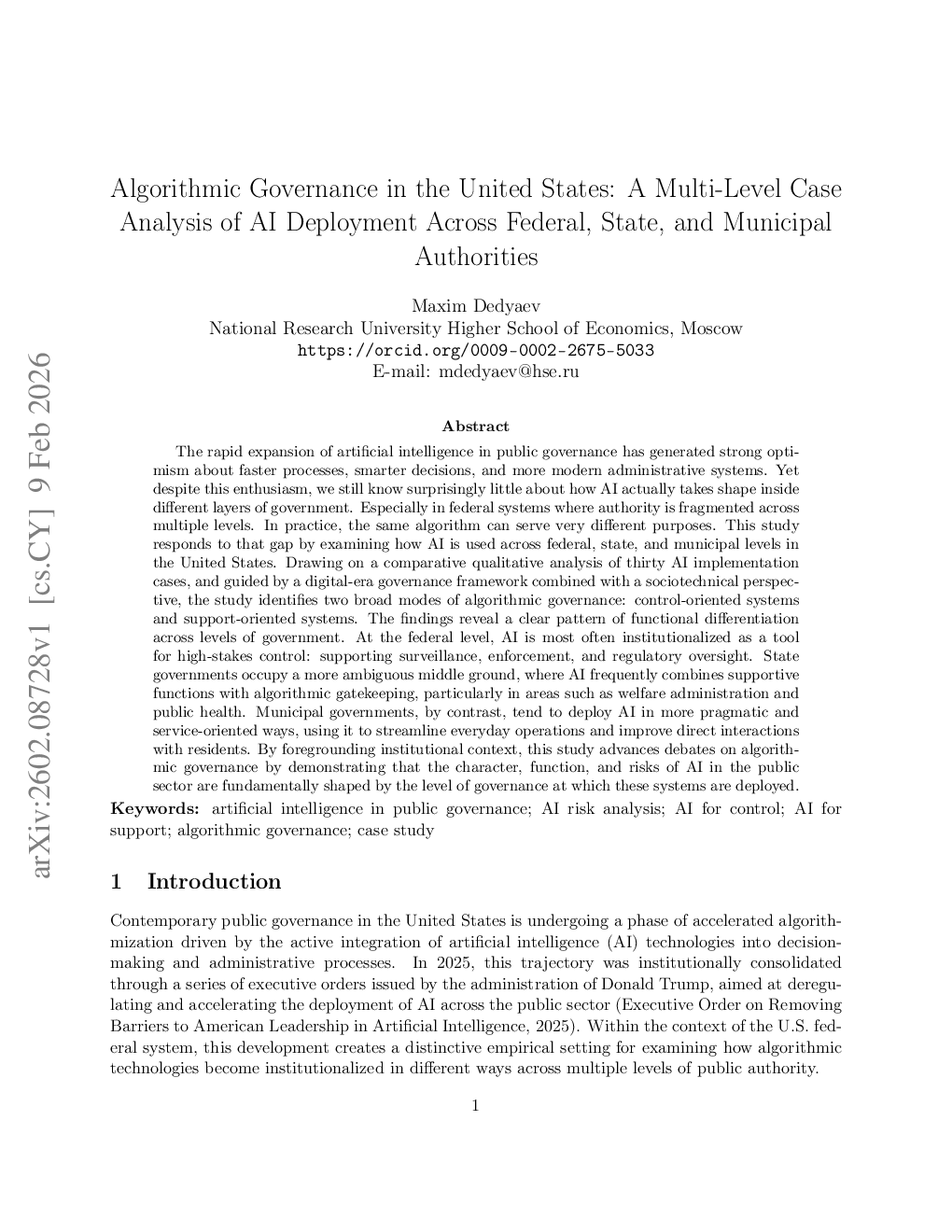
Maxim DedyaevNational Research University Higher School of Economics, Moscow Abstract The rapid expansion of artificial intelligence in public governance has generated strong opti-mism about faster processes, smarter decisions, and more modern administrative systems. Yetdespite this enthusiasm, we still know surprisingly little about how AI actually takes shape insidedifferent layers of government. Especially in federal systems where authority is fragmented acrossmultiple levels.In practice, the same algorithm can serve very different purposes.This studyresponds to that gap by examining how AI is used across federal, state, and municipal levels inthe United States. Drawing on a comparative qualitative analysis of thirty AI implementationcases, and guided by a digital-era governance framework combined with a sociotechnical perspec-tive, the study identifies two broad modes of algorithmic governance: control-oriented systemsand support-oriented systems.The findings reveal a clear pattern of functional differentiation Keywords:artificial intelligence in public governance; AI risk analysis; AI for control; AI for 1IntroductionarXiv:2602.08728v1 [cs.CY] 9 Feb 2026 Contemporary public governance in the United States is undergoing a phase of accelerated algorith-mization driven by the active integration of artificial intelligence (AI) technologies into decision-making and administrative processes.In 2025, this trajectory was institutionally consolidatedthrough a series of executive orders issued by the administration of Donald Trump, aimed at deregu-lating and accelerating the deployment of AI across the public sector (Executive Order on Removing The relevance of this study is further reinforced by the scale and pace of AI diffusion withinthe U.S. public sector. Available estimates indicate that the use of AI in public administration hasbeen expanding steadily, accompanied by strong expectations of efficiency gains and reductions inadministrative costs (SAS Institute, 2024; Deloitte Insights, 2023). Public-sector investment in AI isgrowing faster than in any other sector, with projected annual growth reaching 19 percent between2022 and 2027 (IDC Worldwide AI Spending Guide, 2024). The economic potential of algorithmizing The scale of AI adoption is particularly pronounced at the federal level. Within a single year, thenumber of officially registered AI use cases across major U.S. federal agencies more than doubled,including a sharp increase in the deployment of generative models (Federal Artificial IntelligenceUse Case Inventory, 2024).This momentum was further reinforced by the adoption of America’s At the state level, AI has rapidly evolved from an experimental technology into a core priorityof digital governance. By 2025, all U.S. states had either adopted or initiated regulatory and policymeasures addressing the integration and governance of AI within public administration (NASCIO, Similar dynamics are observable at the municipal level, where major U.S. cities have increasinglyemerged as hubs of practical AI deployment in routine administrative operations.According toprofessional associations, a substantial share of large U.S. municipalities already employs AI in at Despite the rapid diffusion of AI across federal, state, and municipal levels of public governancein the United States, scholarly understanding of how algorithmic systems transform administrativeprocesses remains fragmented. Existing research tends to focus either on individual levels of authority As a result, there is still no empirically grounded understanding of how institutional differencesacross levels of public authority shape distinct regimes of algorithmic governance within the U.S. Addressing this research gap, and taking into account the multi-level character of AI deploymentin the U.S. public sector, this study advances a comparative analysis of how algorithmic systems The central research question guiding the analysis is as follows: How do institutional differencesbetween federal, state, and municipal levels of authority in the United States give rise to distinct This study makes three key contributions to the fields of public administration and algorith-mic governance.First, it offers a cross-level, empirically grounded comparison of how AI is usedwithin different layers of government, moving past studies that focus only on single levels or spe-cific technologies. Second, it proposes a framework that distinguishes between control-oriented and proaches to varying risk profiles, shedding light on how AI impacts accountability, decision-makingpower, and discretion across federal, state, and local contexts.Together, these contributions laythe groundwork for future research and help shape current discussions on how to regulate AI in the 2Theoretical Framework 2.1Digital Transformation of the State and the “Third Wave” of the Digital To conceptualize the observed transformation of public governance, this study draws on the