电池储能系统专家系列简讯
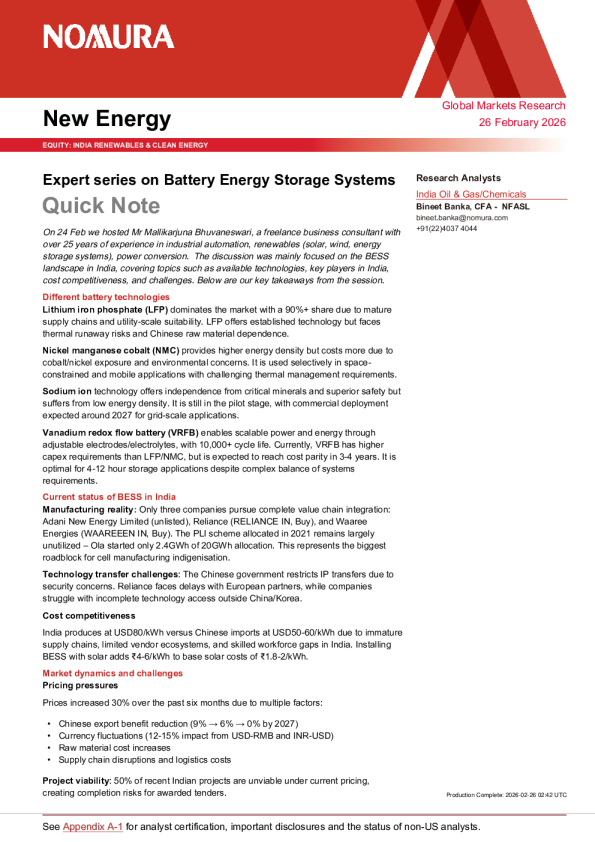
Global Markets Research26 February 2026 New Energy EQUITY: INDIA RENEWABLES & CLEAN ENERGY Expert series on Battery Energy Storage SystemsQuick Note Research Analysts India Oil & Gas/Chemicals Bineet Banka, CFA - NFASLbineet.banka@nomura.com+91(22)4037 4044 On 24 Feb we hosted Mr Mallikarjuna Bhuvaneswari, a freelance business consultant withover 25 years of experience in industrial automation, renewables (solar, wind, energystorage systems), power conversion. The discussion was mainly focused on the BESSlandscape in India, covering topics such as available technologies, key players in India, Different battery technologies Lithium iron phosphate (LFP)dominates the market with a 90%+ share due to maturesupply chains and utility-scale suitability. LFP offers established technology but faces Nickel manganese cobalt (NMC)provides higher energy density but costs more due tocobalt/nickel exposure and environmental concerns. It is used selectively in space- Sodium iontechnology offers independence from critical minerals and superior safety butsuffers from low energy density. It is still in the pilot stage, with commercial deployment Vanadium redox flow battery (VRFB)enables scalable power and energy throughadjustable electrodes/electrolytes, with 10,000+ cycle life. Currently, VRFB has highercapex requirements than LFP/NMC, but is expected to reach cost parity in 3-4 years. It is Current status of BESS in India Manufacturing reality:Only three companies pursue complete value chain integration:Adani New Energy Limited (unlisted), Reliance (RELIANCE IN, Buy), and WaareeEnergies (WAAREEEN IN, Buy). The PLI scheme allocated in 2021 remains largelyunutilized – Ola started only 2.4GWh of 20GWh allocation. This represents the biggest Technology transfer challenges: The Chinese government restricts IP transfers due tosecurity concerns. Reliance faces delays with European partners, while companies Cost competitiveness India produces at USD80/kWh versus Chinese imports at USD50-60/kWh due to immaturesupply chains, limited vendor ecosystems, and skilled workforce gaps in India. InstallingBESS with solar adds ₹4-6/kWh to base solar costs of ₹1.8-2/kWh. Market dynamics and challengesPricing pressures Prices increased 30% over the past six months due to multiple factors: Project viability: 50% of recent Indian projects are unviable under current pricing,creating completion risks for awarded tenders. Production Complete: 2026-02-26 02:42 UTC Technology and investment risks The sector requires substantial capex with rapidly evolving technologies. Companies facecalculated risks - some proceed with LFP while others await sodium ion as a potentialgame-changer. Even CATL (300750 CH, Buy), the largest LFP manufacturer, heavily Policy and regulatory environment Current support: In India, 20% mandatory localization requirement exists, with recentbudget benefits for battery manufacturing equipment and critical minerals. However, noALMM-type protection mechanism exists yet for BESS like for solar modules. Policy gaps: Unlike solar's aggressive promotion through schemes such as KUSUM andPM-KISAN, BESS lacks comprehensive policy support due to technology complexity, Recycling policy: Recycling policy is currently under development following recentindustry conferences. This is critical as EV batteries from 2019 approach end-of-life, Market opportunity and scale Massive potential: India targets 236-260GWh by 2032, requiring 40-50GWh in annualinstallations from 2026-30. This represents a INR5tn market across the entire value chain. Current gap: Despite 60GWh tenders awarded, only <1GWh is operational, with 5GWhunder construction. The government plans require 50GWh by 2027-28, representing 10x Long-term vision: 1,047+ GWh storage needed by 2047, positioning India as one of theworld's largest markets. Future competitiveness and outlookExport potential With full integration by major players, India could become competitive for exports toUS/Europe, leveraging integration expertise and quality standards comparable to those in Technology evolution Near-term (2026-2028): LFP dominance continues, with gradual domestic capacitybuilding Medium-term (2029-2030): Hydrogen begins replacing BESS for large-scale, long-duration applications Long-term: Sodium ion commercialization and hydrogen scaling for industrial applications International Comparison Unlike India, markets such as Australia and Europe have higher electricity prices, makingBESS naturally economical. Their markets are privately driven rather than government- Overall summary The energy storage sector represents a transformational opportunity for India, requiringcoordinated efforts across policy, technology, and industrial development to capture the Appendix A-1 This report has been produced by Nomura Financial Advisory and Securities (India) Private Limited (NFASL), India.SeeDisclaimersfor Nomura Group entity details. Analyst Certification I, Bineet B