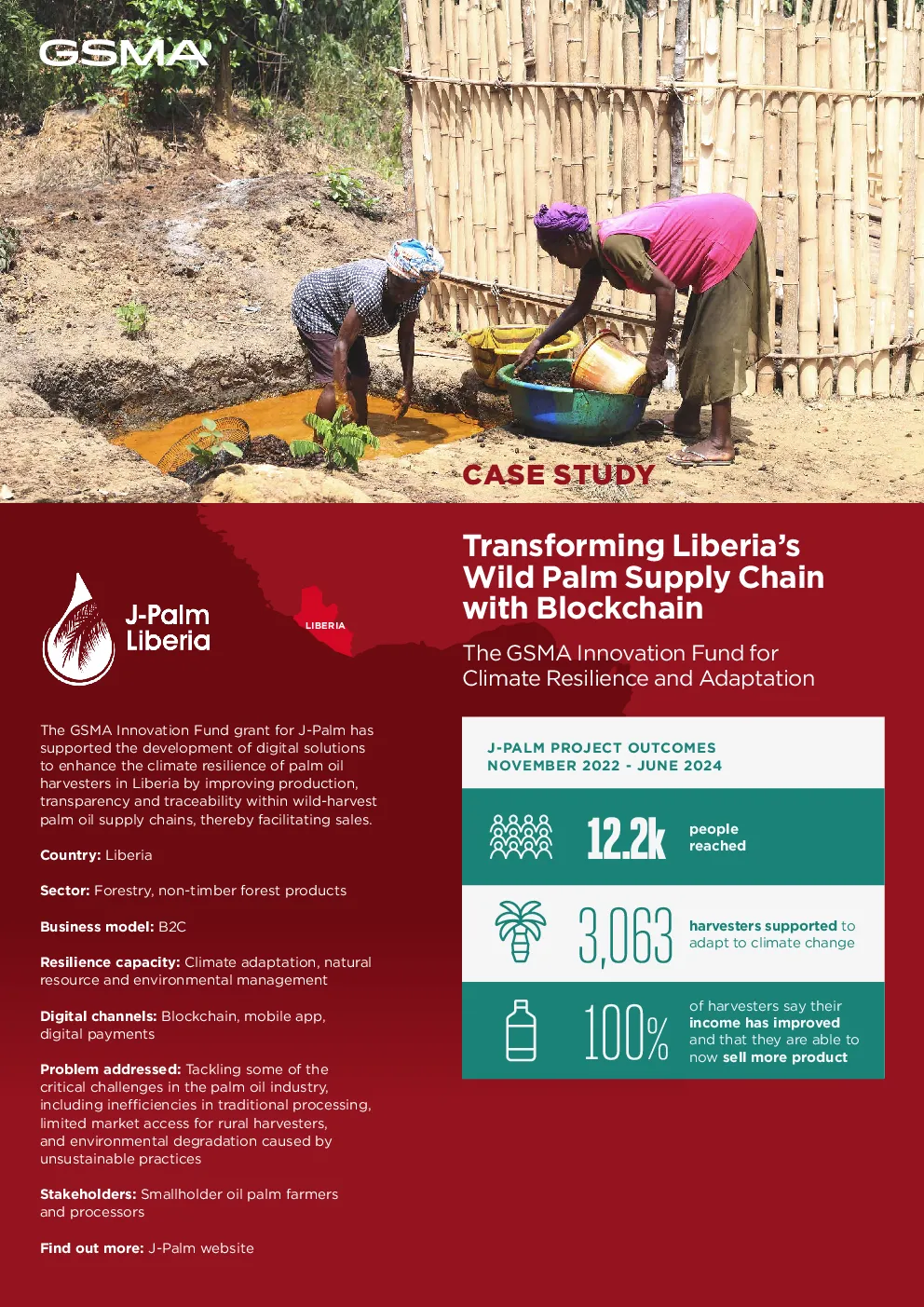
The GSMA Innovation Fund forClimate Resilience and Adaptation The GSMA Innovation Fund grant for J-Palm hassupported the development of digital solutionsto enhance the climate resilience of palm oilharvesters in Liberia by improving production,transparency and traceability within wild-harvestpalm oil supply chains, thereby facilitating sales. J-PALM PROJECT OUTCOMESNOVEMBER 2022 - JUNE 2024 12.2k Country:Liberia Sector:Forestry, non-timber forest products 3,063 harvesters supportedtoadapt to climate change Business model:B2C Resilience capacity:Climate adaptation, naturalresource and environmental management 100%of harvesters say theirincome has improvedand that they are able tonowsell more product Digital channels:Blockchain, mobile app,digital payments Problem addressed:Tackling some of thecritical challenges in the palm oil industry,including inefficiencies in traditional processing,limited market access for rural harvesters,and environmental degradation caused byunsustainable practices Stakeholders:Smallholder oil palm farmersand processors Find out more:J-Palm website About J-Palm J-Palm is a startup based in Liberia that is dedicated totransforming the palm oil industry through sustainablepractices and innovation. J-Palm has introduced minimills to replace manual palm oil extraction, assistingsmallholder farmers and harvesters in Liberia tobecome more efficient by enabling them to producemore oil and reduce processing time and water use. J-Palm also purchases palm kernels from farmers, whichwould otherwise be discarded, to create palm kernel oiland natural beauty products under their ‘Kernel Fresh’brand. The company is committed to environmentalsustainability by producing clean energy from palmkernel shells to reduce deforestation. Through its no-waste manufacturing process, J-Palm Liberia fosterseconomic growth, improves livelihoods and promotesenvironmental stewardship across Liberia. About the GSMA InnovationFund project Introduction J-Palm is one of the start-ups supported by theGSMA Innovation Fund for Climate Resilienceand Adaptation, which was launched in 2022.This initiative is funded by the UK Foreign,Commonwealth & Development Office (FCDO),the Swedish International DevelopmentCooperation Agency (Sida) and is supported bythe GSMA and its members. In most of West Africa,including Liberia, palmoil is indigenous tothe region and growsnaturally in the forestwithout anyone havingto plant palm trees…Unfortunately, almost allthe farmers who make what is arguably the most It allows palm trees to grow naturally, reducingthe need for chemical fertilisers and pesticides,and supports traditional livelihoods, empoweringsmallholder farmers by providing a decentralised,community-based income source without theenvironmental costs of intensive cultivation. Impact of climate change onharvesters in Liberia The project spanned 18 months from November2022 to April 2024. With the support of the GSMAInnovation Fund, J-Palm successfully deployedmini mills, enabling smallholder farmers to improvetheir agricultural practices, better adapt to climatechange, and stabilise or increase their income.Additionally, J-Palm developed and launched atraceability app that has enhanced supply chaintransparency and laid a solid foundation for thecompany’s long-term commercial sustainability. organic palm oil in the world, continue to live inpoverty because they don’t have access to the rightprocessing tools to efficiently produce palm oil. Climate change causes unpredictable weatherpatterns in Liberia, including rising temperatures,erratic rainfall and increased frequency of extremeweather events such as floods and droughts.These changes significantly impact palm oilproduction and disrupt traditional farmingpractices, particularly for smallholder farmersand wild harvesters. Wild harvesters, who rely on gathering palm fruitsfrom forests for their livelihoods, face increasingchallenges as climate change disrupts fruitingcycles and reduces yields. These challenges areespecially concerning given agriculture’s criticalrole in Liberia’s economy, employing over 60% ofthe workforce.3 Mahmud Johnson, Founder, J-Palm Liberia’s palm oil industry consists of traditionalwild harvesters, smallholder farmers, medium-sizedgrowers and large concessionaires. Both wild palmharvesting and cultivated palm farming are integralto Liberia’s economy. The palm farming industry inLiberia has seen significant growth in recent years,primarily driven by large-scale plantations runby multinational corporations. These plantationshave adopted formal cultivation practices whichhave boosted palm oil production. By 2021,approximately 21.2% of farming households wereengaged in palm oil production, employing over220,000 individuals in the sector.1 In 2022, Liberiaexported $90.8 million worth of palm oil.2 In response, the Liberian government, withsupport from international organisations, hasdeveloped policies and initiatives to promotecli