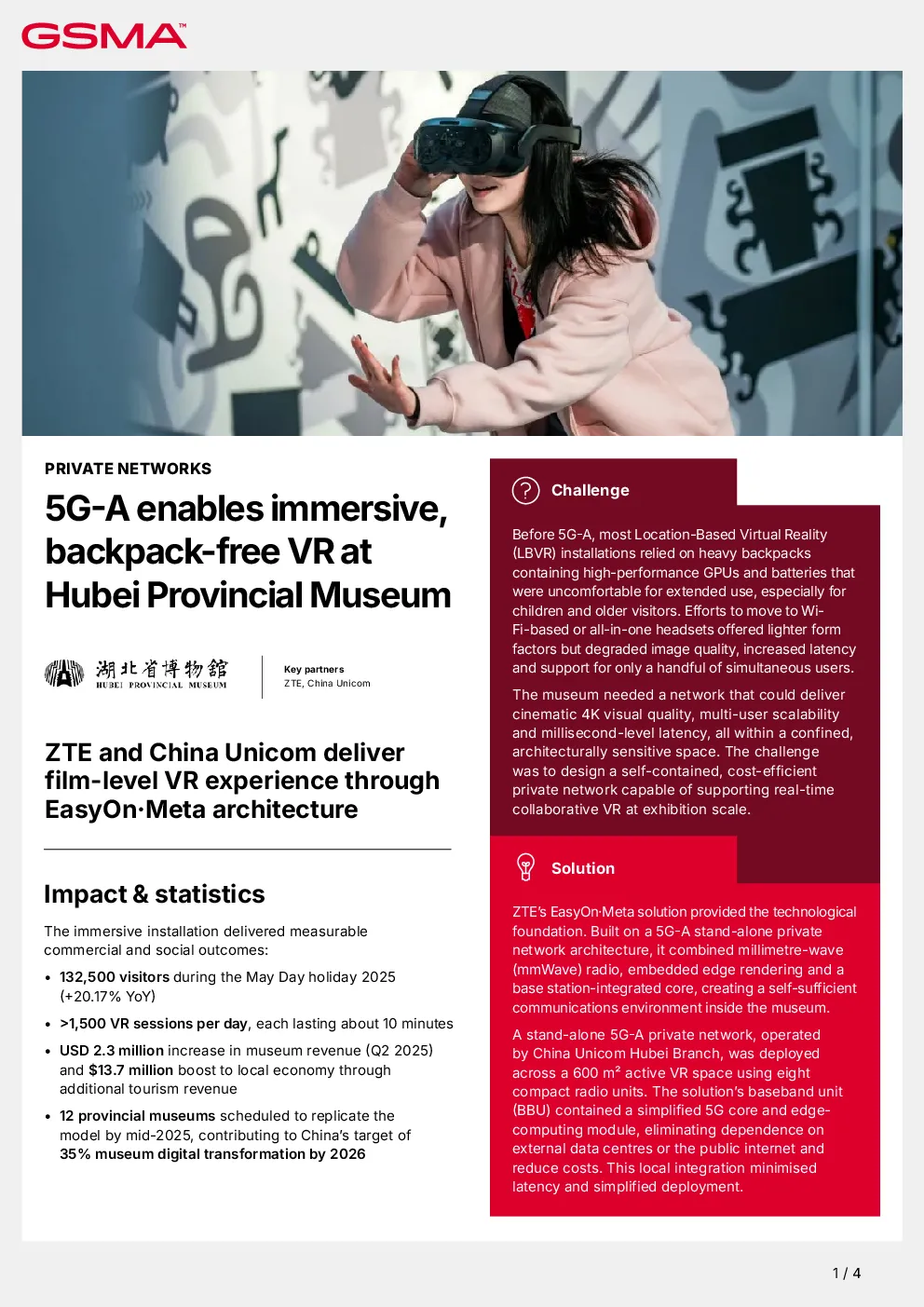
PRIVATE NETWORKS Challenge 5G-A enables immersive,backpack-free VR atHubei Provincial Museum Before 5G-A, most Location-Based Virtual Reality(LBVR) installations relied on heavy backpackscontaining high-performance GPUs and batteries thatwere uncomfortable for extended use, especially forchildren and older visitors. Efforts to move to Wi-Fi-based or all-in-one headsets offered lighter formfactors but degraded image quality, increased latencyand support for only a handful of simultaneous users. Key partnersZTE, China Unicom The museum needed a network that could delivercinematic 4K visual quality, multi-user scalabilityand millisecond-level latency, all within a confined,architecturally sensitive space. The challengewas to design a self-contained, cost-efficientprivate network capable of supporting real-timecollaborative VR at exhibition scale. ZTE and China Unicom deliverfilm-level VR experience throughEasyOn·Meta architecture Solution Impact & statistics ZTE’s EasyOn·Meta solution provided the technologicalfoundation. Built on a 5G-A stand-alone privatenetwork architecture, it combined millimetre-wave(mmWave) radio, embedded edge rendering and abase station-integrated core, creating a self-sufficientcommunications environment inside the museum. The immersive installation delivered measurablecommercial and social outcomes: •132,500 visitorsduring the May Day holiday 2025(+20.17% YoY) •>1,500 VR sessions per day, each lasting about 10 minutes•USD 2.3 millionincrease in museum revenue (Q2 2025)and$13.7 millionboost to local economy throughadditional tourism revenue•12 provincial museumsscheduled to replicate themodel by mid-2025, contributing to China’s target of35% museum digital transformation by 2026 A stand-alone 5G-A private network, operatedby China Unicom Hubei Branch, was deployedacross a 600 m² active VR space using eightcompact radio units. The solution’s baseband unit(BBU) contained a simplified 5G core and edge-computing module, eliminating dependence onexternal data centres or the public internet andreduce costs. This local integration minimisedlatency and simplified deployment. Source: ZTE The cultural tourism industry has faced mounting pressure to remainrelevant in the digital era. While more than 5,000 museums worldwidehave digitised most of their collections, more than 70% of this contentis not interactive. Visitors spend less than a third of the time at digitalexhibits compared to traditional ones on average, limiting bothengagement and revenue potential. In China, this “digital survival crisis” prompted theHubei Provincial Museum to seek an immersive,interactive solution that could attract newdemographics while respecting the constraintsof public heritage institutions. In partnership withZTE,China Unicom Hubei Branchand2:10 AMCultural Communication, the museum launchedTraversing the Bronze Age, the world’s first film-level 5G-Advanced (5G-A) digital cultural relicslocation-based virtual reality (LBVR) experience. This private network model ensures that all data,including 3D artefact scans and visitor interactionmetrics, remains within the museum, addressingconcerns over intellectual property protectionand cultural data sovereignty. The success ofTraversing the Bronze Age has made the 5G-ALBVR architecture a reference design for futureimmersive cultural projects across China. Visitors wear lightweight VR headsets connectedby a short USB-C cable to a palm-sized mmWaveCPE (customer premises equipment) worn on thearm or in a pocket. This provides backpack-freemobility while maintaining 4K@90 fps ultra-highdefinition rendering. The EasyOn·Meta platformdynamically allocates rendering workloadsbetween terminals and XR servers throughintelligent time slot scheduling and joint beammanagement, sustaining consistent frame rateseven with more than 100 concurrent users. This isn’t a gimmick. It’s agenuine transformation ofuser experience that setsa new standard for howinstitutions engage withdigital audiences. The collaboration extended beyond technology.China Unicom provided spectrum resources andoperational support while ZTE delivered the 5G-Ahardware, software and network integration and2:10 AM Cultural Communication designed thecinematic VR content. Together, they achievedfilm-level realism in a multi-user environmentwhere visitors could freely explore a reconstructedBronze Age world, interact with artefacts andexperience history as an unfolding narrative. Chen MingDirector of Cultural Experience Innovation, ZTE ARCHITECTURE AT A GLANCE ZTE EasyOn·Meta 5G-A LBVR —Terminal-edge collaborationfor real-time rendering and interaction control—Intelligent joint beamforming andtime slot schedulingfor mobilityoptimisation—4K@90 fpsUHD streaming withmillisecond-level latency—Support for 100+ concurrent userswithin >600 m² active VR area—Portable mmWave CPE + USB-Ctethered headsetenablingbackpack-free operation —Private 5G-A stand-alone networkoperated by China Unicom HubeiBranch (Ser