大北极地区的光伏发电和能源安全
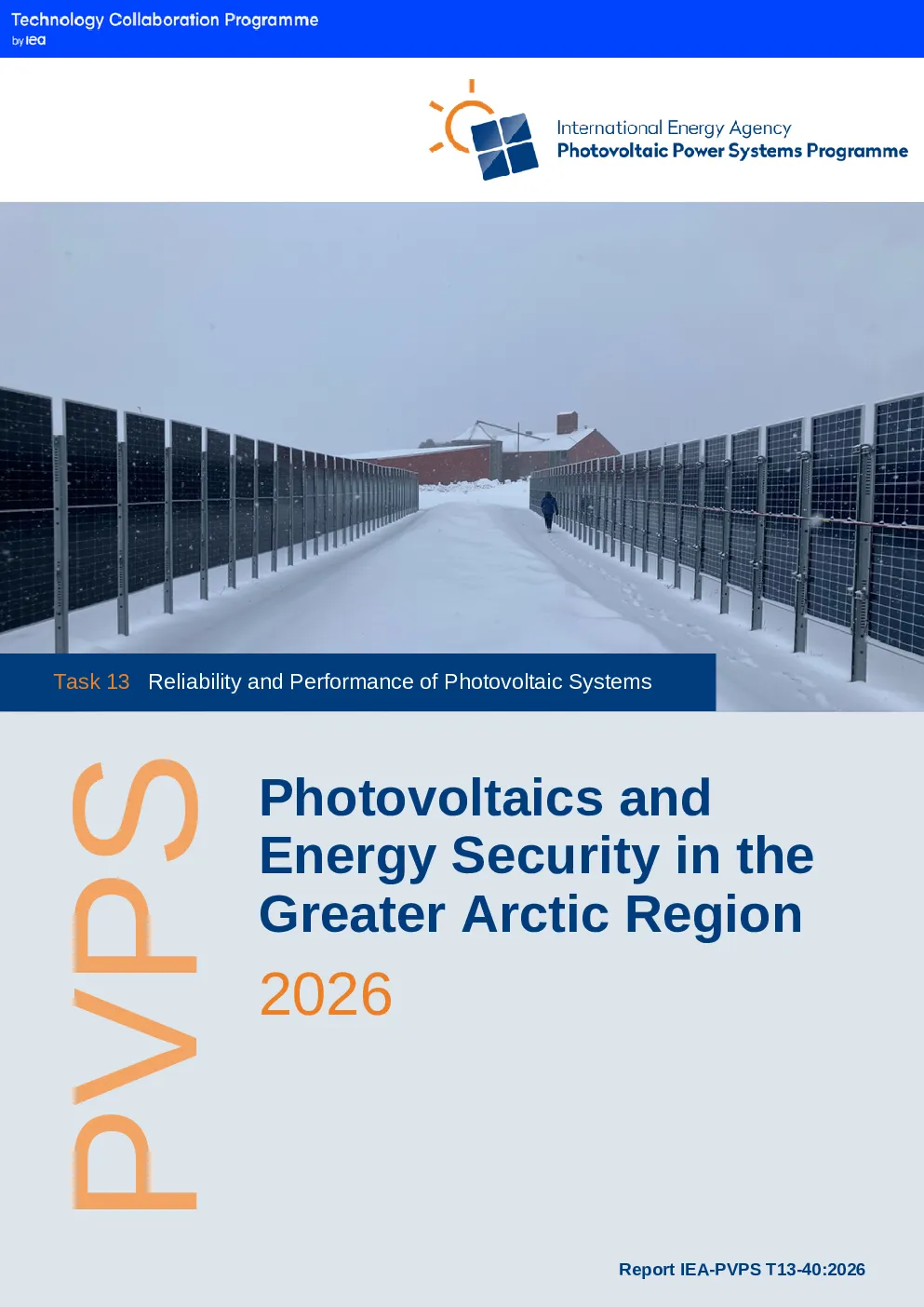
Photovoltaics andEnergy Security in the 2026 What is IEA PVPS TCP? The International Energy Agency (IEA), founded in 1974, is an autonomous body within the framework of the Organization for EconomicCooperation and Development (OECD). The Technology Collaboration Programme (TCP) was created with a belief that the future of ener- The IEA Photovoltaic Power Systems Programme (IEA PVPS) is one of the TCP’s within the IEA and was established in 1993. The missionof the programme is to “enhance the international collaborative efforts which facilitate the role of photovoltaic solar energy as a cornerstonein the transition to sustainable energy systems.” In order to achieve this, the Programme’s participants have undertaken a variety of joint The 28 IEA PVPS participating countries are Australia, Austria, Belgium, Canada, China, Denmark, Finland, France, Germany, India, Israel,Italy, Japan, Korea, Lithuania, Malaysia, Morocco, the Netherlands, Norway, Portugal, South Africa, Spain, Sweden, Switzerland, Thailand,Türkiye, the United Kingdom and the United States of America. The European Commission, Solar Power Europe and the Solar Energy Visit us at:www.iea-pvps.org What is IEA PVPS Task 13? Within the framework of IEA PVPS, Task 13 aims to provide support to market actors working to improve the operation, the reliability and thequality of PV components and systems. Operational data from PV systems in different climate zones compiled within the project will help The general setting of Task 13 provides a common platform to summarize and report on technical aspects affecting the quality,performance,reliability and lifetime of PV systems in a wide variety of environments and applications. By working together acrossnational boundaries, wecan all take advantage of research and experience from each member country and combine and integrate this knowledge into valuable Task 13 has so far managed to create the right framework for the calculations of various parameters that can give an indication of the qualityof PV components and systems. The framework is now there and can be used by the industry who has expressed appreciation towards the The IEA PVPS countries participating in Task 13 are Australia, Austria, Belgium, Canada, Chile, China, Denmark, Finland, France, Germany,Israel, Italy, Japan, the Netherlands, Norway, Spain, Sweden, Switzerland, Thailand, and the United States of America,and the Solar Energy DISCLAIMER The IEA PVPS TCP is organised under the auspices of the International Energy Agency (IEA) but is functionally and legally autonomous. Views, findings andpublications of the IEA PVPS TCP do not necessarily represent the views or policies of the IEA Secretariat or its individual member countries. COPYRIGHT STATEMENT This content may be freely used, copied and redistributed, provided appropriate credit is given (please refer to the ‘Suggested Citation’). The exception is that SUGGESTED CITATION Stein,J.S.,Whitney, E.(2026).Maugeri,G.,Stein, J.S.,Jahn, U.(Eds.),Photovoltaics and Energy Security in the Greater Arctic Region(Report No. T13-40:2026). IEA PVPS Task 13.https://iea-pvps.org/key-topics/t13-security-greater-arctic-region-2026/DOI:10.69766/JXHM9635 COVER PICTURE 100 kWvertical bifacial PV pilot plant near Luleå, Sweden constructed by the Sunna Group. Photovoltaics and Energy Security IEA PVPSTask 13 Report IEA-PVPS T13-40:2026February2026 ISBN:978-1-7642902-9-6DOI:10.69766/JXHM9635 Main Author(s) Joshua S. Stein,Sandia National Laboratories,USAErin Whitney,University of Alaska Fairbanks, USAErin Tonita, University of Ottawa, CanadaAlexander Granlund, RISE Research Institutes of Sweden, SwedenMattias Lindh, RISE Research Institute of Sweden, SwedenAndré Augusto, Sustainable Energy Research Centre, Dalarna University, SwedenMari Ogaard, Institute for Energy Technology, NorwayAdam R. Jensen, Technical University of Denmark, DenmarkSilvia Ma Lu, Mälardalen University, SwedenChristopher Pike, University of Alaska Fairbanks, USA Sami Jouttijärvi, University of Turku, FinlandMichelle Wilber, University of Alaska Fairbanks, USA Acknowledgements........................................................................................6List of Abbreviations.......................................................................................7Executive Summary........................................................................................8Introduction............................................................................................12Unique Environmental Characteristics of the Arctic: Irradiance,Temperature, and Snow.........................................................................142.1Irradiance.......................................................................................142.2Ambient Temperature....................................................................162.3Snow and Albedo Effects...............................................................18Data Ch