克里米亚危机中的欧洲旅游业
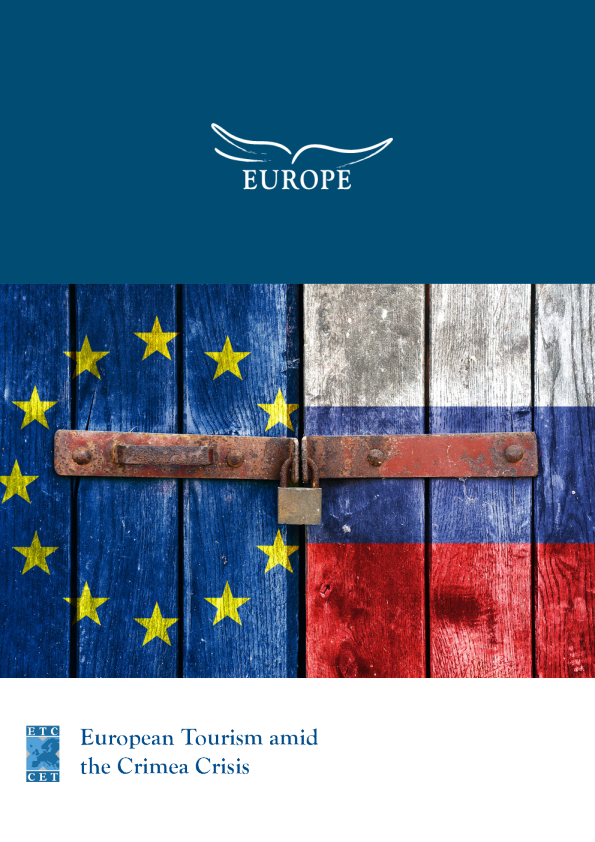
European Tourismamid the Crimea Crisis A report produced by the European Travel Commissionand Tourism Economics (an Oxford Economics Company) Copyright © 2014 European Travel Commission European Tourism amid the Crimea Crisis All rights reserved. The contents of this report may be quoted, provided the source iscited accurately and clearly. Distribution or reproduction in full is permitted forpersonal or internal use only. While we encourage distribution via publicly accessible The designations employed and the presentation of material in this publication donot imply the expression of any opinions whatsoever on the part of the Executive Data sources: This report includes data from the TourMIS database /www.tourmis.info, STR Global, IATA, and UNWTO. Economic analyses and forecasts are provided by Tourism Economics and Published and printed by the European Travel Commission Rue du Marché aux Herbes, 61, 1000 Brussels, BelgiumWebsite:www.etc-corporate.org Email:info@visiteurope.comISBN No: 978-92-990067-4-0This report was compiled and edited by:Tourism Economics (an Oxford Economics Company) Cover: EU and Russian flag on the background of old locked doors©Borislav Bajkic FOREWORD In recent years, Russia has become the third largest source market forEurope. European destinations received nearly 32 million arrivals fromRussia in 2013, with forecasts pointing towards a 3.6% growth for 2014. While the European tourism sector is not a direct target of internationalsanctions introduced in response to the crisis, it does suffer indirectly.Theweakening Rouble,partly a by-product of deteriorating traderelationships, has progressively reduced outbound travel from Russia. National Tourism Organisations can play a crucial role in containing thenegative impact of this crisis by addressing the information needs of With this report, the European Travel Commission wishes to providetimely information to its members and support in co-ordinating actions ETC Executive Unit THE CRIMEA CRISIS IS AN INTERNATIONALCRISISOVER THE CONTROL OF THECRIMEANPENINSULAPRINCIPALLY European Tourism amid the Crimea Crisis EXECUTIVE SUMMARY Over the past decade,Russia has become a key contributor to tourism growth inEurope. In2013, European destinations received nearly 32 million arrivals fromRussia, becoming Europe’s 3rdlargestmarket(6% of Europe and 4% of ETC destinations'total inbound travel). Russia is alsoEurope’s3rdfastest growing market(+13%in 2013). Over thepast decade, Russian outbound travel to Europe has grown by an averageof 11% per year, a pace faster than the market average (9%). As a result, Europe has The underlying fundamentals for outbound travel from Russia remain strong,although deteriorated economic conditions and uncertainty-partly a by-product ofthe conflict over Crimea–will necessarily affect travel from this market. Accordingtothe IMF,geopolitical tensions are slowing the economy,which is alreadyweakened by structural bottlenecks. RussianGDP is expected to grow by only 0.2% Travel demand from Russia dropped as the year progressed.After a good start inQ1, travel from Russia fell during Q2 by an estimated 6%. Air bookings point to arecoveryof demand in Q3,although values remain below 2013 level.Q3performance shall be interpreted as the effect of longer travel lead times for mainholidays rather than as an early sign of recovery.If no changes occur,Russian A fall inleisure spending is also expected.Inflationary pressure isexpected toerodeincomes and spending power even further. This mayimpact modestly on travel, butwillcertainlyaffectleisure spendingand choice of destinations.Overnights have For better or for worse,the crisis will be felt most by destinations with a strongpresence of Russian travellers in their guest mix.Finland,Lithuania, Switzerland andCzechRepublicare threatened by this yearnegative performance of the market. Atthe other end of the spectrum,Cyprus,Turkey-who adopted a neutral position in The crisis will hit mostin 2015.For next year, inbound travel from Russia to Europeis expected atsome 10% lower than what it would have been,had the crisis notoccurred. Some faster growth can be expected for 2016, under the assumption that THE FUNDAMENTALS OF RUSSIAN OUTBOUND TRAVEL GROWTH In the early 1990s, the end of the Cold War (1991) and the collapse of the Soviet Union released a huge pent-updemand for travel to Western countries. After the initial euphoria, the impact of the transition from a planned to a The modernisation of the Russian economy led to a dramatic reform of the tourism industry and market. A moreopen economy and surging oil prices have contributed to improving the economic wellbeing of Russia middle-classsince the 2000s. Real GDP per capita rose from 7,700 USD in 1995 to 18,400 USD in 2014, and is projected to reach The market-oriented development of the Russian tourism sector has stimulated outbound travel from the country,thanks to the expanded activity of fo