负责任的人工智能AIForAll
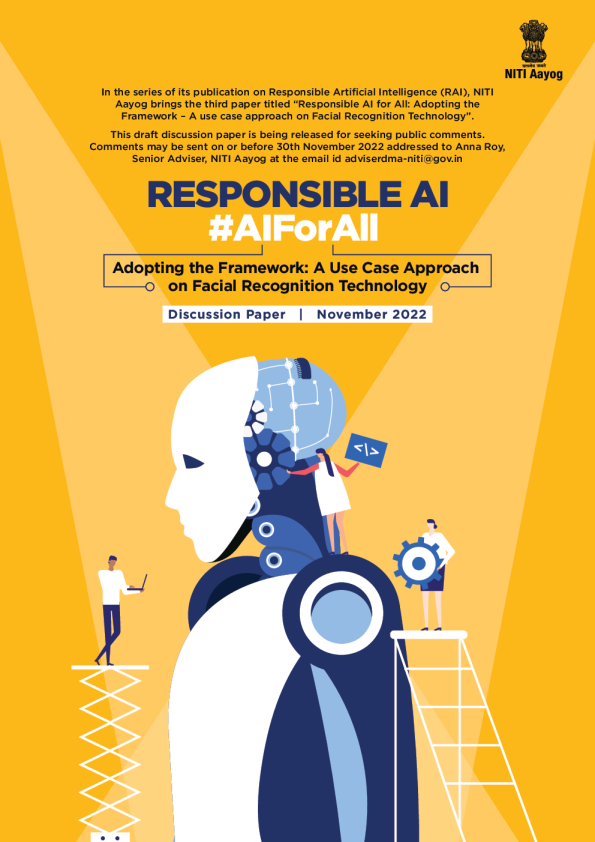
This draft discussion paper is being released for seeking public comments.Comments may be sent on or before 30th November 2022 addressed to Anna Roy,Senior Adviser, NITI Aayog at the email id adviserdma-niti@gov.in RESPONSIBLE AI#AIForAll Adopting the Framework: A Use Case Approachon Facial Recognition Technology Discussion Paper|November 2022 RESPONSIBLE AI#AIFORALL Adopting the Framework:A Use Case Approach onFacial Recognition Technology DISCUSSION PAPER November 2022 ACKNOWLEDGEMENTS We are pleased to have collaborated with Vidhi Centre for Legal Policy astheKnowledge Partner in developing the document where the principlesand mechanisms of Responsible AI from the previous publications have beentested out in the first use-case concerning Facial Recognition Technology. Thevaluable contributions of Mr. Ameen Jauhar, Ms. Jai Vipra, Mr. Dhruv Somayajulaand Ms. Trishee Goyal from the Vidhi Centre of Legal Policy are acknowledged. In writing this report, Responsible AI for All: Adopting the Framework – Ause case approach on Facial Recognition Technology, Saurabh Thukral andRishabh Bezbaruah from NITI Aayog has made valuable contributions. We are also grateful for the support and contributions of several expertsfrom India and globally including Dr. Anand S. Rao from PwC and Mr. RohitSatish from ArtPark. Valuable inputs were also provided by various Ministries/Departments of the Government of India and regulatory Institutions, namely,the Ministry of Civil Aviation, the Ministry of Home Affairs, the Ministry ofElectronics & Information Technology, the Department of Science & Technology,the Office of the Principal Scientific Adviser to the Government of India, andthe Unique Identification Authority of India. Anna RoySenior AdviserNITI Aayog Discussion Paper: Responsible AI for All|iiiAdopting the Framework: A Use Case Approachon Facial Recognition Technology LIST OFABBREVIATIONS Discussion Paper: Responsible AI for All|vAdopting the Framework: A Use Case Approachon Facial Recognition Technology vi|Discussion Paper: Responsible AI for AllAdopting the Framework: A Use Case Approachon Facial Recognition Technology CONTENTS AcknowledgementsiiiList of Abbreviationsv Summary PART I7 II.FRT as a concept9 A.How does FRT operate?9B.Rise in use of FRT11C.Categorising the applications of FRT121.Non-security uses of FRT132.Security related uses of FRT13 III.Examples of FRT use in India and globally16 A.FRT systems launched in India16B.FRT applications deployed in foreign jurisdictions17 IV.Risks of FRT A.Design-based risks of FRT systems18B.Rights-based challenges to use of FRT systems20 V.Regulatory aspects of FRT23 1.European Union2.United Kingdom3.United States 232424 Discussion Paper: Responsible AI for All|viiAdopting the Framework: A Use Case Approachon Facial Recognition Technology 4.Australia245.Canada24 PART II25 A.The Digi Yatra programme28B.Potential benefits291.Lower congestion at airports302.Seamless, paperless and contactless passenger experience303.Lower operational costs and enhanced civil aviationcapabilities30C.Legal aspects of Digi Yatra31D.RAI principles and Digi Yatra: Evaluation and Recommendations 34E.Actionable recommendations to ensure responsible use of FRT infuture applications40 ANNEXURES49 1.Inaccuracy due to technical factors572.Inaccuracy due to bias or underrepresentation583.Inaccuracy due to lack of training of human agents594.Inaccuracy due to deliberate tweaks in images605.Security risks due to data breaches and unauthorised access616.Accountability, legal liability and grievance redressal617.Opaque nature of FRT systems62 ANNEX 4-RIGHTS-BASED RISKS64 1.Puttaswamy on privacy and informational autonomy642.Issues of informational autonomy643.Threat to non-participants in deployment of FRT systems:654.Legal thresholds applicable to FRT systems665.Anonymity as a facet of privacy66 ANNEX 5-CROSS JURISDICTIONAL REGULATORY COMPARISION69 viii|Discussion Paper: Responsible AI for AllAdopting the Framework: A Use Case Approachon Facial Recognition Technology EXECUTIVESUMMARY In 2018, NITI Aayog released the National Strategy on Artificial Intelligence(NSAI), that inter alia highlighted the roadmap to adopt AI in five public sectorsin a manner that is safe and dispenses benefits to all citizens. The strategydocument coined the “AI for All” mantra, to be the governing benchmarkfor future AI design, development, and deployment in India. A part of thisstrategy was to ensure the safe and responsible use of AI. As a follow-up to NSAI, stakeholder consultations were initiated in collaborationwith the World Economic Forums in 2019 on the proposed approach forresponsible use of emerging technologies. This culminated in 2021, with therelease of a two-part approach paper, identifying principles for responsibledesign, development, and deployment of artificial intelligence (AI) in India,and setting out enforcement mechanisms for the operationalisation of theseprinciples(RA